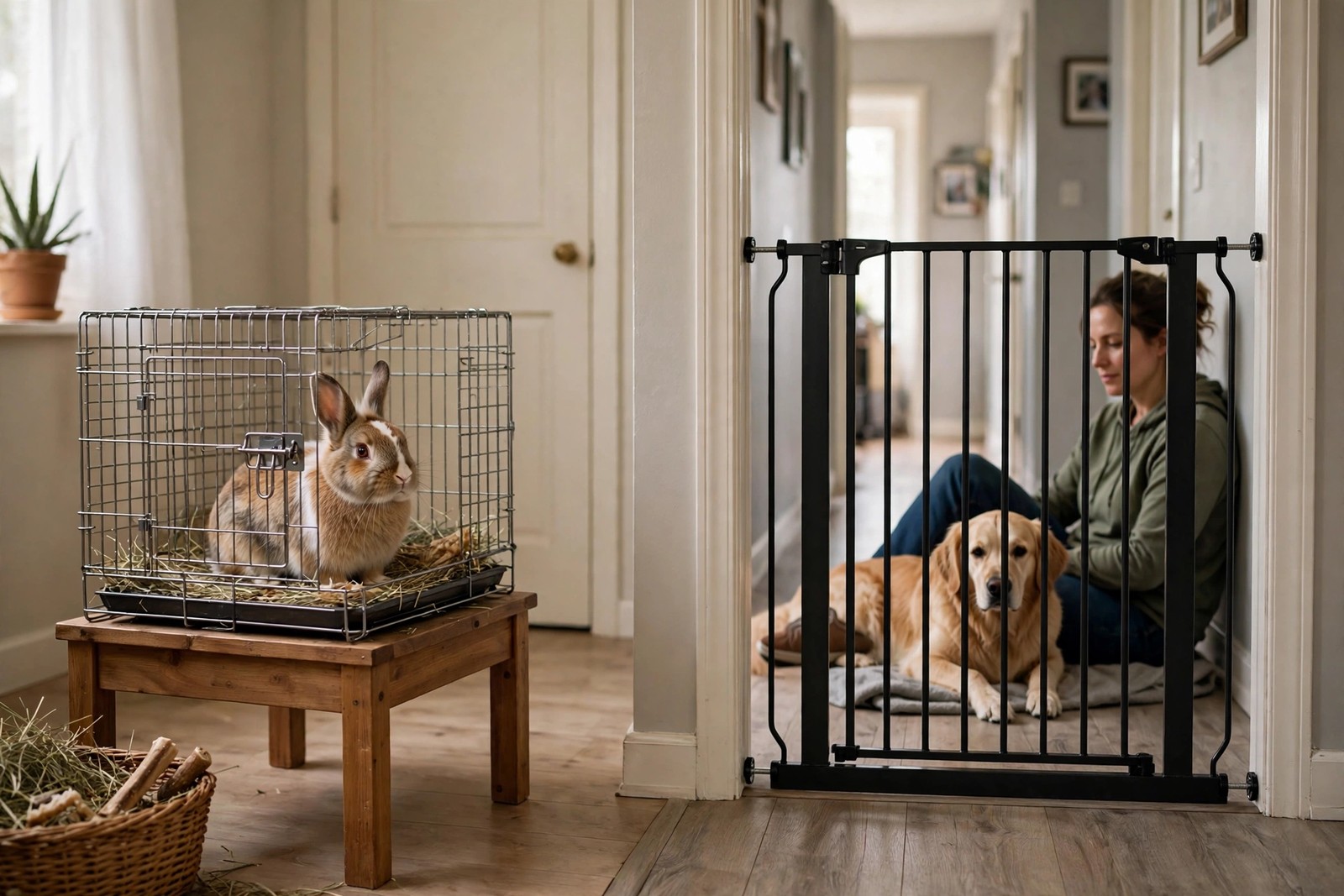
This is a safety system, not a training request. Even a friendly, well-behaved dog can injure a rabbit, guinea pig, hamster, or rat without meaning to: a paw through the bars, a cage rocked off its stand during excited scrabbling, or one sudden lunge when a small animal darts. Prey drive can also switch on in a dog who has ignored the cage for months, triggered by a squeak or a sudden movement. So the rule structure is simple: physical barriers carry the safety, training makes daily life calmer, and the two are never swapped.
Barrier One: A Door or Gate the Dog Cannot Cross
The arrangement that does the most work is a closed door between the dog and the small pets' room, used every time, not only when you leave the house. If the pets live in a shared room, use a sturdy, fixed pet gate the dog cannot push through, climb, or jump, and check the height honestly against your own dog's athleticism — many dogs clear a standard gate easily when motivated. Every household member, including children and visitors, needs the same rule: the barrier is closed again immediately after passing through, every single time. Most real incidents happen during the thirty seconds a door stood open, not during planned interactions.
Barrier Two: A Cage That Is Secure and Out of Reach
Place the cage on a solid, stable stand or table, never on the floor where a dog can circle it, paw at it, and loom over the animals inside. The cage itself should have a latched door a pawing dog cannot spring open — add a simple clip if the standard catch is flimsy — bars spaced so a dog's tooth or claw cannot reach through in a harmful way, and enough weight or fixing that it cannot be dragged or tipped. Give the small pets a hide inside the cage positioned away from the bars, so they can retreat fully out of sight when the dog is in the home; prey animals who cannot hide live in constant low-level stress even if nothing ever touches the cage.
Never leave the dog alone in the room with the cages, full stop. Not while you shower, not while the dog is asleep, not because it has been fine so far. Supervision means you are present and attentive; a dog in the room while you are absorbed elsewhere is an unsupervised dog.
Train Calm Disengagement, Away From the Cages First
Training reduces the dog's fixation so the barriers are not tested daily. Build a reliable leave-it indoors using ordinary objects first: cover a treat with your hand, reward the dog the moment they back off and look at you, and progress until the cue works with dropped food and exciting toys. Practise look-away games at a distance from the pets' door where the dog can still think — reward glances toward the door followed by turning back to you. Play these sessions after exercise, when the dog is settled rather than wired, keep them short, and end behind the barrier again. If the dog fixates, whines, scratches at the door, or cannot take treats near it, increase distance and contact a qualified trainer; a dog in that state is practising arousal you will later have to undo.
Protect the Small Pets' Nerves, Too
Watch the caged animals for the quieter cost of a dog in the house: hiding far more than usual, freezing at sounds, stamping, or eating less. If those signs persist, move the cage to a room the dog never enters at all. Handling sessions and floor time for the small pets should happen with the dog shut safely in another part of the house, and the pets returned to their cage and the barrier closed before the dog is released again.
Barriers only work when the whole household treats them as automatic, and KinsLe Care Teams helps by turning the door, gate, and latch checks into assigned duties that each person marks complete with a timestamp rather than leaving safety to habit.