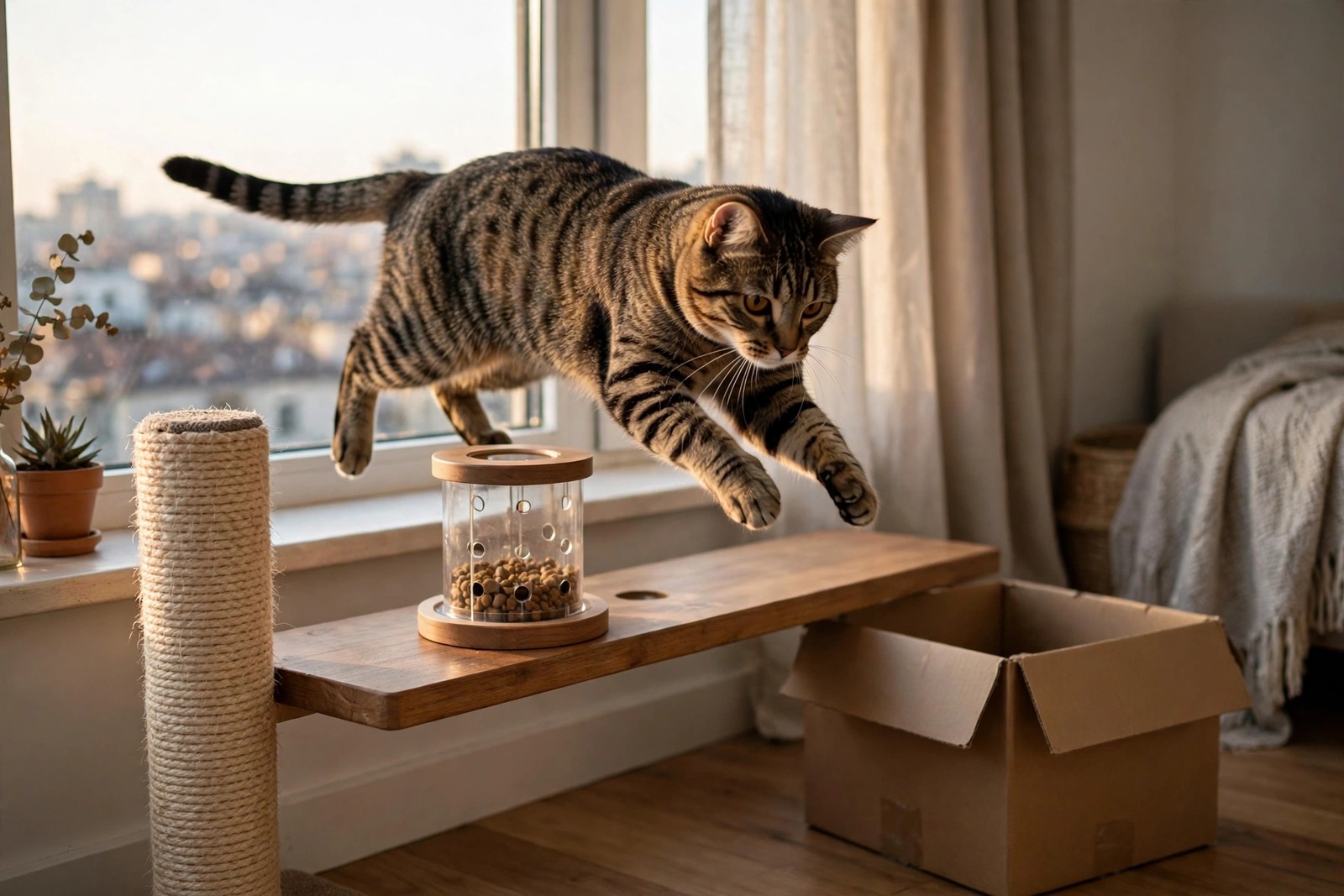
An indoor cat alone for eight hours does not need constant stimulation — cats naturally sleep through much of the day — but she does need her waking hours to contain the things an outdoor life would have provided: hunting, climbing, scratching, watching, and variety. Boredom in indoor cats shows up as 3 a.m. racing, ankle ambushes when you get home, over-grooming, or weight gain, and all of them respond better to a structured day than to a bigger pile of toys.
The Pre-Work Play Session
The most important entertainment happens while you are still home. Spend ten to fifteen minutes with a wand toy before you leave, moving it like prey — away from your cat, freezing, darting under furniture — and let her stalk, chase, and finally catch it several times. End the session by feeding breakfast straight afterwards, ideally in a puzzle feeder or muffin tin with kibble tucked under scrunched paper balls. Hunt, catch, eat, groom, sleep is the sequence a cat's body expects, and honouring it in the morning buys you a cat who naps through the first half of your workday instead of yowling at the door.
Set the Stage Before You Walk Out
Leave out two or three solo toys and rotate them every few days from a small stored collection — a toy that disappears for a week comes back interesting, while ten toys left out permanently become wallpaper. Good solo options need no supervision: crinkle balls, cardboard boxes and paper bags with handles removed, a sturdy scratching post, and a treat ball loaded with part of the day's food allowance. Place a perch or cleared shelf at a window overlooking birds, a garden, or a street; visual hunting through glass occupies many cats for long, contented stretches. Leave a radio or a cat video playing quietly if your cat has shown interest in screens, and always leave fresh water away from the food bowl, as many cats drink more from a separate spot.
The Afternoon Slump and the Second Wind
Most cats wake again in the late afternoon, which is when a second, smaller puzzle pays off: a lick mat with a smear of wet food, a kibble trail hidden in three or four known spots, or a timed feeder that drops a small portion mid-afternoon can bridge the gap until you return. Repeat a shorter play session when you get home, before your own dinner, so evening energy is spent with you rather than at midnight. If your cat is a kitten under six months, an elderly cat on medication, or a cat who has never been left for a full day, build up absence gradually and arrange a midday drop-in for the first weeks — young cats in particular can become destructive or anxious alone for very long stretches, and for some high-energy cats a second compatible cat is the honest long-term answer, introduced slowly and on its own terms.
Safety Checks for an Unsupervised Cat
Entertainment left behind must be safe without you: retire feather wands and anything on string or elastic to a cupboard — swallowed string is a surgical emergency — and check toys weekly for loose eyes, bells, and cracked plastic. Keep washing-machine and tumble-dryer doors closed, toilet lids down for kittens, and cleaning chemicals and houseplants known to be unsafe for cats out of reach. If a neighbour, friend, or professional sitter covers the midday visit, they need the feeding amounts, the puzzle routine, your vet's number, and any medication timing in writing rather than by memory, and KinsLe's Care Pass is built for exactly that handoff, giving a sitter time-boxed access to your cat's care details through a temporary link, with no account needed and nothing shared beyond the window you set.