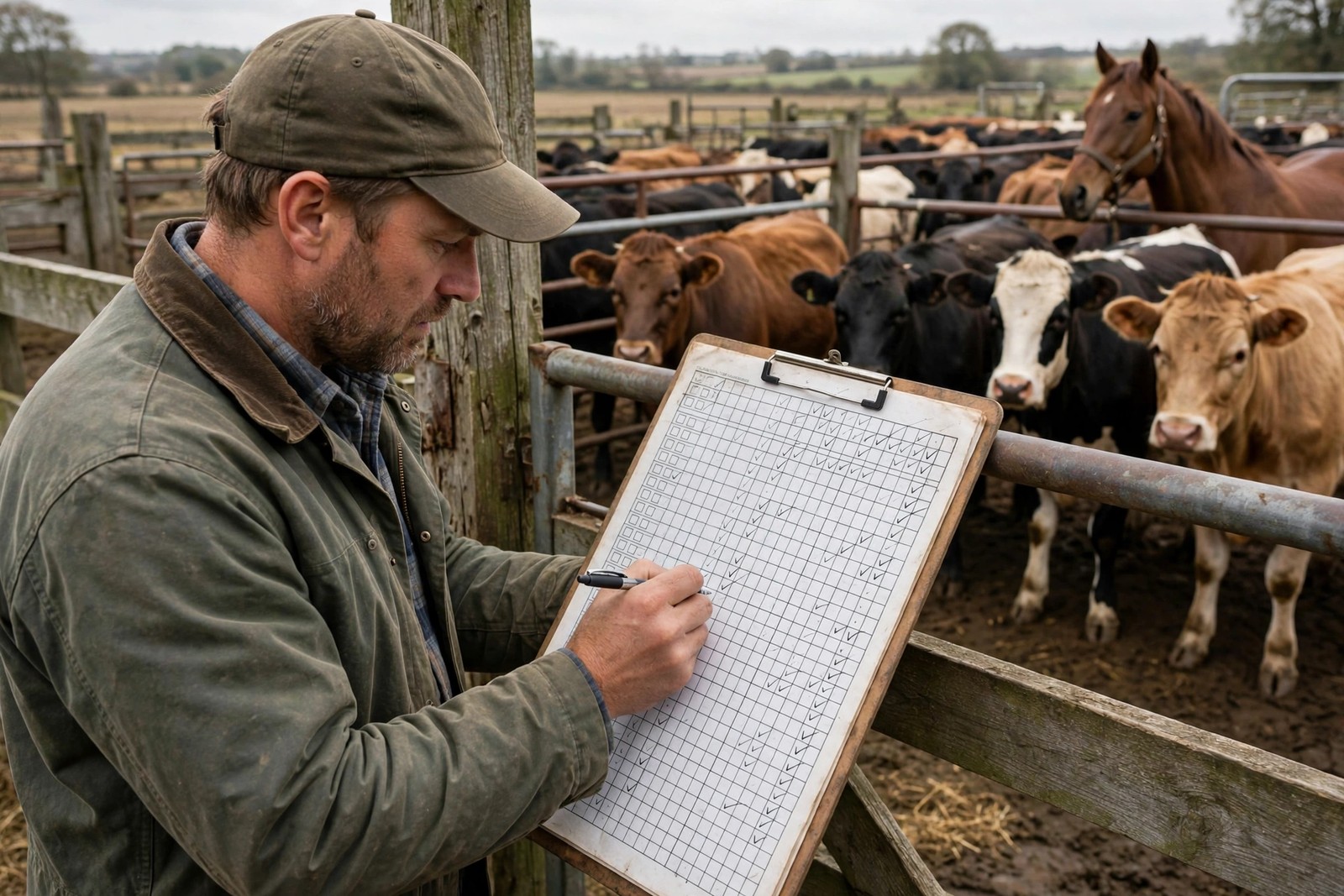
Vaccination tracking that works for two animals collapses at twenty, and fails dangerously at a hundred. Individual cards get separated, dates live in different people's memories, and the animals most likely to be missed are the quiet ones at the back of the group. Herd and flock tracking needs a different design: one master record every animal appears on, a due-date list that always shows what is next, and an update habit tied to the handling session itself rather than to an office hour later in the week.
Build One Master Chart With a Row Per Animal
Create a single chart — a spreadsheet if you keep digital records, a large wall chart in the feed room or office if paper suits your yard — with one row per animal and fixed columns: the animal's identity (name, tag, band, or microchip number, whichever your holding uses), species and management group, each vaccine that animal receives, the date it was last given, and the next due date. Your vet sets the schedule for each species and group, because what a breeding ewe, a dairy goat, a broodmare, and a laying hen each need differs substantially, and some vaccinations are timed to breeding, lambing, or housing seasons rather than to the calendar alone. The chart's job is to hold the vet's plan faithfully for every animal at once, so record the due date the vet confirms at the time of the visit rather than calculating it yourself months later.
Work From a Due-Date List, Not the Whole Chart
The master chart holds everything, but day to day you work from a short extract: every animal due in the coming period, sorted by due date, earliest first. Regenerate or rewrite this list whenever the chart changes. The sorted list is what lets you plan efficiently — animals due in the same window can be gathered into a single handling session and, where your vet agrees, a single visit, instead of the vet being called out repeatedly or animals being mustered again and again. Set a reminder for each due date at the moment the previous vaccination is given, with enough lead time to book the vet and plan the gather, because a reminder that fires on the due date itself is already a late system for a herd.
Update the Chart the Same Day, at the Pen
The discipline that makes the whole system trustworthy is same-day updating. Record each animal as it is handled — a clipboard or phone at the pen beats a tidy write-up later — noting the date given and the new due date, and mark any animal that was missed, evaded gathering, or was unwell and held back, with the reason. That missed list matters: an animal absent from a group session is invisible in the records unless its exception is written down, and it should head the due-date list for a catch-up session rather than waiting silently for the next round. Reconcile the chart against the animals actually present at least once a season, because deaths, sales, and new arrivals all create rows that are wrong in opposite directions.
New Arrivals and Breeding Stock Need Their Own Rows Immediately
Add every incoming animal to the chart on arrival day with whatever vaccination history came with it, and flag the row clearly where history is unknown. Keep newcomers separate from the main group until your vet advises how their cover should be brought into line with the herd or flock programme; folding an animal of unknown status into the main chart as if it shared the group's history is how gaps get papered over. Young stock get their rows when their first vaccinations are scheduled, grouped with their dams or their age-group cohort so their dates travel together as they move between groups.
A chart this size only stays accurate when updating it is somebody's named job rather than everybody's intention, and KinsLe Care Teams lets you assign each vaccination session, catch-up gather, and chart update to specific yard staff, with every completed task timestamped against the herd's routine.