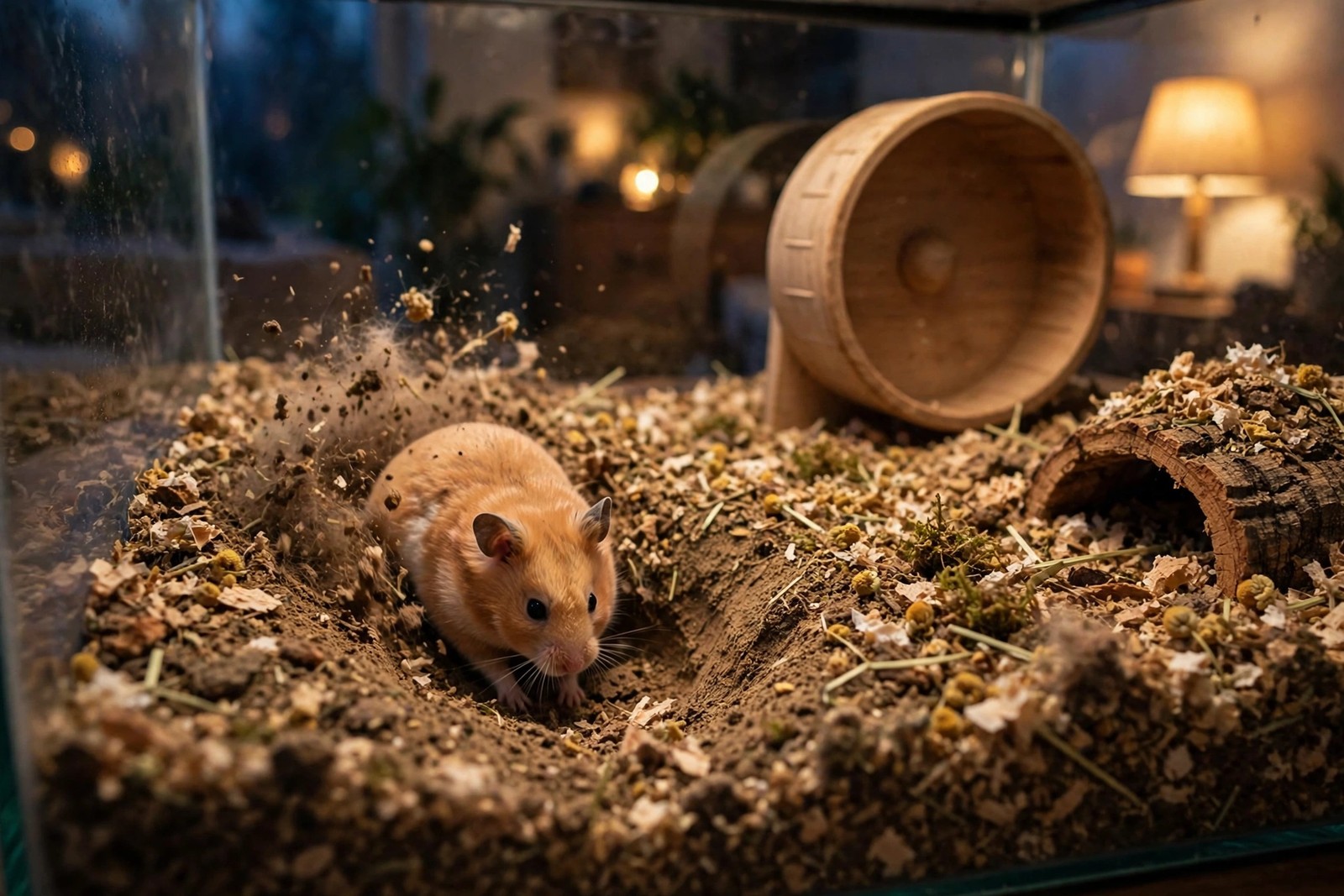
Hamsters are ground animals who, in the wild, travel long distances at night and maintain burrow systems — so the honest measure of a cage is its floor, not its height or its colourful tube network. A cage can look busy and still be far too small, and hamsters tell you so through behaviour long before most owners think to get out a tape measure.
Measure the Floor That Actually Counts
Measure the inside length multiplied by the inside width of the main living area. That single continuous rectangle is the number that matters: shelves, ramps, upper levels, and connecting tubes do not add to it, because a hamster cannot run, forage, and burrow across disconnected platforms the way he uses open floor. Many current welfare guides suggest at least around 600 square inches of unbroken floor space for a Syrian hamster — roughly a 40 by 15 inch footprint as a starting point — with dwarf species needing only slightly less, and bigger being genuinely better rather than a luxury. If your measurement comes in well under that, the cage is too small regardless of how it was marketed, and small barred cages sold as starter homes very often do. A large glass tank or a deep storage-bin conversion with a meshed lid frequently delivers the floor space and bedding depth a hamster needs for less money than a multi-level plastic cage.
Let the Hamster Cast the Second Vote
Behaviour is the other half of the diagnosis, and in a too-small cage it is remarkably consistent. Bar biting — chewing the bars repetitively, often in one favoured spot — is the classic sign, and it damages teeth as well as signalling stress. Climbing the bars and dropping from the top, sometimes called monkey-barring, pacing the same route along one wall, frantic digging at corners, and sudden aggression or unusual lethargy all point the same way. Any one of these in a cage that also fails the tape-measure test settles the question. Note when the behaviour happens: most hamsters are active at night, so check in the evening rather than judging by a sleeping animal at midday.
Check Whether the Essentials Even Fit
A cage can pass on paper and fail in practice if the equipment it must hold does not fit properly. The wheel is the commonest casualty: a Syrian typically needs a wheel around 11 to 12 inches across, a dwarf around 8 to 10 inches, and the test while running is simple — the back should stay flat, not arched upward, and the head should not be lifted to fit. If a correctly sized wheel will not fit in the cage, the cage is too small by definition. Bedding depth is the second test: hamsters need to burrow, not just nest, so one end of the enclosure should hold bedding around 6 to 10 inches deep for tunnelling. Add a sand bath, a hide at floor level, and space to scatter-feed for foraging, and a marginal cage quickly reveals it has no room for a hamster's actual life.
What to Do With the Answer
If the cage fails, upgrade the enclosure before adding toys — space itself is the enrichment, and a bigger floor with deep bedding, a right-sized wheel, and scatter feeding resolves most stress behaviour within days to a couple of weeks. Keep the old cage as a travel or hospital cage rather than a punishment space. Watch for bar biting or climbing persisting in a genuinely large setup, or appearing alongside weight loss, wet tail, or appetite change, and see a veterinarian, because illness and pain can drive restless behaviour too. For anything still unclear about floor space or stress signs, put a follow-up question to KinsLe's Kinny; he answers using the KinsLe Answers library.