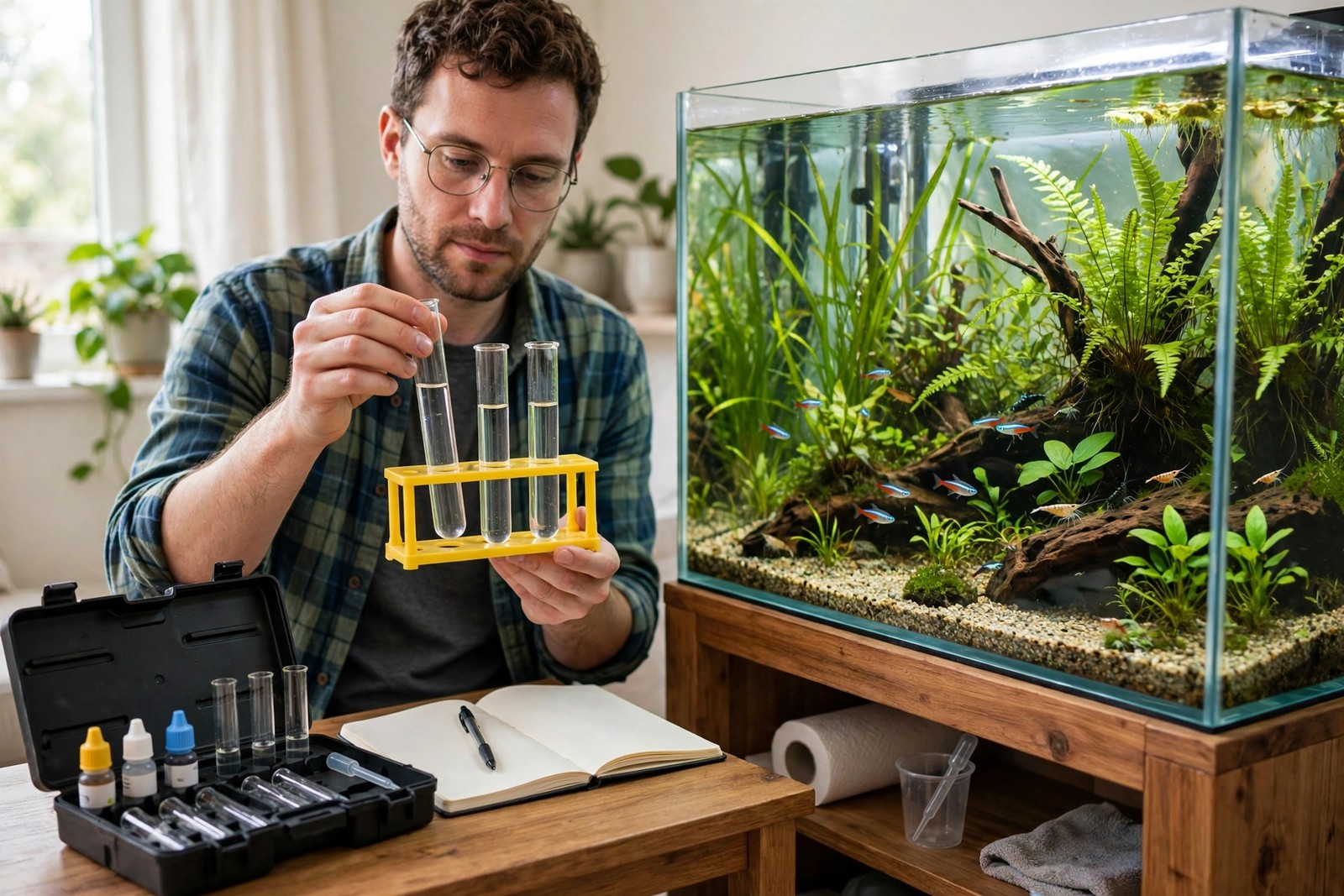
A tank is not cycled because a certain number of weeks have passed, because the water looks clear, or because a product said so. It is cycled when its filter bacteria can convert fish waste — ammonia — through nitrite to nitrate fast enough that the toxic first two never accumulate. That is a claim only water tests can make, so the answer to this question is a set of numbers, plus one practical proof test.
What Cycling Actually Builds
Two groups of beneficial bacteria colonise your filter media and, to a lesser extent, your substrate and decor. The first group converts ammonia, produced by fish waste, uneaten food, and decaying matter, into nitrite. The second converts nitrite into nitrate, which is far less toxic and is removed by water changes and live plants. Ammonia and nitrite are both harmful to fish even at low levels, which is why stocking a tank before these colonies are established — a process that typically takes several weeks — so often ends in losses that get blamed on the fish rather than the water.
The Three Readings That Decide It
Test with a liquid test kit rather than strips, which are notoriously imprecise at exactly the low ranges that matter here. Your tank passes when all three of these are true at the same time: ammonia reads 0 ppm, nitrite reads 0 ppm, and nitrate reads above zero — the nitrate is the receipt proving waste is being fully processed rather than simply absent. If ammonia or nitrite shows any colour at all, the cycle is not finished, whatever the calendar says. Also check pH while you test: a pH that has crashed very low can stall the bacteria and freeze the cycle mid-way, which looks identical to slow progress until you measure it.
The 24-Hour Confirmation Test
A single set of zeros can mislead, because a tank with no ammonia source reads zero trivially. The confirming test, standard practice in fishless cycling, is to dose the tank with a measured amount of ammonia — commonly around 2 ppm — and test again 24 hours later. If ammonia and nitrite are both back to 0 ppm within that window while nitrate has risen, your bacteria processed a realistic day's waste load in a day, and the tank is genuinely cycled. If either reading is still positive, wait, let the colonies grow, and repeat the test in a few days. During the cycle itself, test daily or every other day and keep a written log of date, ammonia, nitrite, and nitrate; the pattern — ammonia falling as nitrite spikes, then nitrite falling as nitrate climbs — tells you where you are far better than any single result.
Stocking Once You Pass
Passing the test is the start of stocking, not the end of care. Do a substantial partial water change first if nitrate has climbed high during cycling, to bring it down to a comfortable level before fish go in. Add fish gradually over the following weeks rather than all at once, because the bacterial colony is sized for the load it has been processing and needs time to grow with each addition. Keep testing two or three times a week for the first month after stocking, feed sparingly, and never rinse filter media under tap water, whose chlorine can kill the colony you spent weeks growing — swish it in water removed from the tank instead. If more than one person in the household feeds and tests, missed doses and double doses are the usual cause of a mysterious ammonia spike, and KinsLe's Care Teams keeps the cycle honest by turning daily tests, doses, and water changes into assigned, timestamped duties everyone can see.