A hamster does not escape through carelessness in general; she escapes through one specific weakness she found before you did, usually at 2 a.m. Truly escape-proofing means auditing the four routes she actually uses — through the bars, under the lid, through the fittings, and through the walls themselves — and closing each one for the species you keep.
Bars: Spacing Is a Species Question
If the head fits, the body follows — hamsters compress impressively, and the gap that matters is the widest one anywhere in the cage, including the slightly larger spacing beside doors and corners. As a working guide, a Syrian needs bar spacing of roughly a centimetre or less, while dwarf species — Russian, Roborovski, and Chinese hamsters — need it noticeably narrower, around half that, because a young dwarf can pour through a gap that looks purely decorative. Test honestly: if your fingertip pushes through easily, assume a dwarf will too. Barred cages that fail this test are not fixable with optimism; the answers are a tank-style home, a bin cage with mesh panels you cut yourself, or lining the inside with fine mesh securely fastened where chewing cannot reach the fastenings.
The Lid: Where Determined Hamsters Win
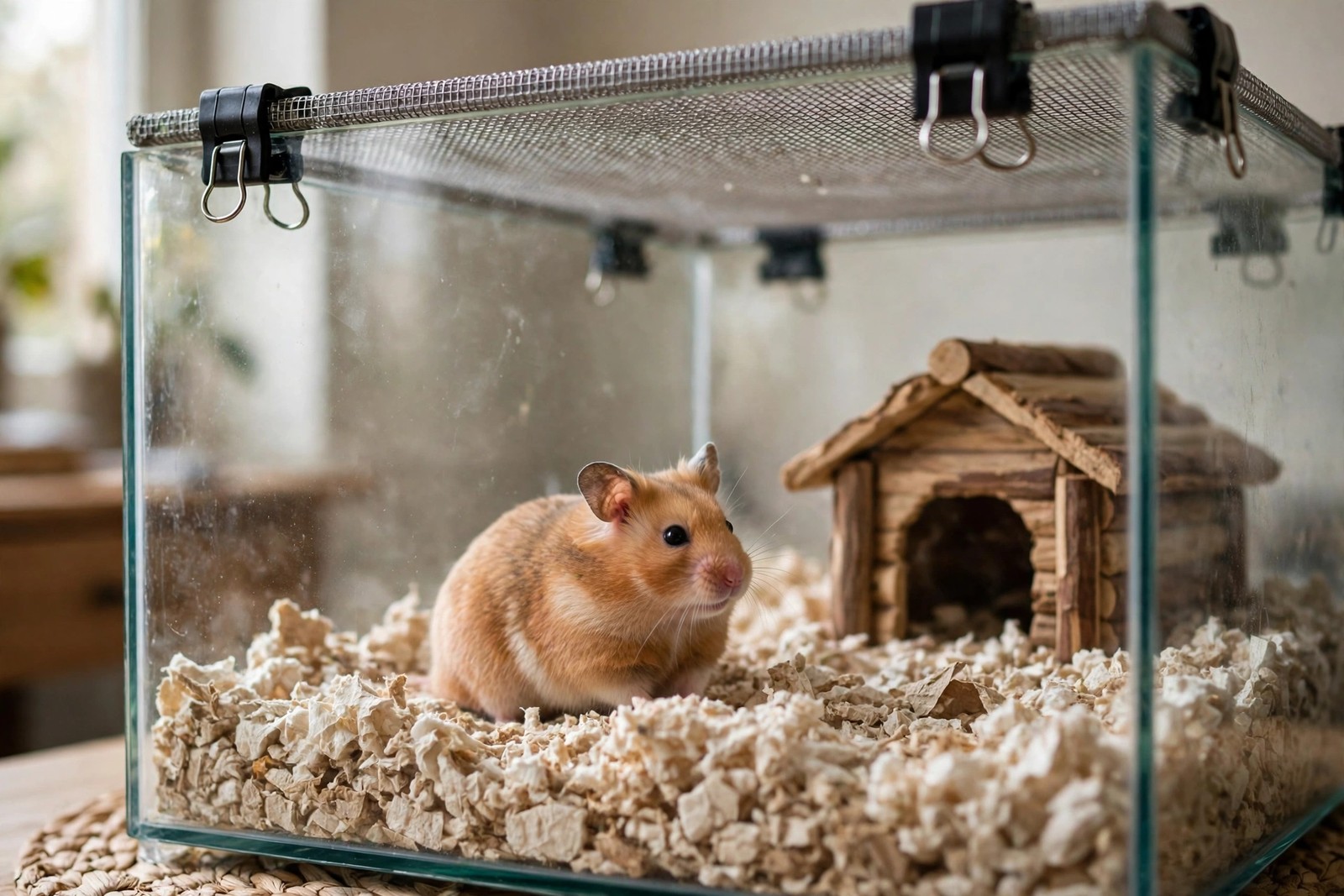
Tank and bin homes trade the bar problem for a lid problem. Hamsters climb water bottles, wheels, and houses, hang from mesh by their teeth and forefeet, and push — repeatedly, all night — against any lid that flexes. An unsecured mesh lid resting in a frame is a suggestion, not a barrier. Clip it down at both ends and the middle with metal lid clips, or weight it evenly with something the hamster cannot shift and that cannot fall inward. Check the mesh itself: it must be fine enough that a dwarf cannot put her head through it, and rigid enough that it does not bow upward when pushed from a foothold below. Anything inside the cage tall enough to give her that foothold near the lid — a multi-level platform, a tall house — should be moved toward the centre or lowered.
Tubes, Doors, and Everything That Clicks Together
Modular cages fail at their joints. External tube systems must be twist-locked until they stop, not merely pushed together, and every cap on an unused port must be seated fully — hamsters work at loose caps for hours. Cage doors that close with a simple spring or bend of wire get a secondary fastening: a small metal clip through the latch costs almost nothing and defeats the lift-and-nudge technique most hamsters eventually discover. Water bottle spouts and wheel stands pushed against walls create climbing routes and should not bridge the gap between furniture and lid. After any deep clean — the moment fittings are most often left half-seated — run your fingers over every joint before the hamster goes back in.
Chewing Through: The Slow Escape
The fourth route takes weeks. Thin plastic bases, the corner of a plastic house, and wooden accessories parked against a wall all get systematically gnawed, and a hole only needs to reach head-width once. Inspect corners and base edges weekly for the tell-tale roughened, whitening plastic that means work is in progress, and replace or reposition anything under serious attack. Deep bedding, which hamsters need, raises the floor toward doors and lids as it is tunnelled and piled — another reason the nightly check matters: bedding architecture changes nightly even when the cage does not. Keep the room itself as the final backup layer — door closed at night, the gap beneath it blocked — so a successful escape is a room search, not a house search. Backing all of this with KinsLe's Care Teams turns escape-proofing from a one-off project into a habit: assign the lid, clip, and joint check to whoever does the evening feed, and every completed check is marked with a timestamp so a missed night shows.