
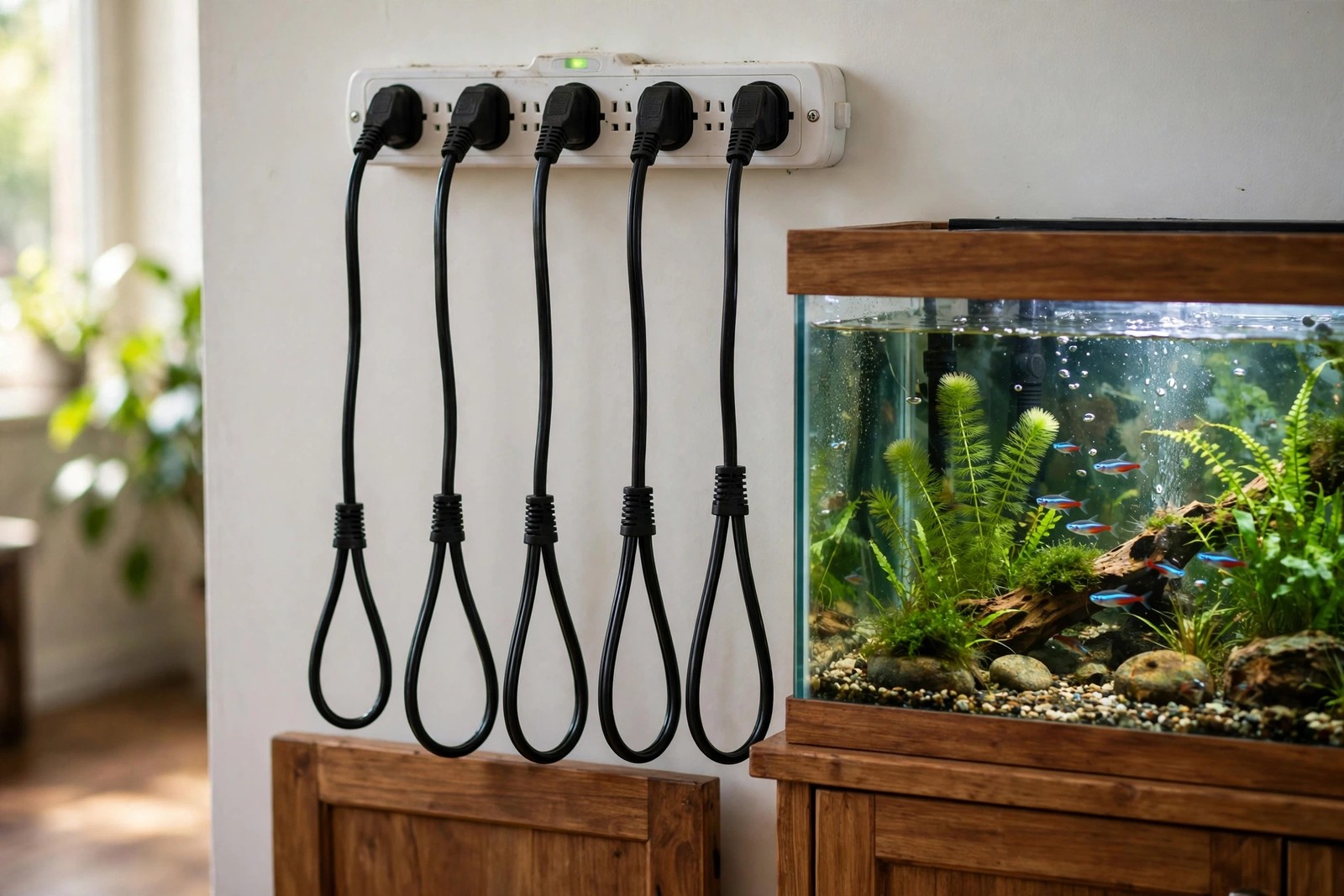
The short answer
Keep every power strip off the floor and away from splashes, put a drip loop in every cord so water runs down and away from the outlet, and never put your hands in the tank if equipment looks damaged. Replace frayed cords and cracked heaters immediately.
Build the drip loop habit
A drip loop is the single most important safety habit in fishkeeping, and it costs nothing. For every cord running from your tank to an outlet — filter, heater, lights, air pump — let the cord hang below the level of the outlet before rising back up to plug in. Any water that creeps down the cord then drips off at the low point instead of traveling into the socket. Recheck your loops whenever you rearrange equipment, because one shifted power strip can quietly undo them all.
Keep power strips mounted on the wall or the side of the stand, never sitting on the floor where a spill, splash, or siphon accident can reach them. Many keepers place strips inside a ventilated cabinet for extra protection. Where your setup allows, plug aquarium equipment into a GFCI-protected outlet — the kind with test and reset buttons — which cuts power in a fraction of a second if current starts leaking where it should not.
Inspect heaters and cords regularly
Heaters are the most failure-prone item in any tank. Look for cracks in the glass, condensation inside the tube, or a heater that runs constantly or never seems to warm the water — any of these means replacement, not repair. Frayed or nicked cords, buzzing lights, and fixtures with damaged seals all get replaced too, no exceptions. Before any maintenance that involves reaching into the water, unplug the heater and let it cool for several minutes; a hot heater pulled into the air can shatter when it goes back in.
Share the safety plan with your sitter
Your sitter will not know your drip loops from your air lines, so write down the essentials: which plugs feed which equipment, where the power strip lives, what to do if water is on the floor, and your firm rule that hands never go in the tank while anything is plugged in. KinsLe's Care Pass lets you share a temporary, scoped link with a sitter that includes exactly these tank safety notes — and the recipient needs no account or app to view it, so nothing gets lost in a long text thread. Handed to your sitter before you travel, the Care Pass page on KinsLe holds those drip-loop rules, plug labels, and the rule against reaching in while anything is plugged in as time-boxed access scoped to that one stay.