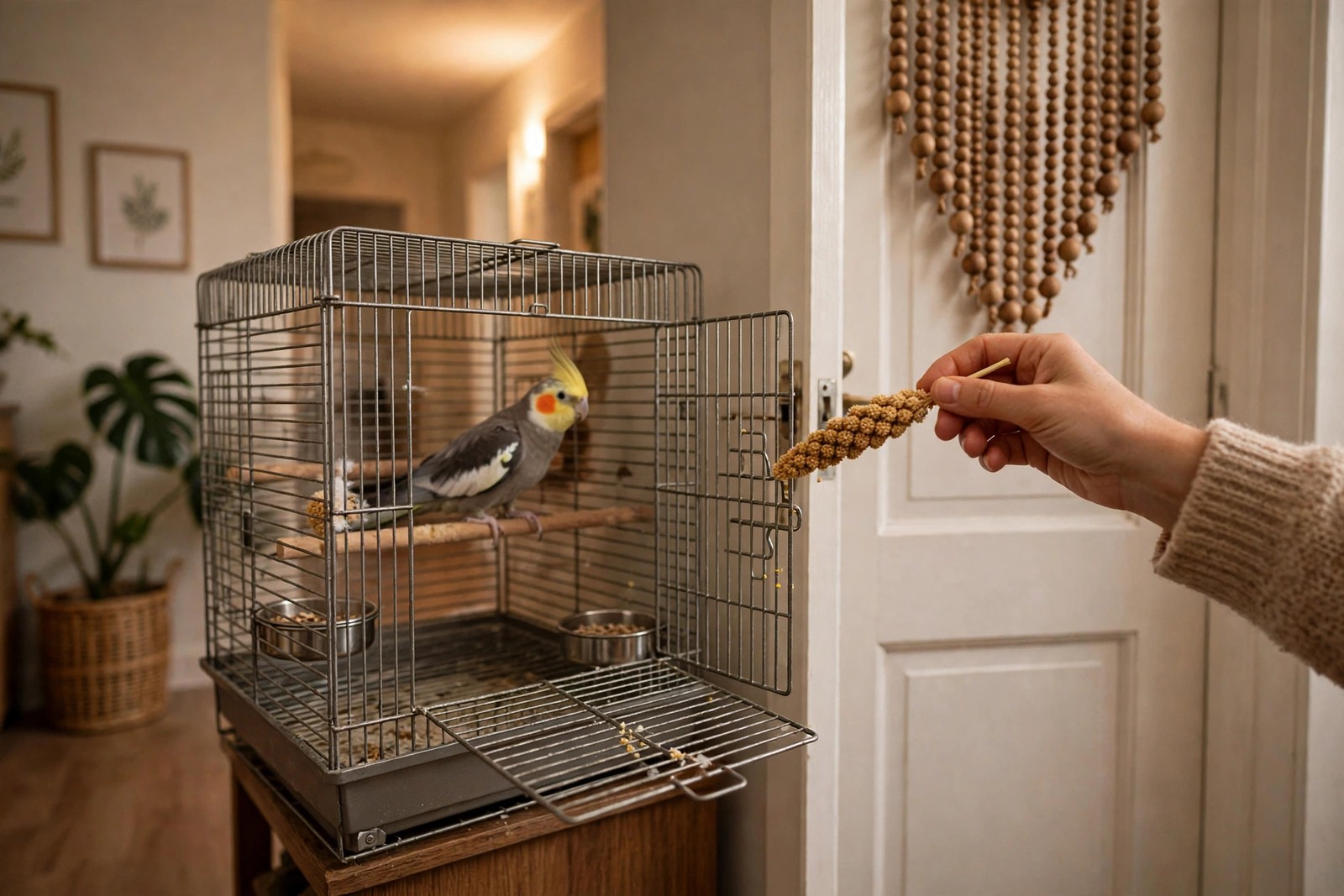
Almost every lost companion bird leaves the same way: not through a broken cage, but through a door opened for three seconds by someone who did not know — or momentarily forgot — that the bird was out. A startled parrot, cockatiel, or budgie can cross a room and be over a visitor's shoulder before anyone reacts. The fix is not vigilance, which fails eventually; it is a protocol that makes an open door and a loose bird physically unable to coincide.
Rule One: The Bird Is Secured Before the Door Moves
Make it absolute and boring: whenever an exterior door is about to open — doorbell, delivery, guests, taking bins out, children coming home — the bird goes into her cage with the door latched, or is carried into an interior room and that door is closed. No exceptions for "just a second" or "she never flies to the door"; startle flights are exactly the ones that do. Train and reward a quick, cheerful step-up and cage return at random times of day, with a favourite treat kept by the cage for exactly this, so the doorbell does not become a chase. Until that recall-to-cage is reliable, schedule out-of-cage time for when the household is settled and no arrivals are expected, and keep a small travel cage near the living area for a fast, low-drama secure-up during unexpected knocks.
Rule Two: Never Rely on a Single Door
Add a second barrier between your bird's space and the street. The strongest version is a double-door arrangement: an inner hallway or porch door that is always closed before the outer door opens, used in sequence, never both at once — the same airlock logic aviaries use. Where that is impossible, fit a screen or storm door that is kept latched, hang a bead or fabric curtain across the doorway as a visual and physical deterrent that slows a flying bird and reminds humans, and consider keeping the bird's main room one closed interior door away from the entrance altogether. Fit clips or locks on cage doors and food-port doors too — many birds learn to lift a simple latch — and check window screens are rigid and fully seated before windows open in summer, because a loose screen is just a slower door.
Make the Whole Household Part of the System
Escapes are usually a communication failure, so make the bird's status impossible to miss. Agree a household call — "bird out" when she leaves the cage, "bird in" when she is secured — that anyone entering announces and everyone acknowledges. Put a small sign at eye level on the inside of the front door: bird loose, check before opening. Brief guests and children on arrival, kindly and once, clearly: doors get closed, nobody carries the bird near the door, and if she startles and flies, freeze and close doors rather than chasing. Deliveries get a default routine too — parcels accepted with the inner door shut, or the bird secured first, every single time, including by teenagers and visitors who "know what they're doing."
Reduce the Other Startle-and-Exit Risks
Keep ceiling fans off in any room where the bird is out, keep her away from open windows without screens, hot cooking surfaces, and open water, and think before carrying her on your shoulder near any doorway — the shoulder-surfing bird by an opening door is the single most common escape story owners tell afterwards. Discuss wing management honestly with your avian vet rather than attempting any trim yourself; a trimmed bird can still fly outdoors on a gust, so it is never a substitute for the door protocol. And prepare for the day the system fails anyway: keep recent photos, note leg-band details and distinctive words or whistles, and if she does get out, stay calm, keep eyes on her landing spot, and use KinsLe's Lost Pet Alert System to send a free alert to nearby Circle of Love members who can message you directly with sightings while you work the immediate streets.