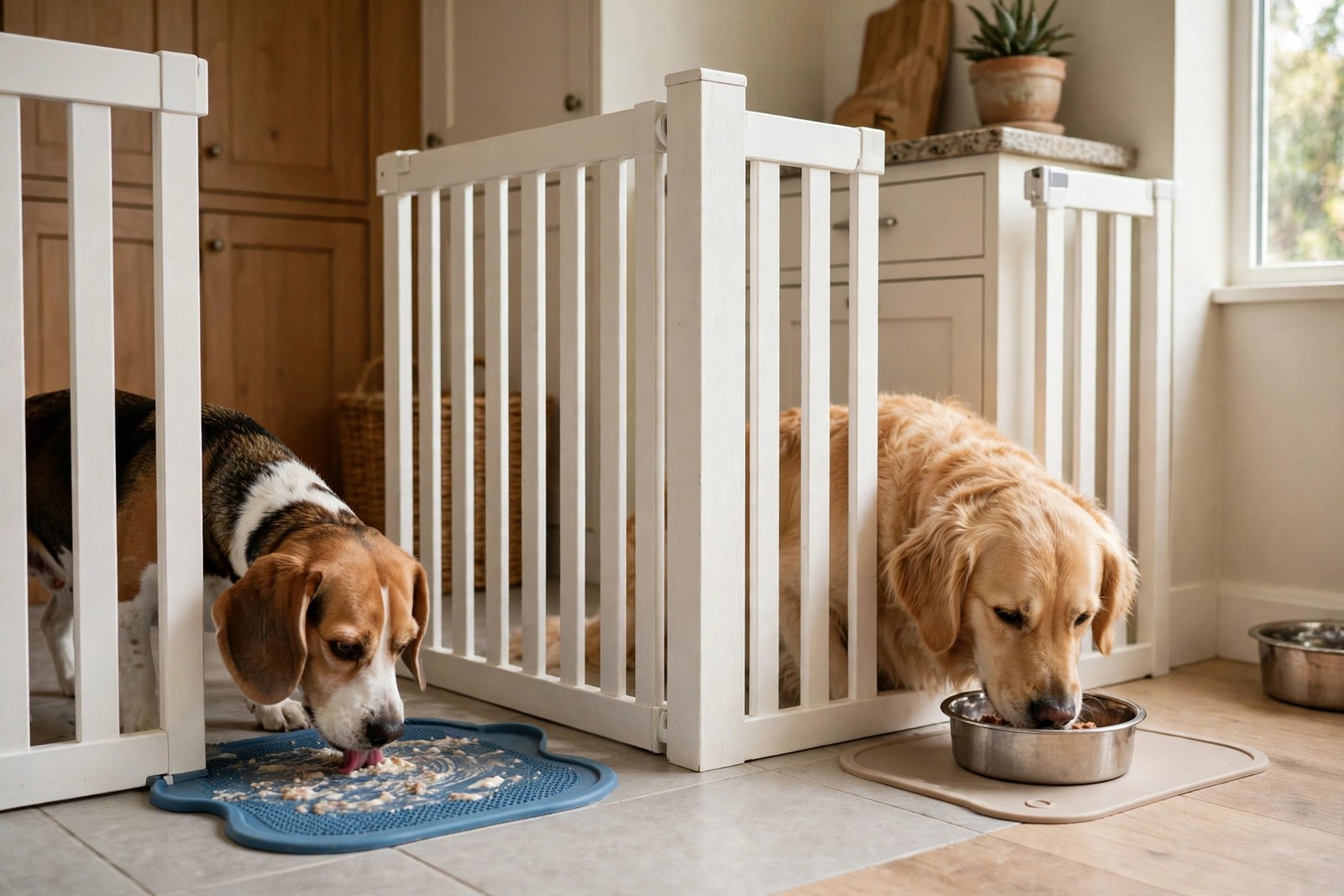
Hovering looks harmless until you watch the slow eater's body language: eating in hurried gulps, glancing up between mouthfuls, or walking away from a half-finished bowl to avoid an argument. A dog who eats under surveillance eats under stress, and over weeks that pressure can harden into guarding — first of the bowl, then of the space around it — while the fast dog learns that intimidation eventually yields leftovers. Managing this well is mostly architecture, not training: arrange the room so the conflict cannot happen, and give each dog a feeding routine that ends predictably.
Separate first, and make separation normal
Feed in genuinely different spaces: one dog in the kitchen, one behind a closed door or baby gate, or each in a crate if both are crate-comfortable. Visual separation matters — a fast dog staring through a gate still pressures a sensitive eater, so use a solid door or position bowls out of each other's sight lines where you can. Keep the arrangement identical at every meal so both dogs trot to their own station unprompted.
Begin before food appears: call each dog to its station, reward settling, then deliver bowls, serving the fast dog last. He stays in his space until you release both dogs, so patience becomes part of his feeding job.
Slow the fast dog down inside his own space
A dog who inhales a meal in forty seconds creates his own long, tempting wait. Stretch his meal with tools rather than scolding him for speed: a slow-feeder bowl with ridges, food scattered across a snuffle mat or clean patch of lawn, a stuffed toy frozen the night before, or his ration split between two bowls delivered a few minutes apart. Five to ten minutes of working at food tires the brain as well as filling the stomach, and by the time he finishes, the slow eater is usually done too.
If he still finishes first, his post-meal job starts automatically: a lick mat fixed to the floor of his space, a chew, or release into the garden for a toilet break and a sniff. Finishing first must lead somewhere good in his own territory — the moment hovering at the gate pays better than his own occupation, you will be training against your own setup.
Protect the slow eater's confidence
Slow eating is information. Some dogs are simply methodical, but a dog who has recently slowed down, drops food, tilts his head or leaves hard pieces deserves a vet check for dental pain or nausea before you treat the pace as temperament. Serve his meals undisturbed, resist standing over him, and lift his bowl only when he has clearly finished and walked away — then lift every bowl, every time, since bowls left down invite grazing disputes.
Weigh both dogs monthly. The fast dog gaining while the slow dog thins is the classic fingerprint of food quietly changing stomachs, often appearing before anyone witnesses actual stealing.
Handle the flashpoints around the meal
Most feeding friction ignites outside the bowls themselves: in the scrimmage while food is prepared, around dropped scraps during cooking, and over high-value chews given casually in shared space. Prepare food with dogs settled behind the gate, wipe spills promptly, and give anything long-lasting only in separated spaces, collecting leftovers afterwards. Keep a household rule of no feeding from table or sofa: scraps in shared space restart the hovering economy you just dismantled.
If you ever see stiffening, hard staring, growling over a bowl or a snap, do not punish the warning — separate the dogs for all future meals without exception and talk to a qualified behaviourist, since guarding that is punished tends to lose its warning signals rather than its feelings.
Writing each dog's station, ration, slowing tool and post-meal job into one shared plan means a partner, teenager or sitter reproduces the system exactly, and KinsLe Care Teams lets you assign those per-dog feeding duties to whoever is on duty, with completed meals timestamped so nobody is fed twice or left hovering-hungry by mistake.