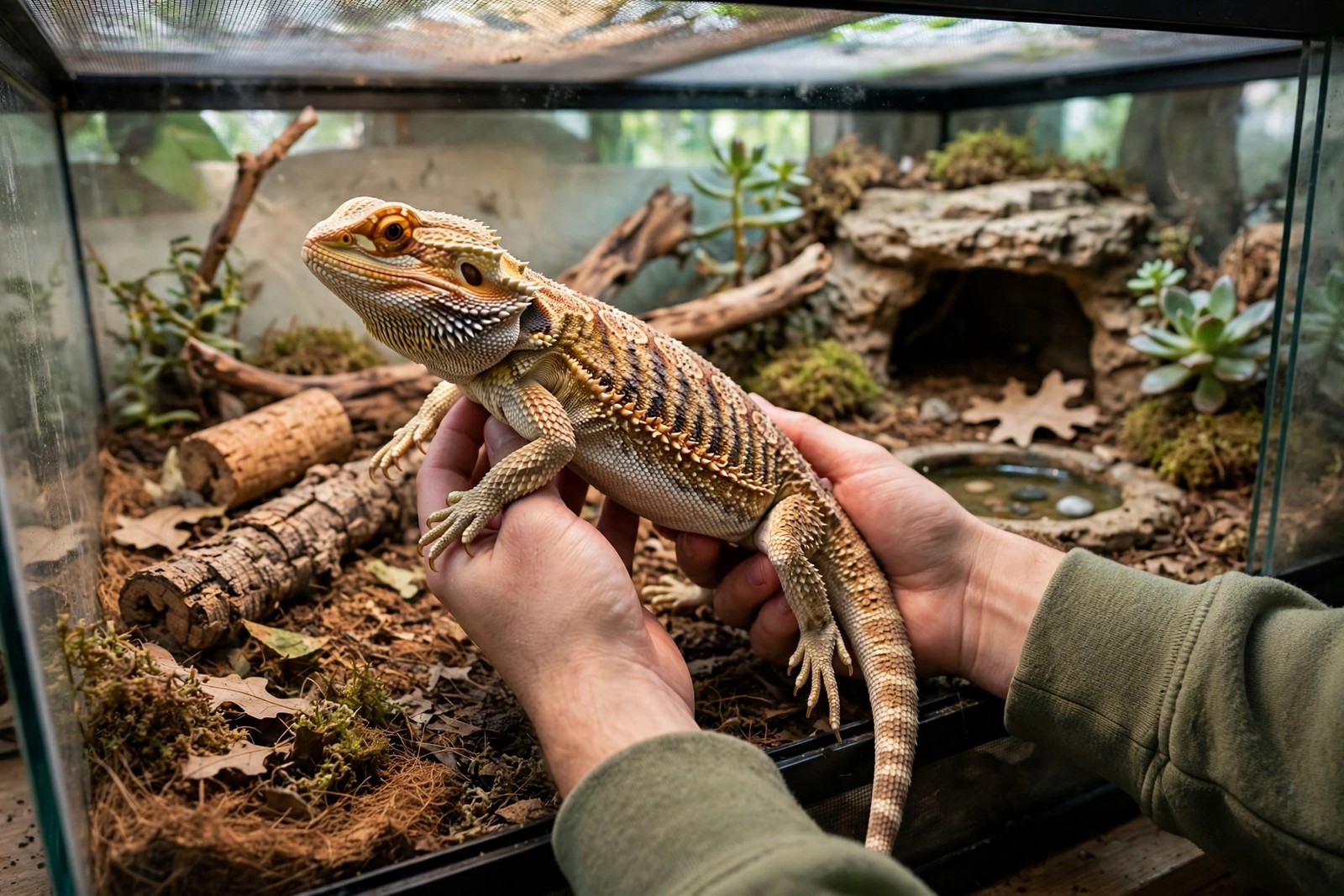
A bearded dragon is a prey animal, and its alarm system is built for predators arriving from above. A hand descending from overhead, a shadow crossing the enclosure, or a sudden grab from behind reads as a threat even when the hand belongs to a familiar person. Calm handling starts by removing those triggers: approach where your dragon can see you, move at a speed that lets it track your hand, and lift with support rather than grip. The result, over repeated sessions, is a dragon that steps onto a hand willingly rather than one that runs at the sight of it.
Approach at Body Level
Begin with your hand inside the enclosure at your dragon's own level, entering from the front or the side rather than lowering it through the top. Pause with your palm open and still, a short distance from your dragon, and let it look, tongue-flick, and decide. Talk quietly, if you talk at all, and avoid reaching over your dragon's head or casting a shadow across it. If your dragon flattens, darkens its beard, opens its mouth, or runs, stop, withdraw slowly, and try again later rather than pushing through the warning signs. That restraint teaches your dragon that its signals work, which is what makes it braver next time. Handling is best done after your dragon has basked and is warm and alert, never straight after waking, during a shed when skin is tender, or just after a meal.
The Scoop, Not the Grab
When your dragon is calm, slide one hand gently under the chest and belly, spreading the fingers so the body rests across your palm, and bring the other hand underneath to support the hind legs and the base of the tail. Every limb should be supported, because dangling legs and an unsupported tail are what make a dragon kick and panic. Lift slowly toward your own chest, where your dragon can feel a warm, stable surface, and keep both hands in contact during the move rather than transferring it mid-air. Never lift a bearded dragon by its tail, never pinch it around the ribs, and never hold it by a single leg or arm. If it wriggles hard, lower it back onto a surface instead of tightening your grip, since a tighter hold on a panicking dragon leads to scratches and a worse lesson for next time.
Build Session Length Gradually
Keep the first sessions short, about five minutes each, and end on a calm note by returning your dragon to its basking spot gently rather than letting the session end in a struggle. Increase the length slowly as your dragon settles, and use the time for quiet sitting rather than constant stroking, since many dragons tolerate handling well but dislike being petted repeatedly on the head. Watch the body language during the session: a relaxed dragon lies flat with a pale beard and slow breathing, while a stressed dragon blackens, puffs out, tries to climb away, or glass-surfs after being put back. Note what worked, the time of day, the approach used, and how long your dragon stayed calm, because those notes reveal whether evenings suit your dragon better than mornings.
One Approach for the Whole Household
A dragon handled gently by one person and grabbed from above by another never fully learns to trust hands, so the household should agree on one method and stick to it. Children should sit down first, with the dragon placed in front of them, rather than walking around holding it. KinsLe's Family Sharing puts the same handling notes, approach, and session lengths in front of every family member who helps, so your dragon meets one consistent, low, slow lift from everyone who picks it up.