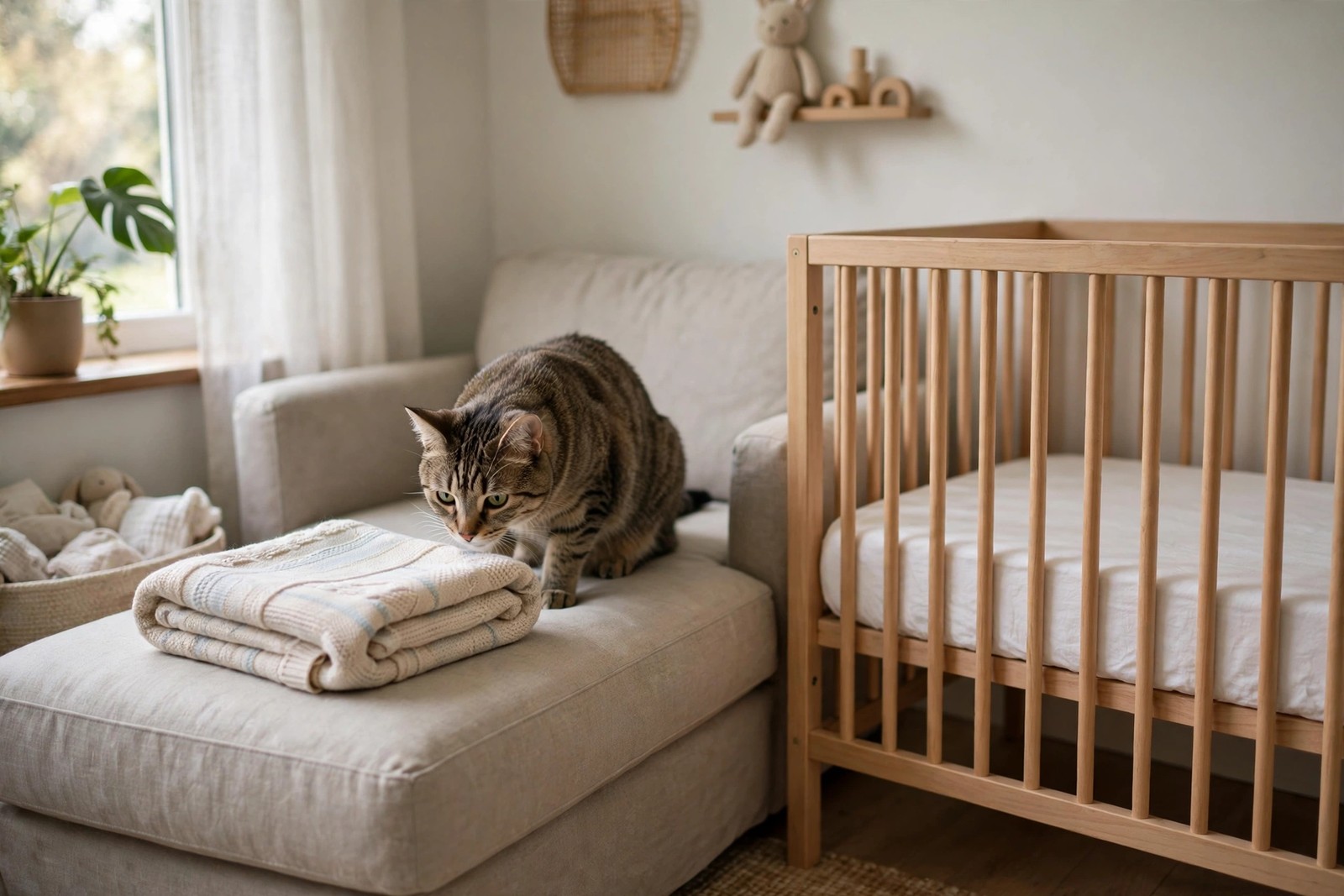
Cats do not object to babies so much as they object to sudden change — and a newborn delivers a landslide of it in one night: new furniture, new smells, crying at 3 a.m., visitors, and owners whose attention and routines vanish overnight. Preparation works because it spreads that landslide across months, letting each change arrive separately, get investigated, and become boring long before the baby comes home.
Months Ahead: Health, Space, and Staging
Book a routine vet check early in the pregnancy so health, parasite control, and any behaviour worries are dealt with while there is time, and raise any litter-tray or spraying issues then rather than later. Set the nursery up in stages over weeks, not in one weekend: assemble the crib, bring in the pram and changing table one piece at a time, and let your cat explore each item, then teach the boundaries you actually intend to keep — most importantly, that the crib itself is not a cat bed, by keeping its door closed or fitting a crib net if your cat is determined. Decide now where your cat's essentials will live permanently: litter tray, food, and water should end up somewhere quiet that a crawling baby will later be kept out of, and any move should happen gradually, tray shifted a little each day, well before the birth.
Sounds, Smells, and the New Routine
Desensitise to baby sounds properly: play recordings of crying, gurgling, and nursery gadgets at low volume during calm, pleasant moments, pairing them with treats or play, and raise the volume slowly over weeks — a cat who has heard a hundred recorded cries at increasing volume files the real one under "known noise." Introduce the smells too: use the lotions, wipes, and laundry products the baby will use on your own skin and bedding so they stop being novel. Just as important, rehearse the post-baby routine now: if feeding, play, and lap time will move to different hours or shrink for a while, shift them gradually during the pregnancy, and build in one protected daily ritual — ten minutes of play and attention that will survive the newborn weeks — so your cat's world narrows by design rather than by neglect.
The Homecoming and First Meetings
Before mother and baby come home, bring back a blanket or item of clothing the baby has worn and let your cat sniff it at her own pace, with treats nearby, so the new scent arrives attached to nothing alarming. On the day, greet your cat calmly first — she will read your behaviour more than the baby's — then allow a supervised look and sniff of the baby in a carrier or in arms, letting the cat choose to approach and to leave; never carry the cat to the baby or restrain her for an introduction. Keep every meeting short, calm, and rewarded, and hold the absolute rule without exception: a cat and a baby are never left alone together, however gentle the cat, because a sleeping baby cannot move away and a startled cat cannot explain herself. Keep nappies, wipes, and baby medication in closed bins and cupboards, and wash hands between litter duties and baby care as basic household hygiene.
Protect the Cat Through the First Months
Watch for stress signals — hiding more, appetite change, grooming a patch bare, toileting outside the tray, or sudden irritability — and answer them with more territory and predictability, not punishment: extra high perches, a guaranteed quiet room, and the protected daily ritual kept even on chaotic days. Keep visitors from chasing introductions with the cat, and tell grandparents and other helpers the feeding amounts, tray routine and vet details directly, so her care does not depend on two exhausted parents remembering everything. Her profile can be opened by relatives you select under KinsLe Family Sharing.