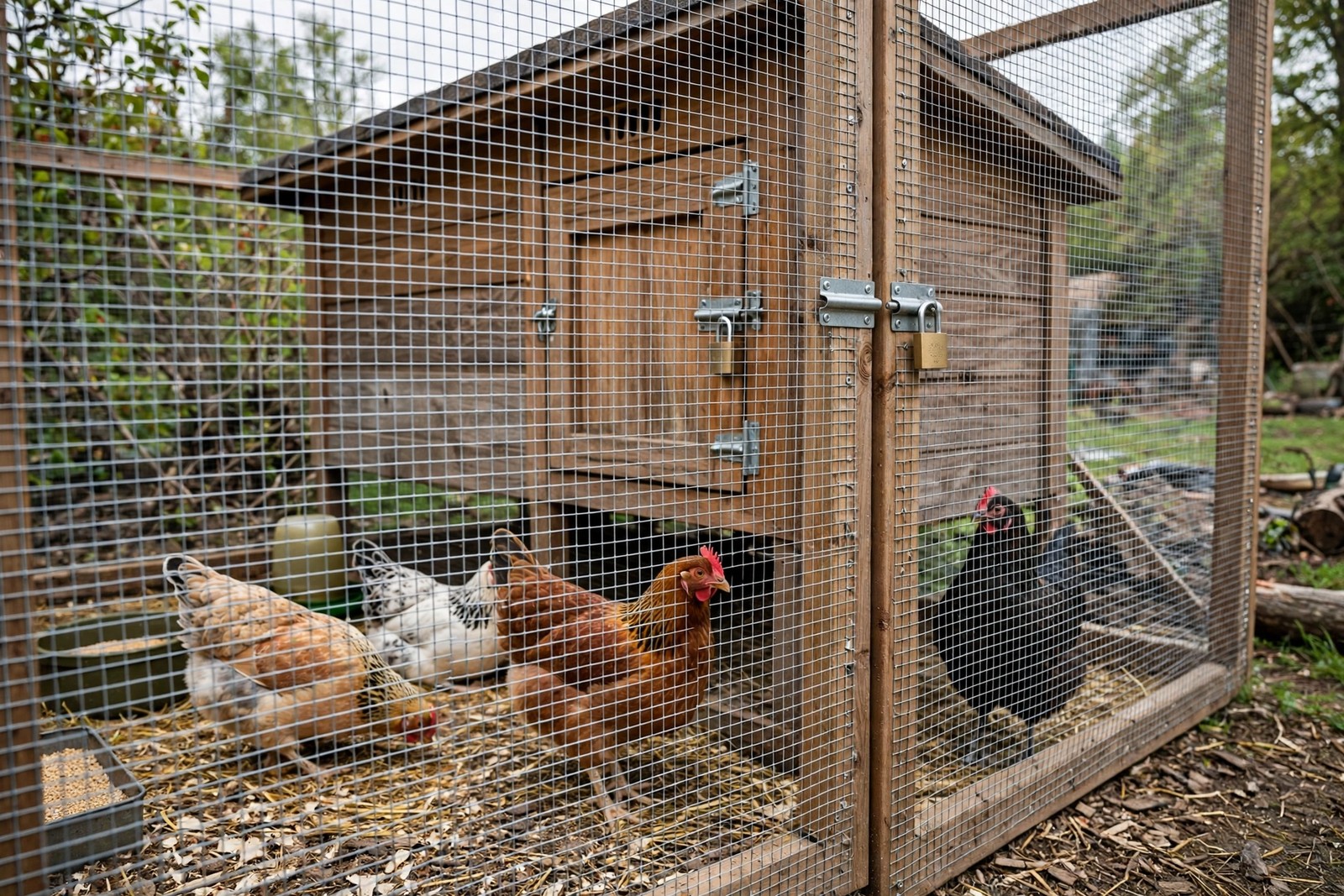
Poultry losses often trace back to a weakness the owner walked past for months: a gap at the eaves, a door latched with a hook a raccoon can lift, soft ground a fox digs under in one night. Predators do not need to beat your whole setup; they need one opening on one night. Work through the coop as they will, testing each surface in turn, and close the flock in before dark on every night without exception, since many hunters work the hour around dusk.
The Mesh: Hardware Cloth, Not Chicken Wire
Chicken wire keeps chickens in; it does not keep predators out, because its thin hexagons tear and stretch under a determined push. Build and repair with hardware cloth, a welded mesh with apertures no wider than half an inch, about 1.3 centimetres, fixed with screws and washers rather than staples a predator can pull free. Cover windows, vents, eaves gaps and the whole run, including any gap where the roof meets the walls, because climbers and small hunters use openings owners forget are openings.
Check the floor as well. A solid coop floor is the simple answer; where the run sits on earth, treat its edges as the weak point the skirt below must cover. Replace rusted or holed mesh the day you spot it.
Digging, Climbing and the Ground Skirt
Against digging, lay an apron of the same hardware cloth flat on the ground around the outside of the run, extending outward at least 12 inches, about 30 centimetres, pinned down and covered with turf or gravel. An animal that digs starts at the fence line, meets mesh under its paws and rarely thinks to back up and start again beyond the skirt. Burying mesh straight down can work too, but the flat apron covers more ground for less digging and can be inspected at a glance.
Seal the pop-hole and doors flush, with no finger-width gap at the bottom, and fit a solid door rather than a flap. For climbing and reaching predators, keep branches, bins and stacked timber away from the run so nothing becomes a ladder, and roof the run in mesh or solid sheeting rather than leaving it open to the sky where birds of prey hunt the flock by day.
Locks, Latches and Feed Discipline
Raccoons open simple bolts, hooks and twist latches with their hands, so fit latches that need two different actions, such as lift-and-slide, and back them with a clip or carabiner-style catch through the hasp. Fit the same standard to feed bins and the nest box if it opens from outside. Padlocks are only worth fitting if someone will lock them nightly, so choose hardware the person doing dusk rounds can operate with cold hands and a torch.
Feed is the invitation that brings predators to test the wire. Feed the flock inside the run, store feed in a sealed metal bin, sweep spilled grain, and take uneaten scraps away at lock-up rather than leaving them to scent the night air. Water outside the run is fine; food outside it is advertising.
The Dusk Routine and After an Attempt
The flock should be shut inside the coop, pop-hole closed and latched, before dusk, not after dark when the hunting has started. Walk the perimeter as you close up: mesh sound, skirt flat, no fresh digging, no feathers caught on wire, no tracks in soft ground that say something visited last night. If you find an attempted dig or a torn corner, repair it that day and vary nothing else; a predator that nearly succeeded will return the following night to finish the job.
Free-ranging, if you offer it, belongs to supervised daylight hours, and the flock returns to the closed box for every unsupervised hour.
Put that nightly round on a rota everyone can see: through KinsLe, the scheduled duties inside Care Teams log who closed the pop-hole, who checked the skirt and when each job was marked done, so a missed evening shows up as a gap rather than a lost flock.