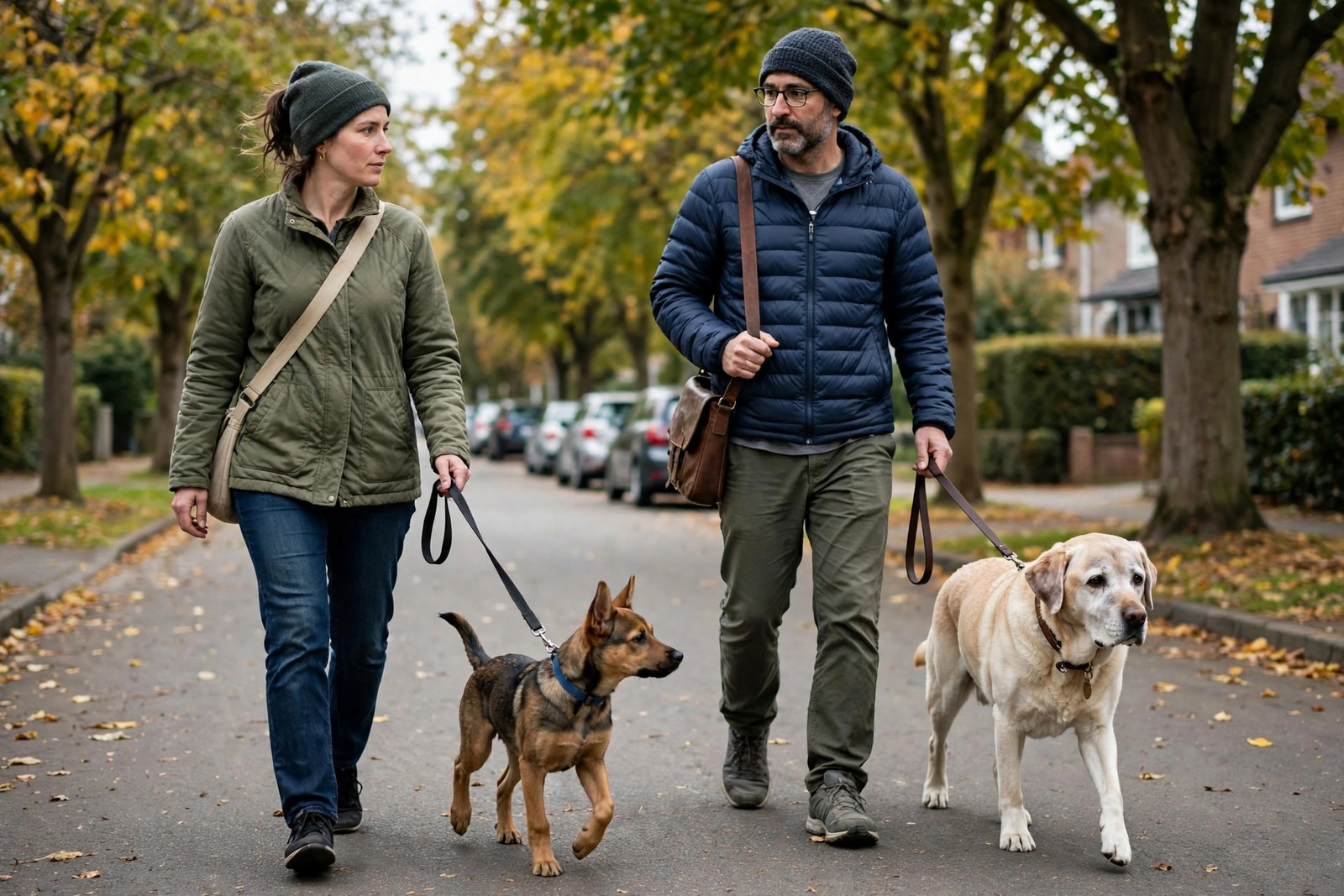
The first meeting decides the tone of everything after it, and the worst place for it is the one most owners choose: the front door, with the older dog already aroused by a knock and a stranger's smell. Do it away from home, on neutral ground, and give the relationship two structured weeks rather than one hopeful afternoon.
The First Meeting: Walk, Don't Greet Face to Face
Meet in a quiet street or park neither dog claims. Two handlers, two loose leads, and start by walking in the same direction with plenty of distance between the dogs — parallel walking lets them read each other's scent and body language without the pressure of a head-on greeting. Close the distance gradually over ten to fifteen minutes if both stay loose and relaxed, allow a brief three-second sniff, then call each dog away cheerfully and keep walking. Repeat a few times, then walk home together and enter the house with the older dog first.
Watch for the signals that say slow down: hard staring, freezing over the other dog, raised hackles that do not settle, or one dog repeatedly trying to mount or crowd the other. Distance fixes most of these on the day; forcing closeness fixes none of them.
The First Days at Home: Separate by Default
For the first week, together time is earned and supervised, and separate is the default setting. Feed in different rooms with a door or gate between — food is the commonest trigger for a first serious fall-out, and an older dog that has eaten undisturbed in the same spot for years should not have to defend it. Pick up high-value items entirely for now: favourite toys, long-lasting chews, and anything your older dog guards. Both dogs get their own bed, their own water, and a way to retreat — a crate, a gated room, or a quiet corner the other is not allowed to follow them into.
Protect the older dog's routine deliberately. It keeps its usual walk order, its usual sofa spot, and its usual one-to-one time with you. A senior with stiff joints also needs the new dog's energy managed for it: step in when play gets boisterous, end sessions before the older dog gets tired or sore, and never let a young dog practise body-slamming a dog that cannot easily move away.
Building Shared Life, Gradually
Increase together time in the rooms where both dogs are calmest, and keep early sessions short and boring — coexisting on leads while you watch television teaches more than excited play. Train each dog separately first, then practise simple known cues side by side, so both learn that listening still pays with the other dog present. Walks together can become the main bonding time: shared sniffing routes build a partnership faster than indoor free-for-alls.
Expect the real settling period to run two to three weeks for daily life, and longer for full relaxation. A setback — a snap over a dropped treat, tension at a doorway — is information, not failure: increase separation around that trigger and rebuild. Get a behaviour professional involved promptly if there is repeated guarding, any bite that breaks skin, or an older dog that starts hiding, skipping meals, or refusing walks, because fear at home is not something either dog should have to live with.
Write the house rules down — who feeds where, which toys are away, when the dogs are separated — and keep that written plan where the household can find it. Family members chosen by the owner may open a profile for either dog once access is granted under KinsLe Family Sharing.