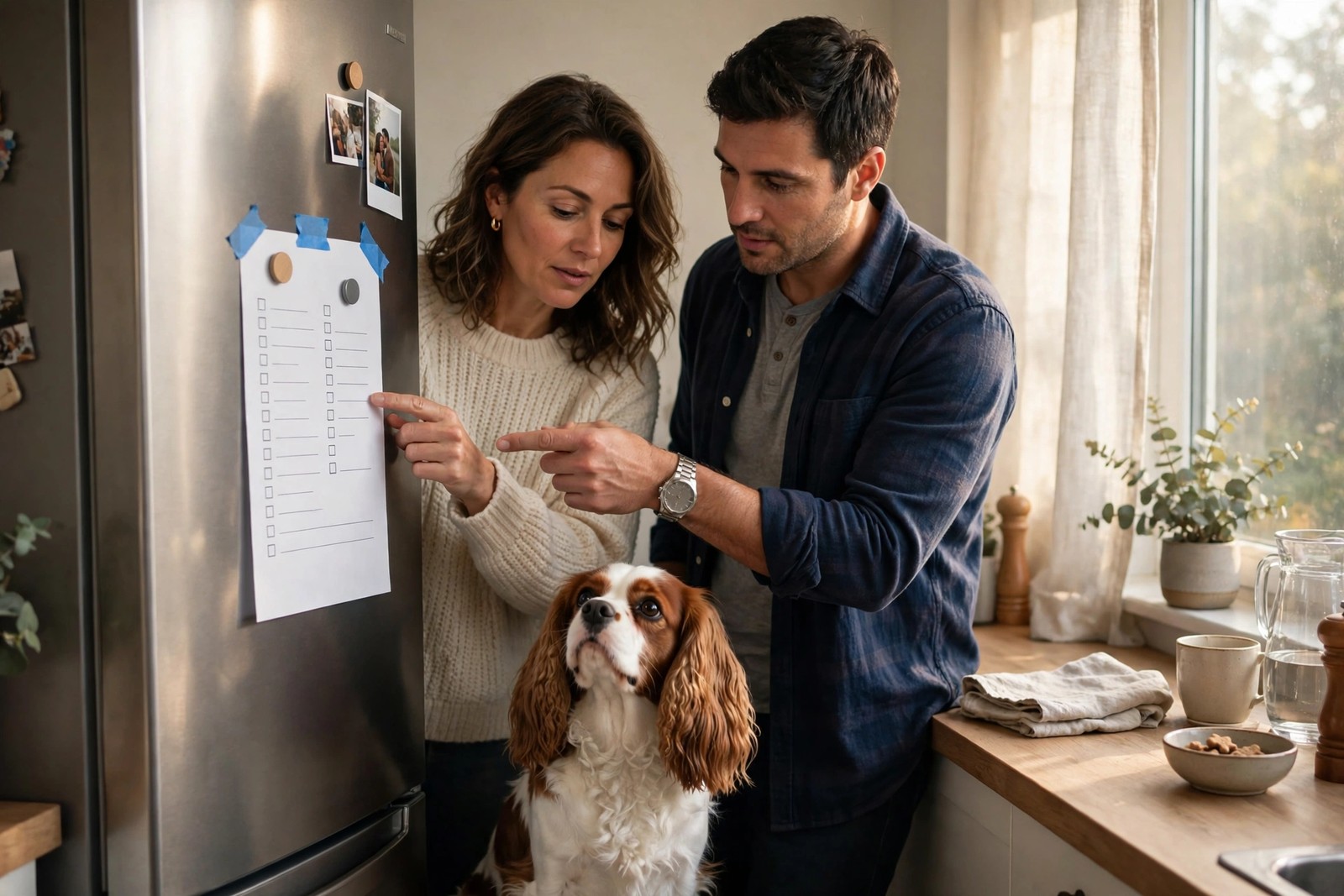
Most arguments about dog care are not really about the dog. They are about one partner carrying the invisible load — remembering the flea treatment date, noticing the food is running low, booking the vet — while the other does the visible walks and assumes things are even. Fairness starts with making the whole job visible.
List Everything, Including the Invisible Jobs
Sit down once and write out the full workload for a month. The obvious items are walks, feeds, toilet breaks, training, grooming, and cleaning up. The ones that usually sit with one person are the planning jobs: ordering food before it runs out, keeping vaccinations and parasite treatment on schedule, arranging cover for late meetings, washing bedding, booking grooming and vet appointments, and being the one who gets up when the dog is restless at night. Put rough times beside each job. A daily 6 a.m. walk before a commute is a heavier lift than a weekend afternoon stroll, and a fair split weighs effort and timing, not just task counts.
Divide by Strengths and Schedules, Then Write It Down
Splitting every single task 50/50 usually makes life worse — two people half-remembering alternate feeds is how a dog gets fed twice. Instead, own whole jobs or whole shifts. A common pattern that works: one partner owns weekday mornings — first toilet break, breakfast, morning walk — and the other owns evenings — dinner, evening walk, last toilet break before bed. Weekends, long walks, baths, and admin get divided by who genuinely minds them least. Plenty of couples find one person loves training classes and the other is happy being the vet-trip driver; play to that rather than enforcing identical duties.
Then make the agreement physical, not verbal: a shared rota on the fridge or in an app, with named owners for each recurring job and a simple 'done' mark. Include a handover rule for exceptions — if the morning person is ill or travelling, the swap gets agreed out loud and written down, not assumed. Dogs thrive on the consistency this creates, too: same cue words, same feeding spots, same rules about sofas and treats from both of you.
Review It Like a Rota, Not a Scorecard
Revisit the split monthly for the first few months, and whenever life changes — a new job, a puppy stage ending, an older dog needing medication at set times. Ask two questions: is anything being missed, and does either of us resent anything on our list? Resentment is the early-warning sign; swap a hated job early rather than letting it curdle. Keep one shared note of the dog's baselines — weight, appetite, normal energy, medication dates — so either partner can spot a change and brief a vet without the other present.
The aim is that either of you could run the dog's whole week alone from the written system, and neither of you has to. Assigning each duty to a named person in KinsLe's Care Teams, where a completed task is timestamped, turns that rota into a shared record — the question of who fed the dog stops being a debate and becomes a fact you can both check.