
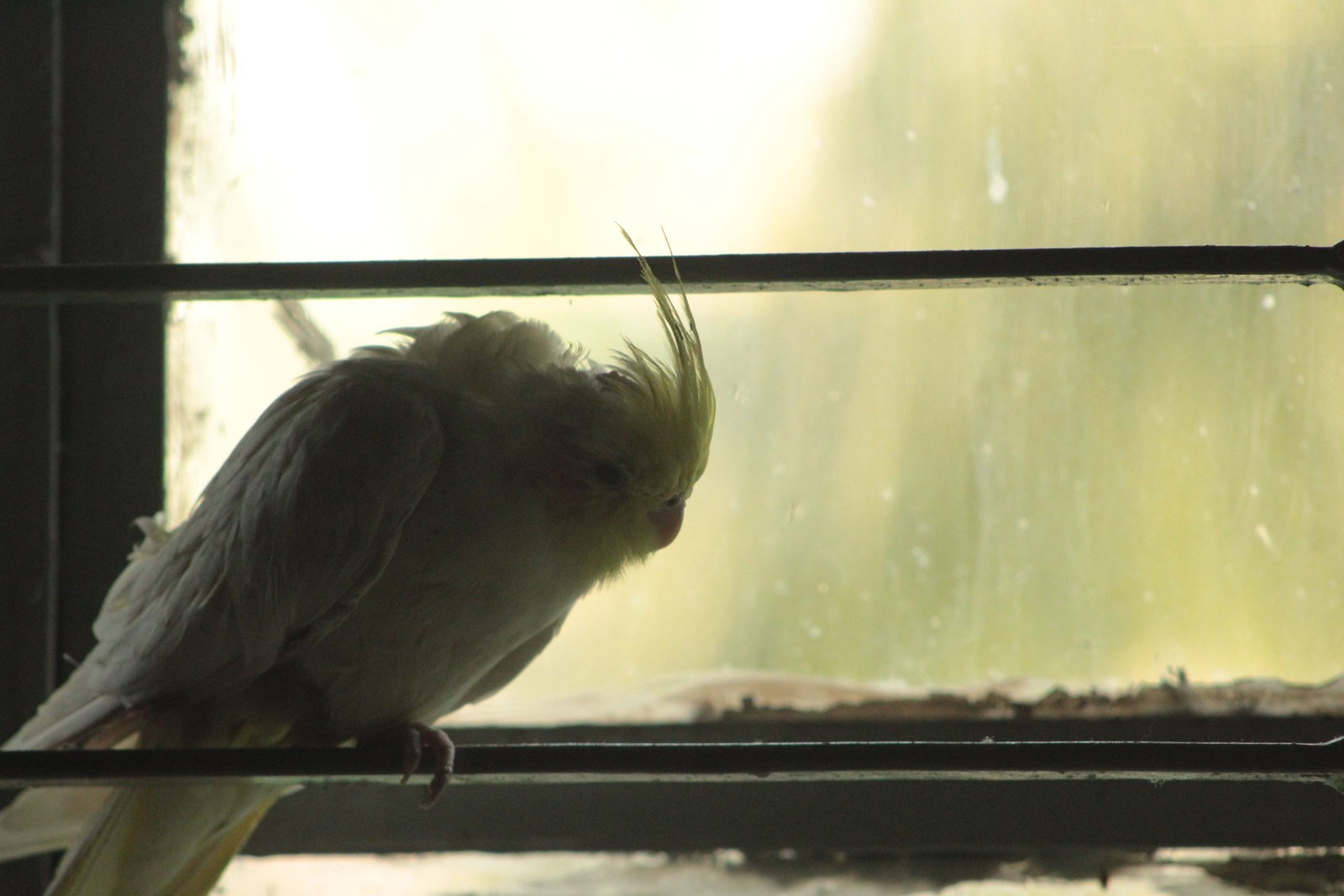
Glass means nothing to a bird: a window reads as open sky and a mirror as another room holding another bird, so panes need to be made visible whenever your cockatiel is out of its cage. Draw the curtains or blinds shut, or break up the reflection with decals and patterns, and introduce your cockatiel to any new room slowly, with supervision, until the room's layout is familiar to it.
Why Cockatiels Fly at Glass
A cockatiel navigates by what it sees, and glass defeats that system twice over. A clear window shows the trees and sky beyond it, so the bird flies toward what looks like the outdoors. A mirror shows a convincing "other cockatiel" in a convincing space, and a social bird flies to join it — or a territorial one flies at the rival.
Speed makes it worse. A startled cockatiel can cross a room in a second, crest raised and wings at full power, with no time to correct. Impacts range from a stunned bird that recovers in minutes to broken beaks, head injuries, and worse. Young birds and birds new to a home are at highest risk because they have not yet mapped the invisible walls.
Make Glass Visible
You have several good tools — use more than one:
- Close curtains or blinds during flight time. Sheer curtains still soften and signal the barrier while keeping the room bright.
- Add window decals, clings, or tape patterns on large panes and sliding doors. Space them a few inches apart across the glass; a single sticker in the middle leaves plenty of "open sky" around it.
- Use soap streaks or washable markers as a quick temporary fix in a new space — vertical lines work well and wash off later.
- Cover mirrors with a sheet or towel during early flight sessions, or angle them so they do not reflect an open flight path.
Keep the treatment in place until your bird demonstrably treats the glass as a wall — landing on the sill, turning before the pane — not just for the first day.
Teach the Room, Gradually
Introduce a new room like a lesson, not a launch. Start with your cockatiel on your hand or a stand near one wall and let it look around. Short, calm flights between two familiar perches teach the room's real dimensions. Some owners gently carry a calm bird near (not into) windows and tap the glass so the bird hears and sees the barrier — done slowly, without chasing, this can help a bird learn that the view has a surface.
Supervise every early flight in a new space. Rearranging furniture, moving house, or even opening a usually-closed set of curtains changes the map, so treat major changes as a mini reintroduction.
If Your Cockatiel Hits a Window
Catch your breath and act gently: pick the bird up carefully, place it in a small, dark, quiet carrier or its cage with perches lowered, and watch closely. A bird that is limp, bleeding, unable to stand, breathing hard, or not returning to normal quickly needs an avian veterinarian immediately. Even a bird that shakes it off deserves monitoring for the rest of the day, and a vet call for advice is never wasted after a hard impact. Do not offer food or water to a dazed bird until it is fully alert.
One Routine for the Whole Household
Glass safety fails when one person opens the blinds for the plants five minutes before flight time. Agree on a simple household routine — blinds position, mirror cover, door closed — and stick to it.
Before the cage door opens, run that household check — blinds down, mirror covered, door shut — as a habit the household keeps for itself, agreed in plain words rather than left to scattered reminders.
Access to its profile can be handed to chosen relatives through KinsLe Family Sharing.