Fence-fighting looks dramatic because the fence guarantees it never resolves. Both dogs charge, bark, race the boundary and retreat unhurt, so each dog leaves believing the display worked, and the next performance starts faster. With a long shared boundary the rehearsal can run dozens of times a day, and rehearsed arousal strengthens exactly like rehearsed obedience. Your plan has to cut the rehearsals, change what your dog can see, and then teach a calmer response at a distance your dog can handle.
Cut the Rehearsal Today
Supervise every garden visit while you retrain, and bring your dog in at the first hard stare or stiffening, before the charge begins. Recall early and pay with something your dog genuinely values, then add a game or a sniffing scatter indoors or away from the boundary so coming away wins rather than loses. Unsupervised garden access during retraining undoes morning practice by afternoon, because one full fence battle rehearses the old habit more strongly than ten calm recalls rehearse the new one.
Talk to your neighbour early and kindly; most are tired of the noise too. Agree staggered garden times for a few weeks, morning for one dog, midday swaps, evenings shared by arrangement, and share a phone signal or knock so releases are not accidental. Two households cooperating calmly solve more fence problems than any single training exercise.
Change What the Dogs Can See
Face-to-face contact through wire, slats or chain link is the fuel. Fit solid screening on your side of the boundary, reed or fabric screening secured tightly, wooden panels, or dense planting where rules allow it, so the dogs can hear but not spar visually. Screening flapping loose or full of gaps at dog height will not work, so check it from your dog's eye level, including the gate area and any raised deck or steps your dog uses as a viewing platform.
The stronger option for a long boundary is a second, inexpensive fence line set a short distance inside your own garden, creating a buffer strip neither dog can reach. Even a modest gap breaks the nose-to-nose confrontation, and the strip can become a planted border. Inspect the boundary weekly for digging, loose boards and worn ground at the fence line, and check paws and mouths after any incident, because dogs injure teeth, nails and pads on fencing while appearing unhurt.
Retrain Calm at the Boundary
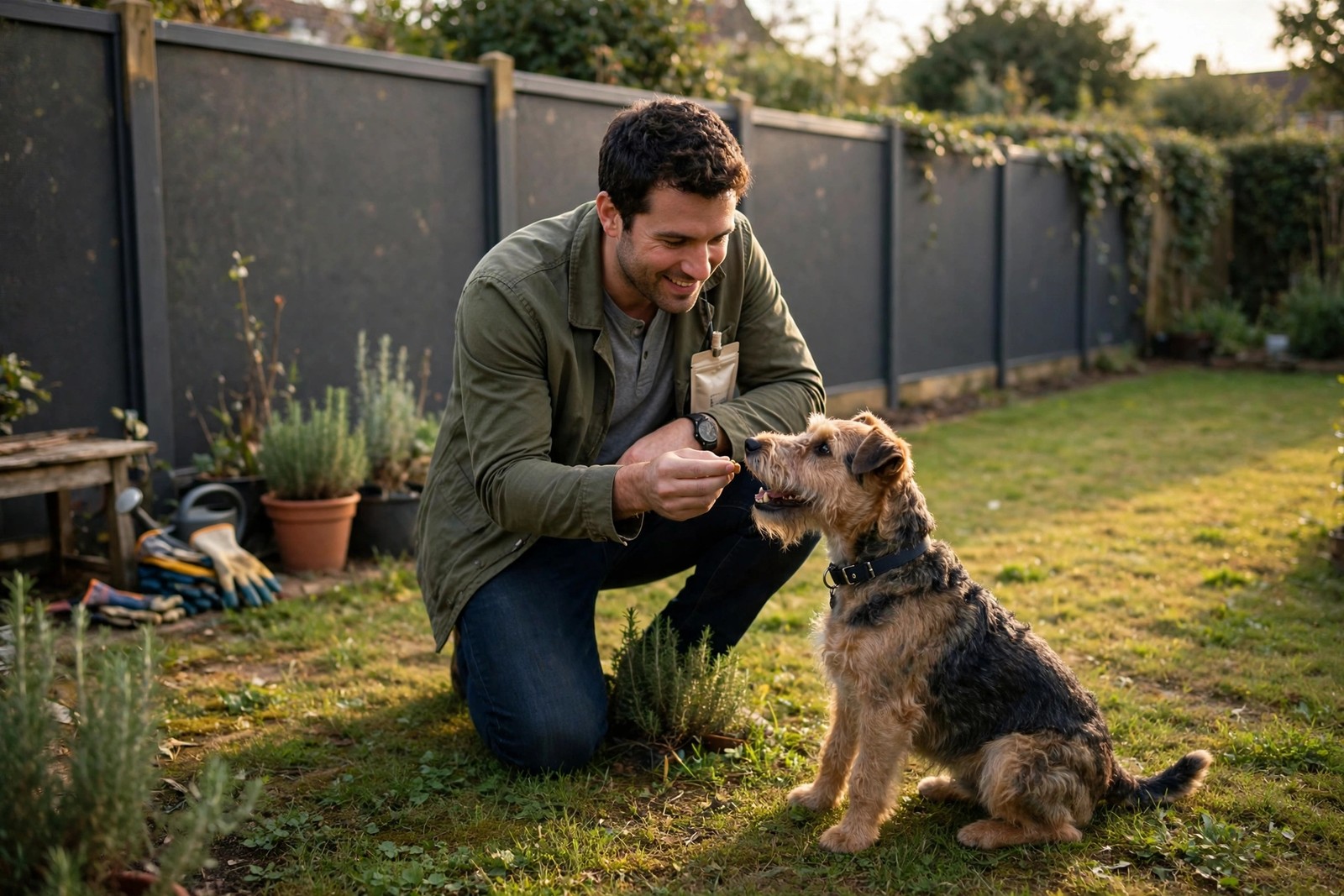
Once management is in place, practise in short staged sessions. Start at the far end of the garden with your dog on a long line: let your dog notice sounds or movement at the fence, mark and reward looking back to you, and work gradually closer over days, only while your dog can still take food and respond to its name. Practise a recall away from the fence as a game in itself, with a jackpot reward and a release back to play, so turning away predicts good things rather than the end of fun.
If both owners agree and it can be done safely, parallel walks on neutral ground, starting at a distance and closing slowly over several outings, often defuse the relationship itself, because the dogs finally meet without a barrier to frustrate them. Never let the dogs meet nose to nose at the fence or gate as a test, and involve a qualified behaviourist if there is genuine intent to bite, redirection onto people, or arousal your dog cannot come down from. In KinsLe, Care Teams keeps the staggered times, screening checks and practice sessions assigned and timestamped, so the plan survives different family members letting the dog out.