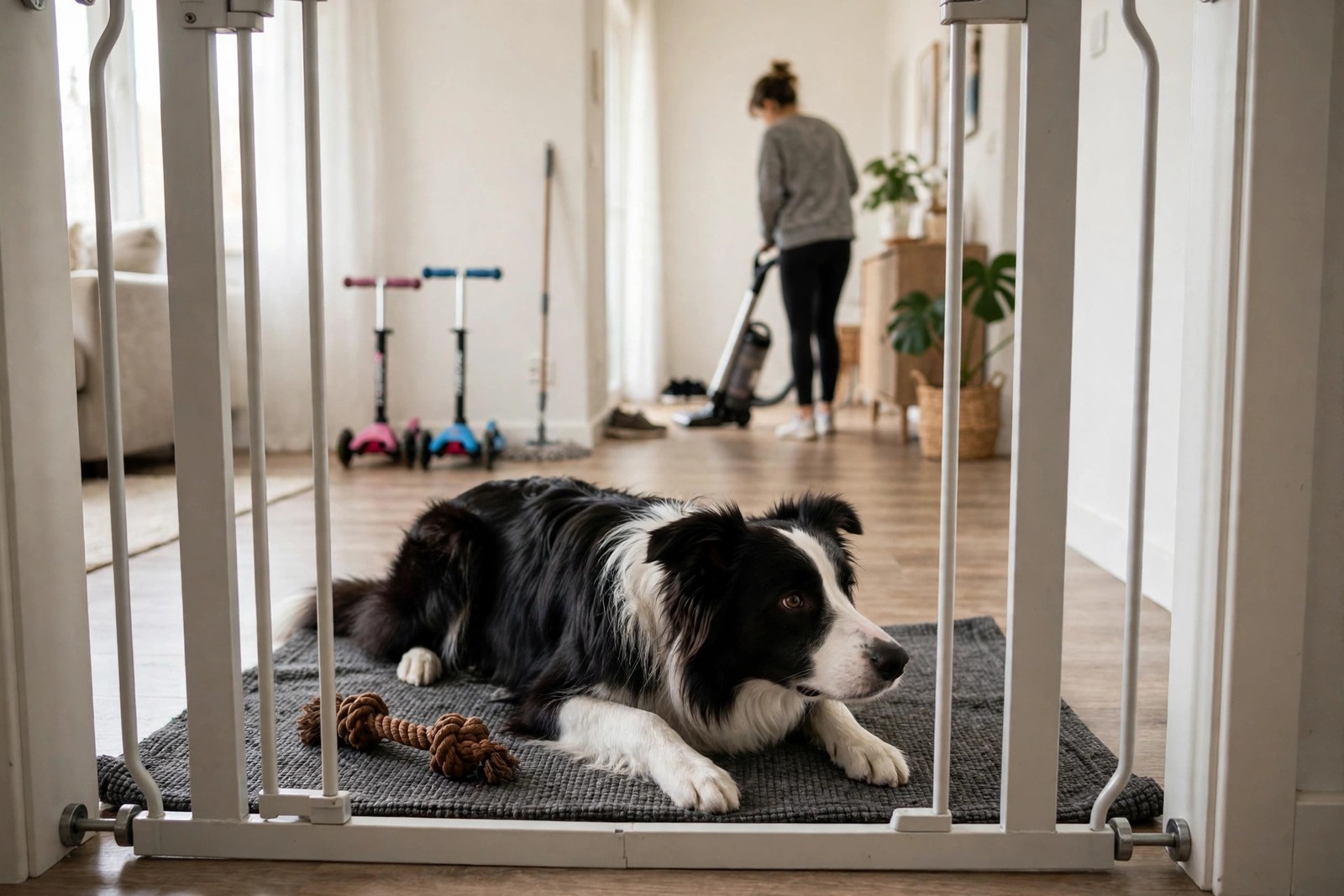
Herding breeds, and plenty of mixed breeds with herding ancestry, run a built-in sequence: eye the moving thing, stalk it, chase it, then grip or nip to turn it. A vacuum cleaner, a mop and a child's scooter trigger every step of that sequence inside your house, and each successful chase rehearses it. You will not train the instinct away, and you do not need to. You need housework to stop being rehearsal, a place behaviour strong enough to hold during movement, and games where the full sequence is allowed under your cues.
Separate the Dog From Housework First
While you build skills, clean with the dog settled elsewhere: behind a baby gate, in another room, or on a mat with a long-lasting chew and a clear boundary. This is not avoiding the problem; it is preventing daily practice of the exact behaviour you want to retire. Vacuum in shorter bursts if that helps, keep the mop bucket and scooter storage out of the dog's resting area, and ask children to park scooters before coming through the dog's space rather than riding past at ankle height.
Families often find the dog is worst at the start of cleaning, when the vacuum first appears and starts moving. Settle the dog before the appliance comes out, not after the first lunge, because a dog already chasing is past the point where a place cue can land.
Teach Place Against Movement, in Layers
Train this away from real housework first. Build a place behaviour on a mat: dog goes to the mat, lies down, and is paid repeatedly for staying while you stand, then while you take a step, then while you walk around the room. Mark and reward calm watching, and release the dog with a clear cue before restlessness builds, keeping early sessions under a couple of minutes.
Add movement in layers over days. Drag a broom slowly across the far side of the room while the dog holds place and is paid generously. Then use an unplugged, still vacuum that you rock slightly, then the vacuum moving while switched off, and only later the vacuum running at the far end of the room. If the dog leaves the mat, say nothing dramatic; calmly reset, make the next step easier, and end sooner. A dog who can watch a moving broom from a mat has learned the actual skill housework needs: movement happens, my job is here.
Give the Sequence a Legal Job
Herding energy spent nowhere becomes herding aimed at everything. Flirt-pole games let a dog chase and catch under rules: the toy starts on your cue, stops dead when you ask, and the dog trades the catch for the next round, which teaches impulse control inside the chase itself. Large-ball control games, where the dog pushes and steers a big sturdy ball around you or toward a goal, echo sheep work more closely and satisfy many collies and shepherd types. Short, frequent training games that use eye contact, waits and direction changes also drain the same mental battery.
Protect the scooter rule absolutely: children riding are never a training prop. If your dog fixates on scooters outdoors, practise place and look-at-me at a distance from a quiet path first, and involve a behaviourist promptly if there is any nipping at heels, clothing or skin, because that is the point where a household problem becomes a safety problem. In KinsLe, Care Teams keeps the housework setup, the place-training stage reached and the scooter rule in one shared plan, so a partner or teenager cleaning up does not accidentally restart the game.