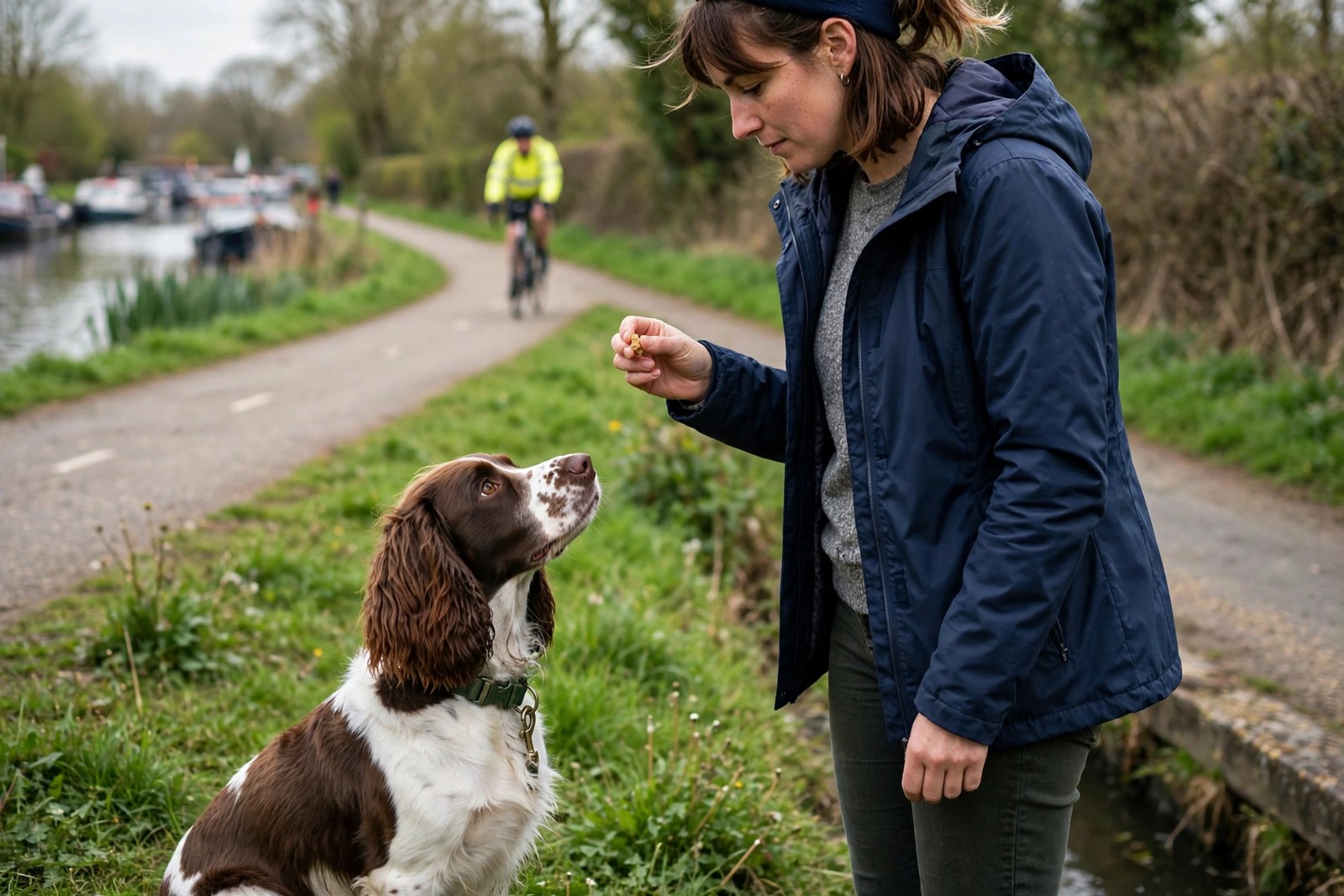
A towpath is a hard classroom: it is narrow, cyclists approach fast and quietly from behind, and there is often water on one side and a hedge on the other, so your dog cannot create distance. Lunging there is usually a mix of chase instinct, surprise and frustration at being held back by the lead. The fix is distance-based practice that starts far below the point of lunging, plus towpath habits that stop close passes ambushing your dog while the new response is still fragile.
Find the Distance Where Your Dog Can Think
Every reactive dog has a thinking distance: far enough from a cyclist that your dog notices, ears up, but can still look at you, take food and respond to its name. Start there, even if it means practising in a wide field, a quiet car park edge or a broad verge rather than on the towpath itself. Use the engage and disengage pattern: let your dog look at the cyclist, mark the look, and pay when your dog turns back to you. If your dog will not take food or cannot look away, you are too close; add distance without scolding and try again.
Keep the lead loose during this work. A tight lead adds physical pressure exactly when a cyclist appears, and many dogs learn that cyclists predict being hauled back, which feeds the frustration you are trying to avoid. Practise U-turns as a cheerful game away from bikes, so stepping off and turning away becomes a normal, rewarded move rather than a panic response.
Build the Bicycle Picture in Stages
Stage one is a still bicycle: walked past at a distance, leant against a fence, wheeled slowly by a helper. Stage two is a helper riding large, slow circles in an open space while you work at your dog's thinking distance. Stage three is a single real cyclist on a wide path. Only then return to the towpath, choosing quiet times, wide sections and passing places, and stepping off early for every pass while your dog practises a hand touch or a settled sit facing you, with a treat after the cyclist has gone.
Reward calm watching as heavily as you reward looking away; a dog allowed to watch a cyclist pass, then check in, is learning that bikes are background, not a problem to solve. End sessions while things are going well, after a handful of successful passes, rather than drilling until one goes wrong.
Handle Towpath Life Honestly
While training is underway, protect it. Walk the towpath at quieter hours, avoid the narrowest stretches and blind bends where a close pass is unavoidable, keep your dog on the side away from the traffic line, and use a well-fitted harness so a sudden lunge does not land on your dog's neck. Never punish the lunge with lead jerks or shouting; punishment beside the trigger teaches the dog that cyclists also predict trouble from you.
Progress looks like this: your dog spots a cyclist, glances at you before you speak, and can take a treat with a soft mouth as the bike passes. If lunging is intense, your dog cannot eat near bicycles at any workable distance, or there has been any contact with a rider, work with a qualified behaviourist on a graded plan rather than escalating towpath exposure on your own. In KinsLe, Care Teams keeps the current training stage, the safe routes and the step-off rule in one shared plan, so a family member walking a different shift does not undo your distance work with one tight towpath pass.