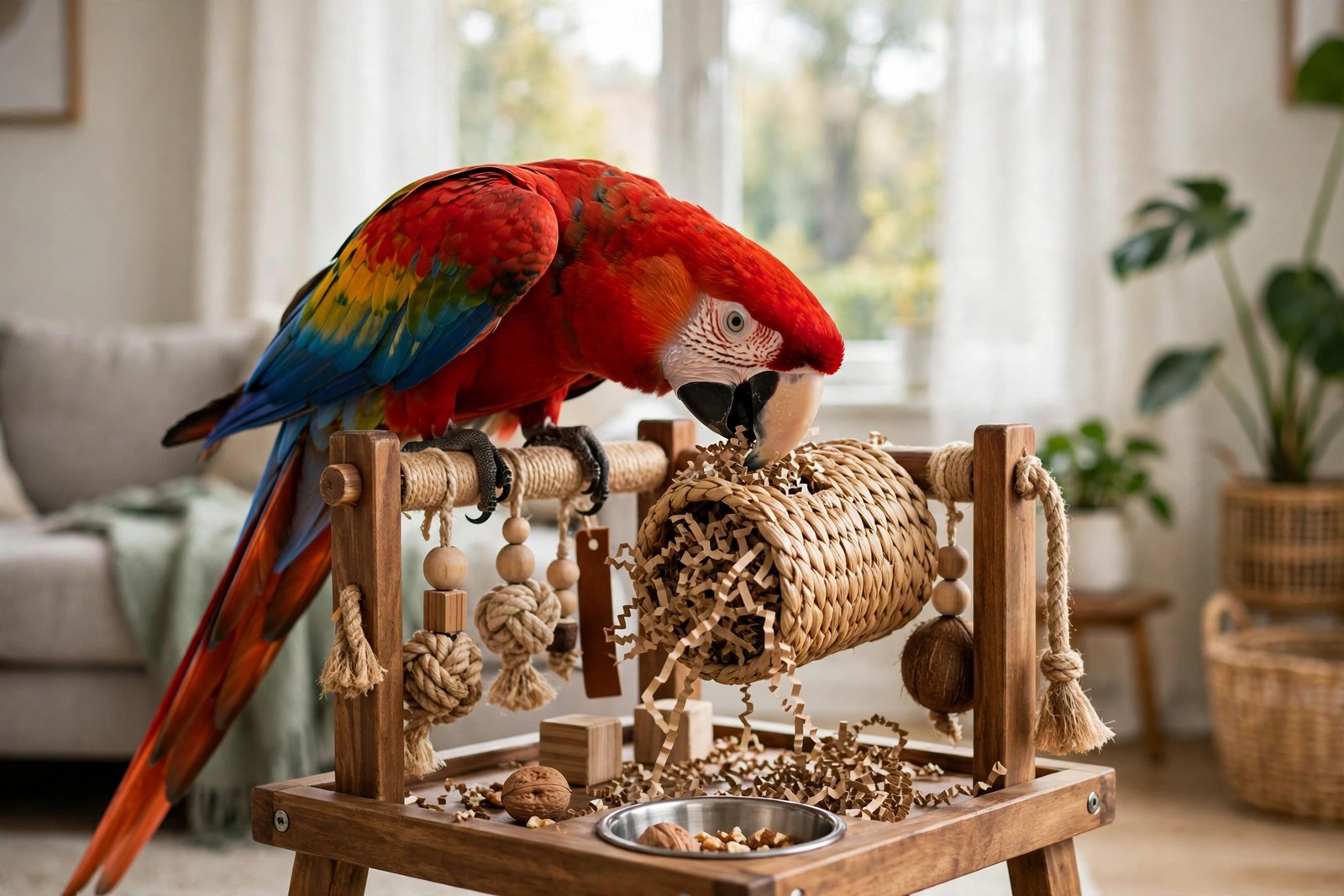
A macaw's voice is built to carry across a forest canopy, and in a living room it is genuinely startling. The goal is not a quiet bird — that bird does not exist — but a bird whose loud moments are the normal, brief ones, rather than long screaming sessions aimed at you.
Know Which Screaming Is Normal
Wild macaws call loudly to their flock at dawn and again towards dusk, and a pet macaw does the same whether you like it or not. A few minutes of exuberant calling at those times, and contact calls when you leave or enter the house, are flock behaviour, not a problem to train away. The problem pattern is different: sustained, repetitive screaming that starts when you leave the room, when you are on the phone, or when the bird wants out, food, or attention — and stops the moment it gets them. That screaming has an audience and a reward, which means it can be changed.
Sudden changes matter too. A normally settled bird that starts screaming far more, or screaming with fluffed posture, reduced appetite, or altered droppings, should see an avian vet, because pain and illness often present as vocal change in parrots.
Remove the Payoff, Reward the Quiet
Screaming is almost always reinforced by attention — and to a macaw, being shouted at is still attention, delivered at flock volume. Every person in the house has to follow the same rule: while the bird screams, nobody looks, speaks, approaches, or offers food. The moment there is a pause — even a few seconds of quiet or a softer call — that is when you appear, praise, and reward. You are teaching a simple exchange: quiet voices get the flock, screaming gets an empty room.
For contact calls specifically, answer from where you are with a soft whistle or a calm word. The bird is asking 'are you there?' and a quiet reply that confirms the flock is near often ends the exchange before it escalates. What does not work is rushing in to reassure at full scream — that confirms screaming is the correct volume for summoning you.
Fix the Day Around the Bird
Unmet needs scream loudest. Protect 10 to 12 hours of uninterrupted dark, quiet sleep — a sleep cage in a quiet room helps many macaws — because a chronically tired parrot is a loud, irritable one. Make the bird work for food: foraging toys, food wrapped or hidden in shredded paper, and meals scattered through destructible toys can occupy the beak and brain that would otherwise be calling. Rotate toys before boredom sets in, schedule predictable out-of-cage and one-to-one time so the bird is not competing for an unpredictable resource, and avoid inadvertently scheduling your attention only after noise — visit the bird during quiet spells throughout the day, on your initiative.
Expect an extinction burst: when screaming stops working, most birds scream louder and longer for a few days before giving up the strategy. That burst is the plan working, and giving in during it teaches the bird that persistence at higher volume is the answer.
Write the household rules down — who ignores, what counts as rewardable quiet, sleep and foraging times — and assign the daily enrichment and sleep-cage duties in KinsLe's Care Teams, so every family member responds to the macaw identically and each completed routine is timestamped.