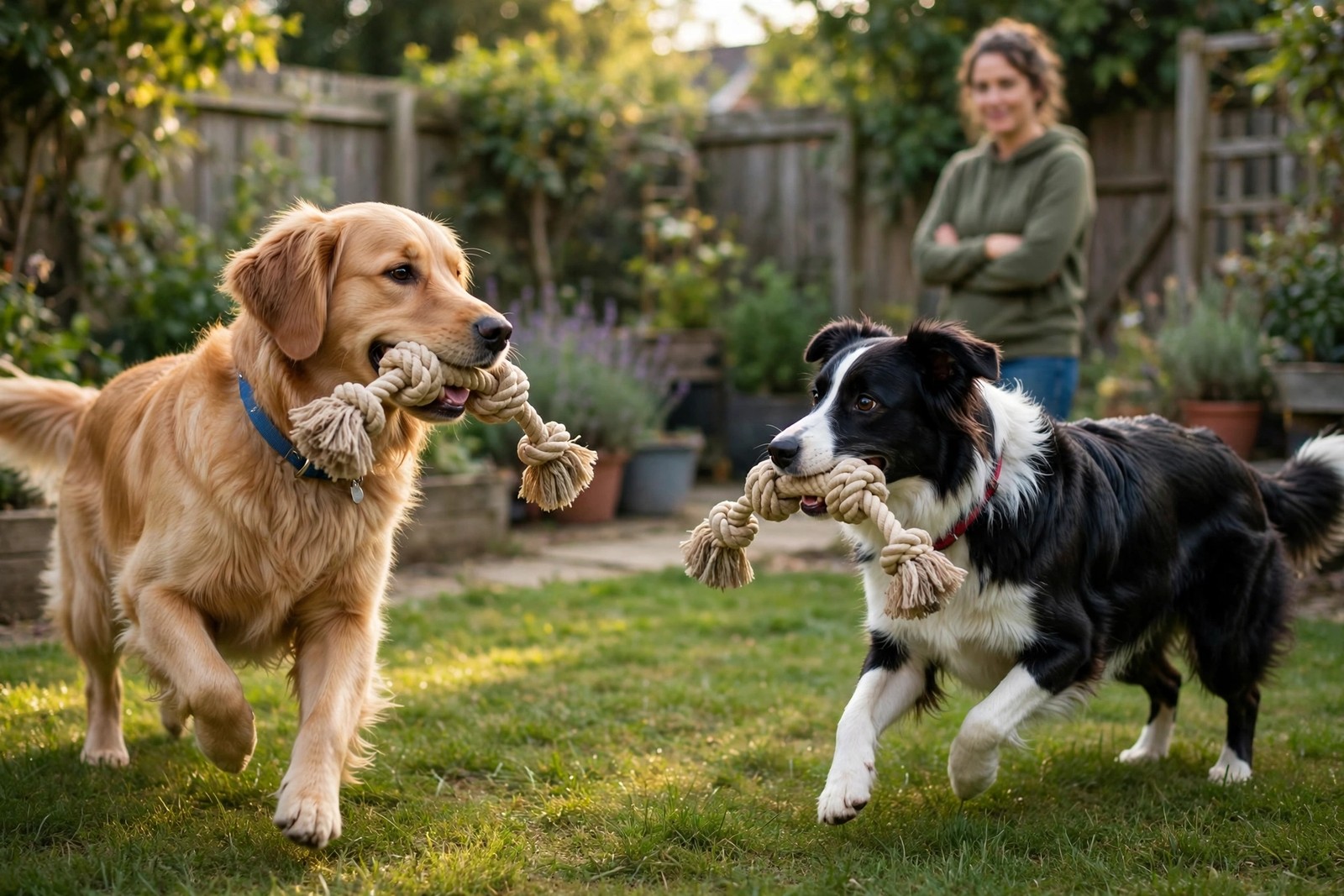
Two dogs arguing over toys are rarely being spiteful; they are doing normal dog maths about a resource that suddenly seems scarce and worth defending. Fights need three ingredients — a valued item, close quarters and a moment nobody interrupts — and good management removes all three while training teaches each dog that another dog near a toy predicts good things, not loss.
Read Guarding Before It Becomes a Fight
Squabbles announce themselves quietly. Watch for a dog going still over a toy, hunching or hovering above it, giving a hard sideways stare, eating or chewing faster as the other approaches, or a low growl that owners too often scold away. The growl is the smoke alarm: punishing it does not remove the fire, it just removes the warning before a bite. Earlier and softer signals — turning the body to block, carrying the toy away, a sharp look — are your cue to intervene while intervention is still just a cheerful voice and a redirection. Learn which dog guards, which items ignite it, and which dog pesters; the pushy one needs managing as much as the guarder.
Set Up Toy Play So There Is Nothing Worth Fighting Over
Keep high-value toys — the one ball, the squeaky favourite, anything new — picked up between games rather than scattered on the floor all day. When toys come out, offer duplicates: two of the same ball, two tug ropes, so choosing the same item is never forced. Play in open space where a dog can move away, and supervise actively, stepping in with a happy recall or a thrown treat the moment body language tightens, then ending that round. Short, ended-on-a-high games teach more than one long session left to boil. If one dog reliably steals and the other reliably objects, play with them one at a time and let group play be about chasing and wrestling without objects at all.
Teach Trading Up, One Dog at a Time
Trading is trained solo, never rehearsed in the heat of a pair game. With one dog, offer a dull toy, then trade it for a favourite treat or a better toy, and give the original back as often as you can — the lesson is that a human approaching a toy makes life better and usually returns it anyway. Build up to trading genuinely prized items, then practise the same skill with the other dog present at a distance, behind a gate at first. Separately, teach both dogs a reliable settle on their own mats or beds, paid generously, so you have somewhere to send each dog when play needs a breather.
Chews and Food Toys Never Happen Loose Together
However well toy play is going, long-lasting chews, bones and food-stuffed toys belong behind a barrier: separate rooms, crates used happily, or a baby gate between them. These items last long enough for arousal and guarding to build, and a finished dog wandering over to a still-chewing one is the classic setup for a serious fight. Pick up leftovers before the dogs are back together. Any fight that draws blood, guarding that spreads to people, resting places or empty floor space, or a dog who cannot relax around the other at all needs a qualified behaviourist involved promptly — that is beyond household management. Rules only protect the dogs if every person follows them on every occasion, and KinsLe's Family Sharing helps by letting you share each dog's guarding triggers, the duplicate-toy rule and the separated-chew rule with family and sitters, so the system holds even when you are not the one handing out toys.