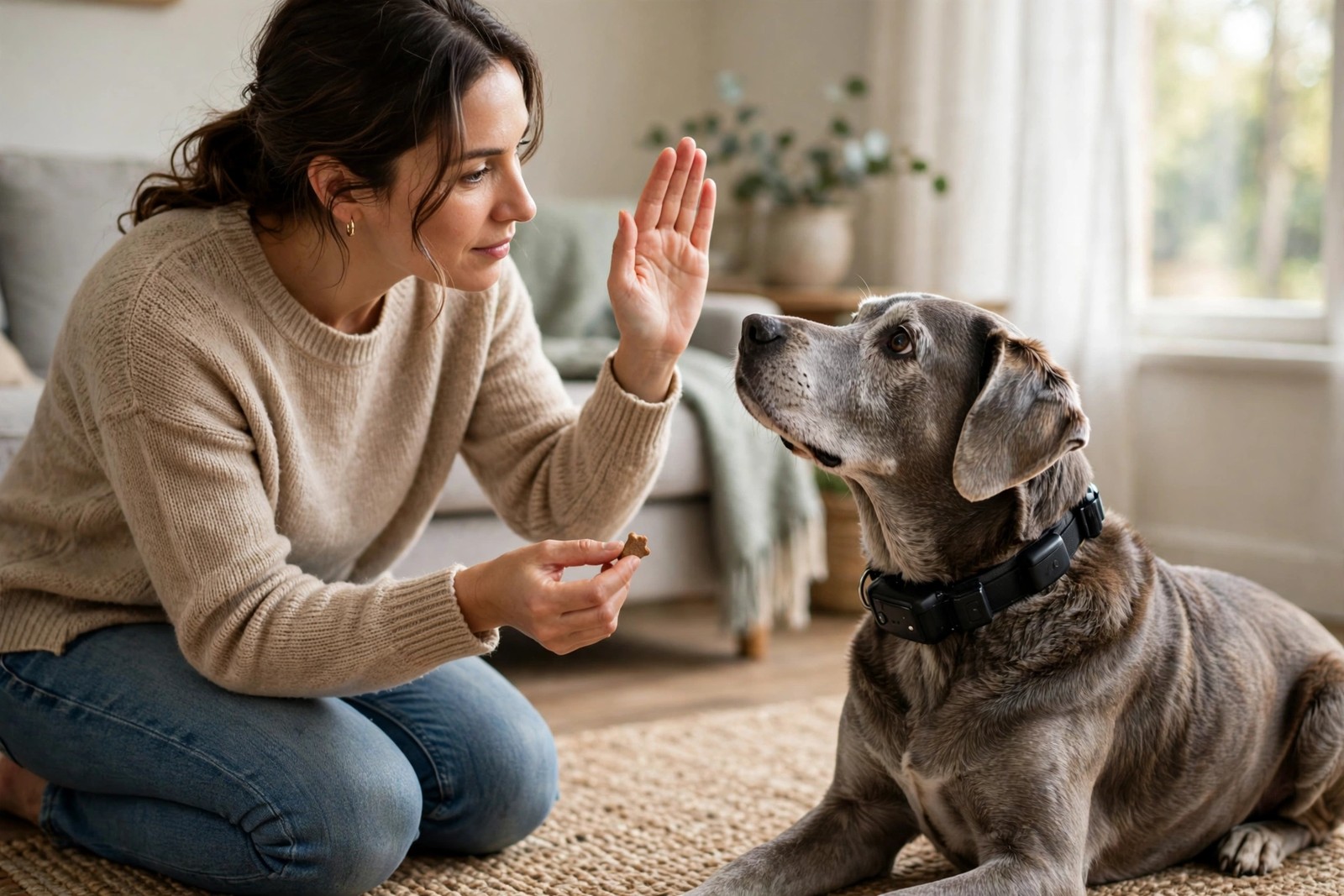
For a dog who has lost her hearing, a vibration cue can replace the recall word she can no longer hear, but only if the sensation itself becomes good news. A senior dog startled by an unexpected buzz learns to dread the collar, and a deaf dog who starts avoiding her collar or flinching at touch has lost more communication than she gained. The method below is deliberately slow: the vibration is introduced at its gentlest, paired again and again with food and affection, and only used at a distance once your dog treats it the way hearing dogs treat a whistle blown for dinner.
Choose and Fit the Collar Carefully
Use a vibration-only collar with adjustable intensity, and set it to the lowest level before the first session. This training uses vibration only, never any shock function, and many owners prefer a unit with no such function so no mistake is possible. Fit the collar snugly enough that the contact sits against the neck without pressure, roughly two fingers of slack, and put it on for short, pleasant periods at first, walks, meals, sofa time, so the collar itself predicts ordinary good life rather than only training. Check the skin under the contact daily, as senior skin is thinner, and take the collar off overnight.
Have your veterinarian confirm the hearing loss and check her ears and general health before you begin, because pain, infection or other senior problems change both her responsiveness and what is fair to ask of her.
Pair the Vibration With Good News
Begin indoors with your dog relaxed near you. Trigger one brief pulse, about a second, and the instant it ends, offer a genuinely favourite treat, soft cheese, chicken, or whatever she loves most, with eye contact and a smile she can see. Repeat five to eight times in a session, two or three sessions a day, and then take the collar off and do something else pleasant. Most dogs need several days at this stage. You are ready to move on when the pulse makes her look up at you expectantly, ears and body soft, before the treat appears.
Then build the meaning: pulse means look at me. When she turns, mark it with a clear visual signal, a thumbs-up or an open flashing hand, and pay. Practise at a few steps' distance indoors, then across the room, always while she is awake and settled; never pulse a sleeping deaf dog to test the cue, because waking to a vibration with no context is exactly the startle you are working to avoid. Approach and wake her gently by touch or by letting her catch your scent instead.
Take It Outdoors With a Safety Net
Move to the garden on a long line once indoor responses are cheerful and reliable. Pulse, wait for the look, mark with the hand signal, reward, and let her return to sniffing, so the cue stays cheap to answer. Add your visual recall, a wide arm wave or both arms raised, as the main signal, with the vibration used to get her attention when she is facing away. Build distance gradually over weeks, and keep her on a lead or long line anywhere near roads, water or livestock permanently, because no cue, however well taught, substitutes for physical safety with a dog who cannot hear traffic or your warning shout.
If she flinches, licks her lips, moves away from the collar or stops taking treats, the intensity, the timing or the pace is wrong: drop back a stage, use the gentlest setting, and shorten sessions. A behaviourist can help if worry persists. In KinsLe, Care Teams keeps her cue stage, her hand signals and her collar-fit checks in one shared plan, so every family member uses the vibration in the same kind way and notes progress with a timestamp.