
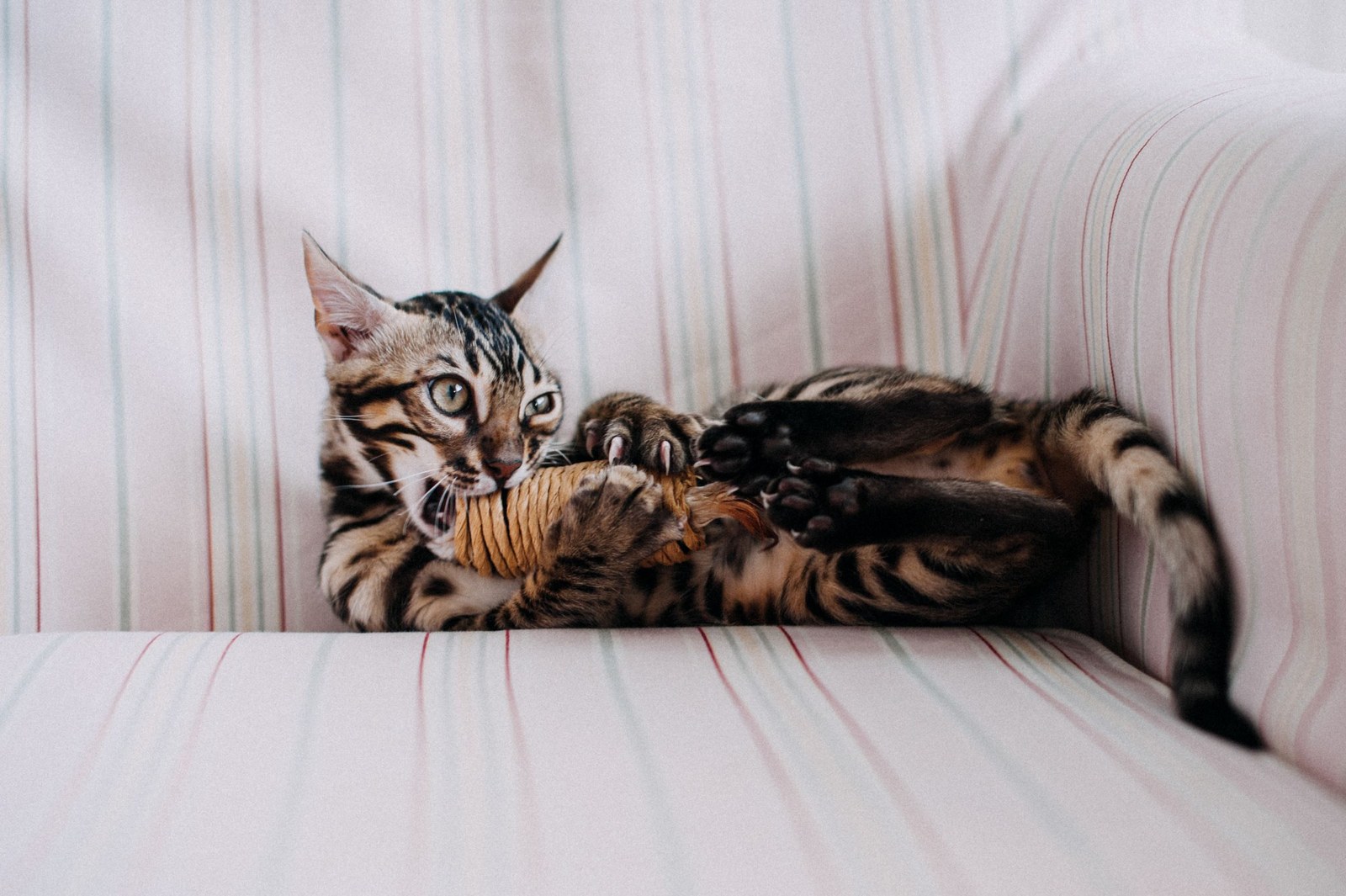
You teach gentle play by controlling the three things that decide how rough a session gets: what your cat is allowed to grab (toys, never hands), how long play lasts (stop before excitement boils over), and how every session ends (with a satisfying catch, not frantic overstimulation). Cats who learn those patterns early rarely progress to the biting and scratching that owners worry about.
Start With Toys, Not Body Parts
Hands, feet under blankets, and dangling hair all blur the line between person and prey. From the first session, put a toy between you and your cat every time. Wand toys are ideal because they keep claws and teeth a full arm's length away while still letting her chase, leap, and wrestle something.
Choose toys that invite a full-bodied catch — a plush bird on a string, a kicker stick she can hug and rake with her back feet, or a mouse she can pin. If she accidentally connects with your skin, go still, end the game for half a minute, and restart with the toy. The lesson is simple and never frightening: skin stops the fun, toys keep it going.
Learn Her Overstimulation Signals
Most 'sudden' bites during play are not sudden at all. Cats broadcast that they are nearing their limit:
- Tail lashing side to side or thumping the floor, after earlier happy tail-up play
- Ears rotating sideways or flattening, whiskers pushed forward, pupils suddenly wide
- Skin rippling along the back, body going tense, or play shifting from the toy to staring at your hand
- Bunny-kicking harder, vocalizing, or grabbing with claws out instead of soft paws
When you see those signs, freeze the toy and let her settle, or end the session entirely on a calm note. Stopping early is not losing — it is the training. Over weeks, you will also learn her personal threshold: some cats are good for 15 relaxed minutes, others are done at five.
Keep Sessions Short and End With a Catch
Frequent short sessions teach control better than one wild half-hour. Try five to ten minutes, two or three times a day, and always engineer a finale where she catches and 'wins' the toy. A cat who never catches anything gets frustrated, and frustrated cats redirect onto whatever moves — often you.
Follow the catch with a small snack or meal to close the hunt-eat-groom-sleep loop. If she tends to get rough when she is hungry, schedule play before meals rather than long after them.
Gentle Play for Kittens and Adults
Kittens need the rules from day one, because they are learning bite pressure in real time. Redirect every mouth-on-skin moment to a toy and never wrestle back, even in fun. Adult cats with an established rough style need patience rather than punishment: shorten sessions, increase distance toys, and reward soft-paw play with longer games and treats. An older cat who has newly become rough when touched or during play should see a veterinarian, since pain commonly hides behind irritability.
Never use spray bottles, shouting, or rough handling to correct play that got too intense. Fear does not teach gentleness; it teaches a cat that people near her when she is excited are unsafe, which produces worse biting later.
Share Her Play Cues With a Sitter Through KinsLe
Your cat's signals are individual — what calms her, what winds her up, when to stop — and a sitter should not have to guess them. With a Care Pass on KinsLe, you can share those play cues and care notes through a temporary, scoped link; the recipient needs no account and no app to view it, so a weekend sitter gets her limits in writing before the first wand toy comes out. Before a weekend away, give your regular sitter access through the Care Pass on KinsLe for the weekend only, limited to your cat's play signals and stopping cues, so gentle play survives your absence.