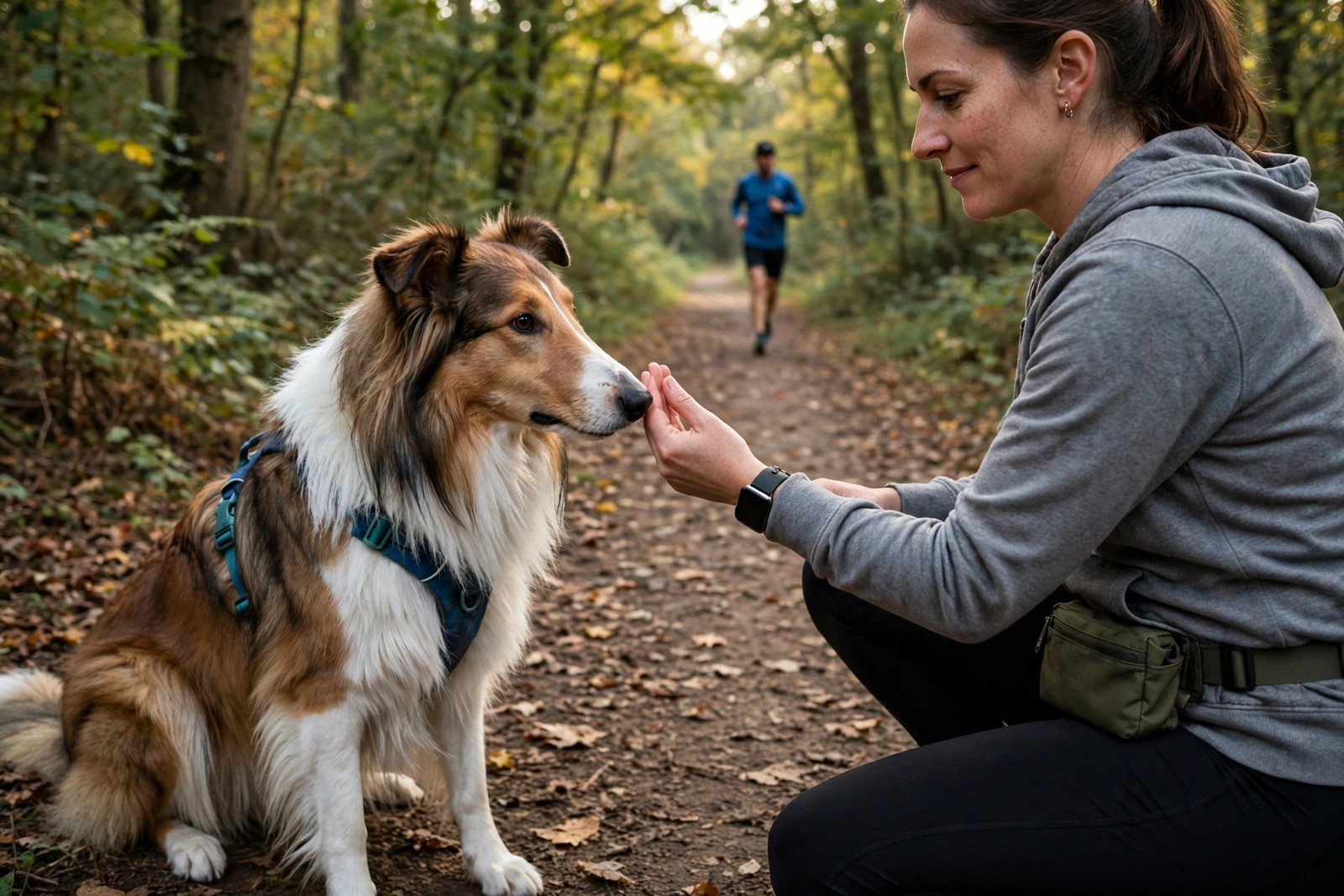
Movement is the trigger, and it is a powerful one: a runner appears suddenly, moves fast, and disappears, which presses chase, guard and startle buttons all at once. Corrections cannot teach a dog to feel calm about that picture; a jerk on the lead at the sight of a runner mostly teaches that runners predict discomfort too. Distance and rewards work differently: they let your dog practise noticing a runner and choosing you instead, at a range where choosing is still possible.
Find the Distance Where Your Dog Can Think
Every dog has a range at which a runner is interesting but manageable, and a closer range at which thinking stops. Work only in the first. Watch for the early signs that you are too close: ears locked forward, mouth closing, body weight shifting onto the front feet, food taken hard or refused. At a workable distance your dog can look at the runner, look back at you, eat softly and answer a cue. Step off the trail early when you see a runner coming, move to your distance before the runner reaches you, and treat the verge as your classroom rather than squeezing past on the path and hoping.
Teach Look, Pay, and Look Away
The core game is simple: your dog looks at the runner, you mark the look, and your dog turns to you for excellent food. Repeat until the sequence runs itself: runner appears, dog glances, dog checks in. Then add a job for the pass itself. A hand touch gives the mouth and brain a target, a few steps of heel keep the body organised, and scattering treats in the verge lets a dog snuffle while the runner goes by, which lowers arousal for many dogs better than a static sit. Practise in two trail sessions a week with a helper, because a known helper lets you control the one variable that matters: how the runner behaves.
Build a Helper Runner Ladder
Run the ladder across separate sessions, not in one ambitious afternoon. First your helper walks past at a distance, then walks closer, then jogs slowly past far away, then jogs at your dog's working distance, and only later runs at real pace. If your dog reacts at any rung, the next session repeats the rung below, without disappointment; ladders are climbed at the dog's speed. Vary the picture once the ladder holds: a runner approaching from behind after you have stepped aside and seen them coming, two runners together, a runner with a dog of their own. Each new picture deserves a little extra distance at first, because novelty spends the same budget as closeness.
Keep Real Trails Honest While You Train
Outside practice sessions, management carries the load. Choose wider trails at quieter times while the ladder climbs, step off early and generously, and keep the lead short but loose as runners pass so your dog feels guidance rather than a tightrope. Never let your dog chase, even in play, and if a runner surprises you at close range, turn away, create whatever distance you can and pay your dog for coming with you rather than rehearsing a shouting match beside the path. Dogs who bark and lunge at runners despite weeks of patient distance work deserve a session with a qualified behaviour professional, who can watch the reaction in person and judge what is driving it.
Through KinsLe's Care Teams, the ladder stays the same in every walker's hands: assign the two weekly trail sessions, record which rung your dog last handled calmly, and mark each completed session with a timestamp, so nobody tests a real-pace runner before the slow jog is solid.