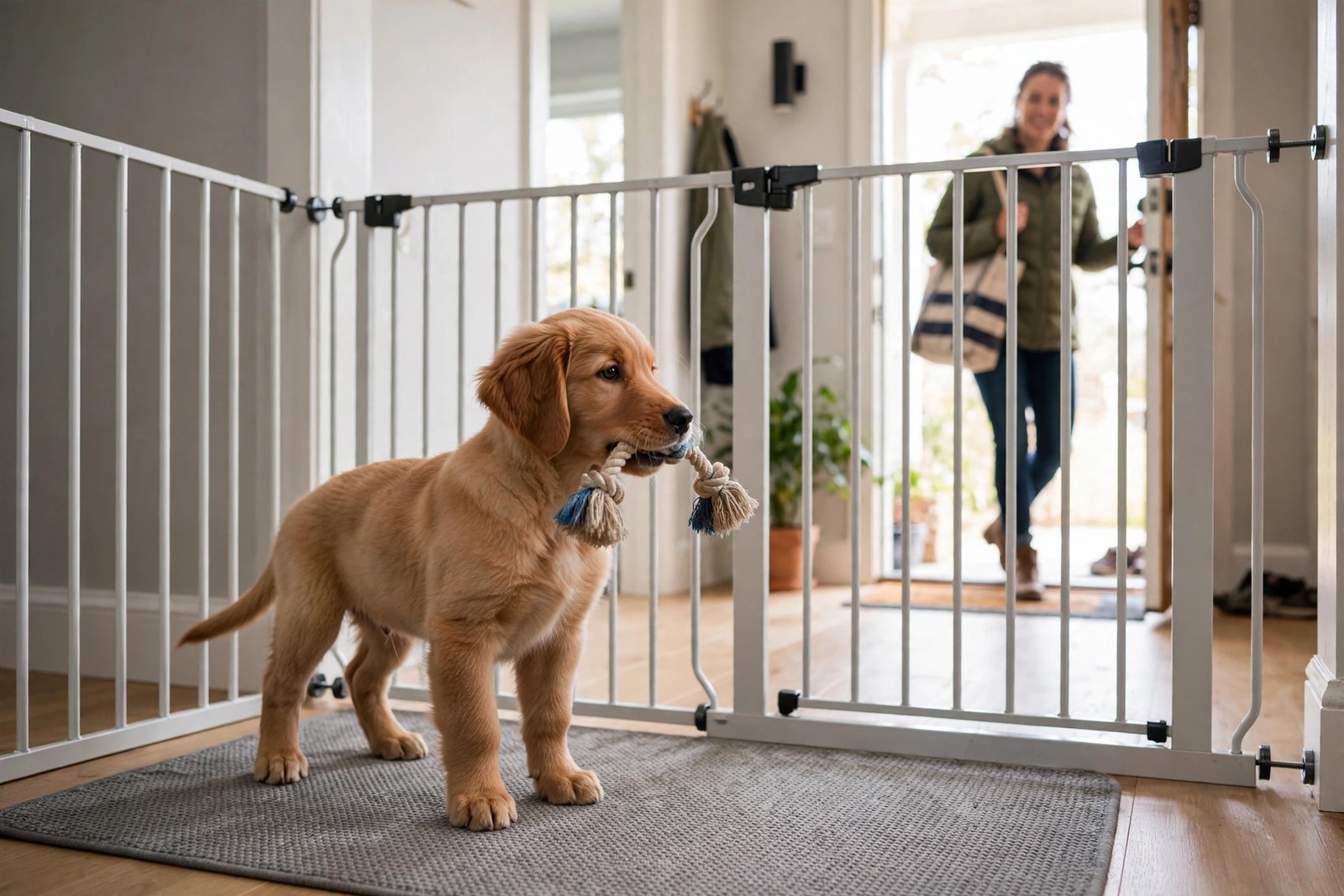
Puppies jump and mouth because visitors are thrilling and because jumping has always worked: it gets faces close, hands moving, and voices going. You cannot lecture that excitement away, but you can give the puppy a rehearsed alternative that pays better. The method is a script, practised in layers, so that by the time a real guest arrives the puppy has already performed the calm version many times.
Practise the arrival with no visitor at all
Start with the sounds and movements of an arrival and nobody new behind them. Knock on your own door, or play the doorbell, then cue the puppy to her mat placed behind a baby gate or across the room from the door. Feed a stream of small treats on the mat and on the floor around it; food delivered low anchors her weight downward and makes the floor, not the visitor, the interesting place. Release her after a few seconds, reset, and repeat. When the knock alone sends her trotting to the mat, the foundation is in, and it usually takes several short sessions spread over days rather than one long drilling.
Add people in graded stages
Household members play the visitors next, entering with increasing theatre: first calm and sideways, later waving, talking loudly, and wearing rustly coats. The rule the puppy must discover is mechanical. If she leaves the mat or jumps when released to greet, the visitor turns away, folds their arms, and goes boring until all four paws are down again; the moment she is grounded, the visitor crouches sideways, greets her briefly, and treats rain at floor level. Keep early greetings to a few seconds, then send her back to the mat for another payment. Puppies learn the contingency fast because the contrast is stark: jumping makes the fun stop, and standing makes it start.
Solve the mouthing half of the problem
Mouthing clothes rides along with the same arousal, and a puppy cannot grab a sleeve while her mouth is already occupied. Keep a toy basket by the door and hand her a toy to carry before greetings begin; many puppies learn to fetch their own toy when the doorbell rings, which becomes the household's favourite habit. If she drops the toy and mouths clothing anyway, the visitor goes still and the greeting pauses, and you redirect her back to the toy without scolding. Check the basics behind the wildness too: an overtired or under-exercised puppy greets like a firework, so schedule practice for after a play session and a nap, not at the end of a long crated morning.
Run real visitors under management
Until the script holds with your best pretend visitors, real guests get the managed version: puppy on a lead or behind the gate for the arrival itself, greeted only once the coats are off and the room has settled, and released to say hello for a few seconds at a time between paid returns to the mat. Brief your guests before they arrive: no reaching over her head, no squealing greetings, and ignore her completely while she jumps, because one guest who rewards jumping with delighted wrestling can undo a week of staging. Small children and frail visitors skip floor greetings entirely until the behaviour is solid; the puppy can be paid on her mat for watching them instead.
What progress looks like
Expect the staged version to hold within a couple of weeks and the real-visitor version to wobble at first, especially with guests who arrive loudly. Judge by paws, not perfection: a puppy who bounces once, remembers, and plants herself for payment is succeeding. KinsLe's Care Teams keeps arrivals consistent across the household, because one named person is assigned as greeter-coach for each visit and marks the practice sessions complete, so the puppy meets the same script whoever answers the door.