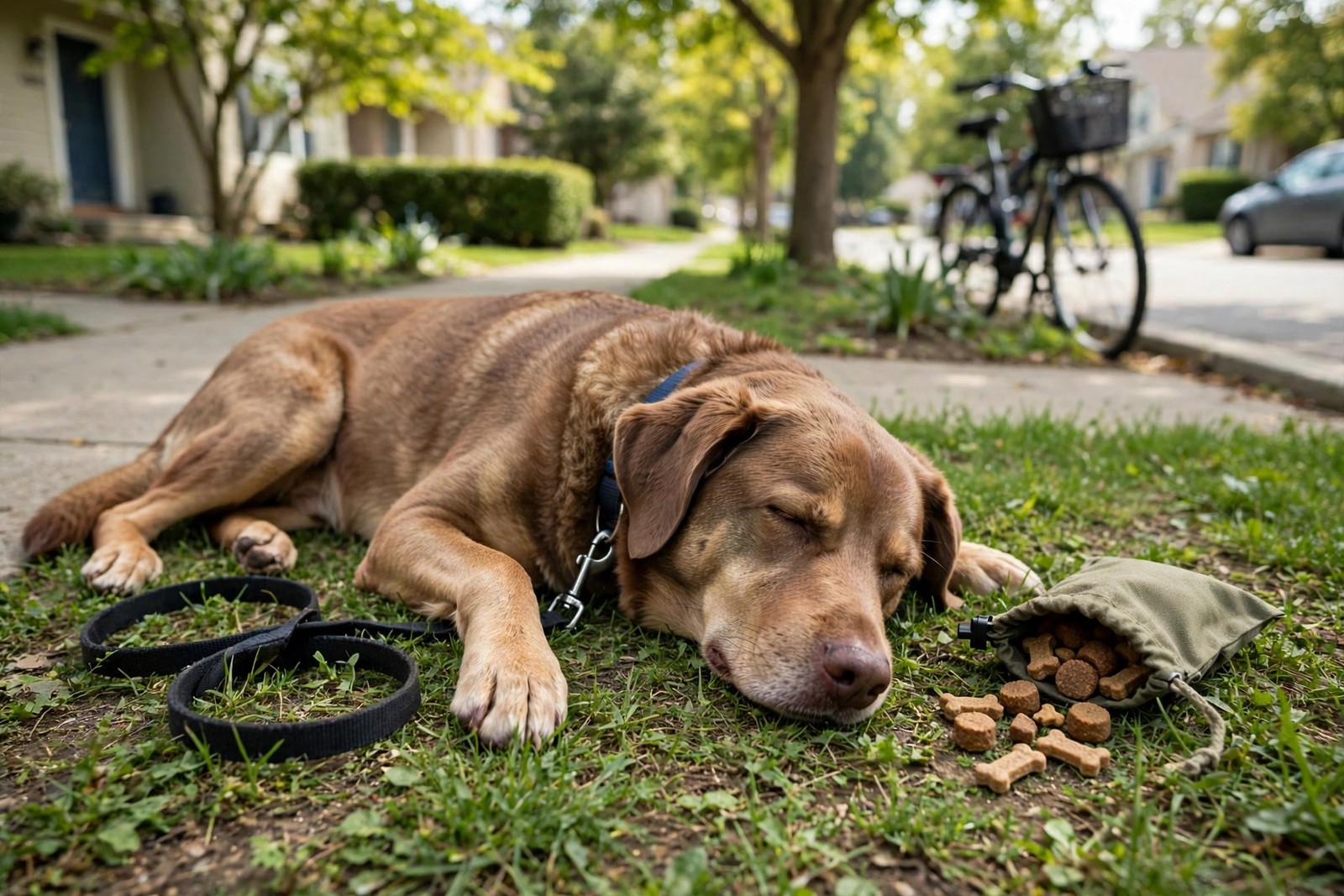
Treats rarely announce themselves as a diet problem. Each one looks trivial in isolation, and a dog can collect a dental stick at breakfast, training rewards at the park, a chew during your evening television, and tidbits from three different people without anyone registering a total. The audit exists to replace impressions with arithmetic. For seven ordinary days, write down everything the dog eats that does not come from the measured meal bowl.
Capture the Full List, Not the Highlights
Place a notebook or a phone note where treats live, and log each item with its type and size at the moment you give it. Include the categories owners forget: the crust offered during sandwich making, the piece of cheese used to hide nothing at all, the biscuit from the café jar, and the rawhide-style chew that lasts an hour. Ask every household member to log their own giving, because the audit fails politely when one person reports honestly and another forgets a nightly handful.
Weigh a sample of the usual treats on kitchen scales. A single large biscuit can hold the calories of a substantial fraction of a small dog's meal, and the scale replaces guesswork about what handful means. Note the daily meal ration in grams as well, so both sides of the comparison use the same unit.
Do the Comparison Honestly
Total each day's treats, average the seven days, and set that figure beside the daily ration. A widely used rule of thumb holds treats to roughly a tenth of daily intake, and that figure works as a practical ceiling rather than a precise measurement for an individual dog. A worked example shows the method. A dog eating 300 grams of food a day would sit near a 30-gram daily treat ceiling under that rule of thumb. An audit that finds 90 grams of daily extras means treats supply a share three times the intended ceiling, and the meal bowl has quietly lost control of the diet.
Watch for behavioural clues that support the numbers. A dog who picks at meals yet never refuses a treat, a waist that thickens while the meal amount stays fixed, and training sessions fuelled by whole biscuits all point the same way. Weight creep alongside a constant ration is itself evidence, because the extra energy must be arriving from somewhere.
Shrink the Treat Without Losing the Training
Cut treats smaller before you cut them out. Dogs respond to the frequency of rewards during training far more than to the size of each piece, and a pea-sized fragment delivers the same training signal as a whole biscuit. Break every treat into small pieces as standard practice and watch the daily total fall without any change to the dog's motivation.
Move part of the ration into the treat budget. Reserve a measured handful of the day's kibble in a separate pot and use those pieces as rewards, which keeps training generous while the nutritional total stays fixed. Save purchased treats for high-value moments such as recall practice near distractions, where a stronger reward earns its place.
Address the social sources too. The neighbour with pocket biscuits, the grandparent who equates food with affection, and the café staff with a treat jar each need a friendly redirection. Offer them pieces from the dog's own daily pot, and the generosity continues inside the budget.
Recheck after a month. Weigh the dog, rerun the hands-on rib and waist check, and confirm the trend matches the new arithmetic. If weight still climbs despite a verified audit, a vet can investigate other possibilities that sit beyond feeding maths.
A shared tally prevents the audit from decaying into one person's suspicion, and KinsLe Care Teams lets the whole household log treats against the same allowance so the real total stays visible.