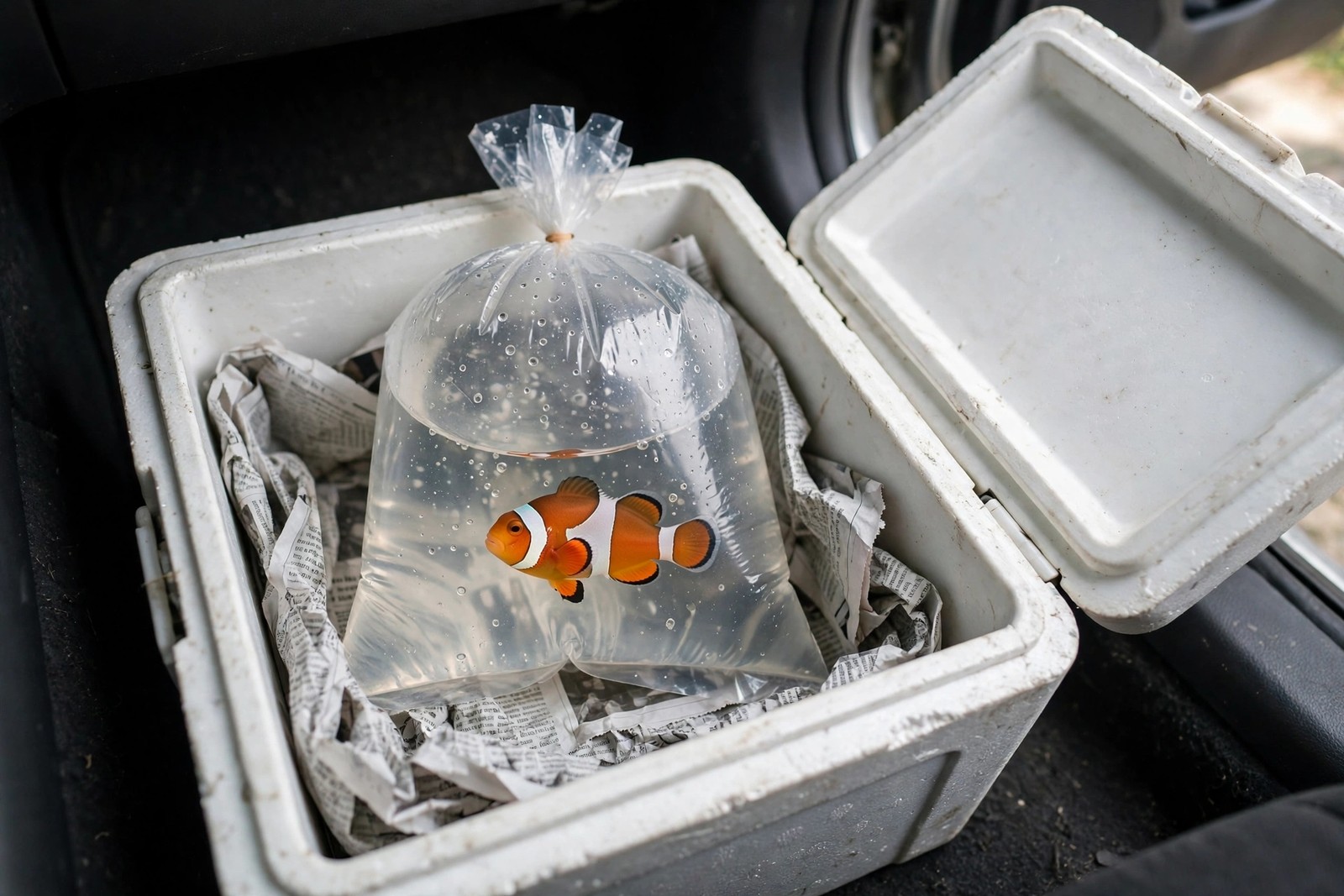
Fish travel well when four needs are met: clean water with enough oxygen in it, a stable temperature, darkness and stillness, and a gentle return to new water at the other end. Almost every transport death traces back to one of those four failing — a bag that chilled on a long drive, water fouled by a last big meal, or a fish tipped straight from bag water into a very different tank. The method below suits most home moves and shop-to-home trips, scaled up for longer journeys.
Prepare the Fish and Bags the Day Before
Skip feeding for roughly a day before travelling. A fed fish produces waste in a sealed bag, ammonia builds in a small volume, and that, not the driving, is the usual killer on longer trips. Catch fish calmly with a soft net and a container where possible, guiding rather than chasing, and work in dim light to keep stress down. Use proper thick fish bags, one fish per bag except for tiny schooling fish that travel better in a small group. Fill each bag about one-third with water from the fish's own tank and two-thirds with air — pure oxygen from a shop if the journey is long — twist and knot or band it shut, then slide it into a second bag tied the opposite way up, so a leaking knot drips into plastic, not the car.
Pack the Box So It Cannot Shift or Chill
Stand the bags upright in an insulated box or cool box, wedged with scrunched newspaper or a towel so nothing rolls or sloshes violently at corners. Darkness calms fish, so the lid goes on. Temperature stability matters more than any exact number: the insulation that keeps a tropical fish warm in winter also slows overheating in summer. Keep the box out of direct sun, off a hot boot floor, and ideally on a rear footwell where cabin temperature is steadiest and the box can be seat-belted or wedged so it cannot tip under braking. Plants travel in their own damp bag, and snails or shrimp in a separate bag with a plant sprig to hold onto. Never leave fish sitting in a parked car while you stop for lunch; cabin temperatures swing fast in both directions.
Drive Smoothly and Check Without Opening
Drive like the box is full of open cups of tea: gentle acceleration, early braking, slow corners. Short journeys need no intervention at all. On long ones, stop every few hours to check — in shade, briefly — that bags are upright, still inflated and not leaking, resisting the urge to open them, since each opening trades away the oxygen you sealed in. For journeys stretching beyond several hours, a small battery-powered air pump and airline into the bags during stops, or bags packed with oxygen at the outset, bridges the gap; very long moves are exactly what overnight fish couriers exist for, and fragile or valuable stock may be worth that handover instead.
Acclimate Slowly at the Other End
At the destination, set up and fill the receiving tank first, then float each closed bag for fifteen to twenty minutes to equalise temperature. Open the bag, roll its top down so it floats, and add small cups of tank water every few minutes over the next half hour or so, until the bag holds mostly tank water — slower for sensitive species or a big chemistry difference. Net the fish gently into the tank and discard the bag water rather than pouring it in; it carries the journey's waste with it. Leave lights off and skip feeding until later that day, then watch for clamped fins, gasping or hiding that persists, and test the receiving tank's water over the following days. A move goes best when the person receiving the fish is not guessing, and KinsLe's Pet Passport helps by keeping each fish's species, home temperature and water values, and acclimation notes together in one packet that travels with the box, so the handover at the far end is calm and exact.