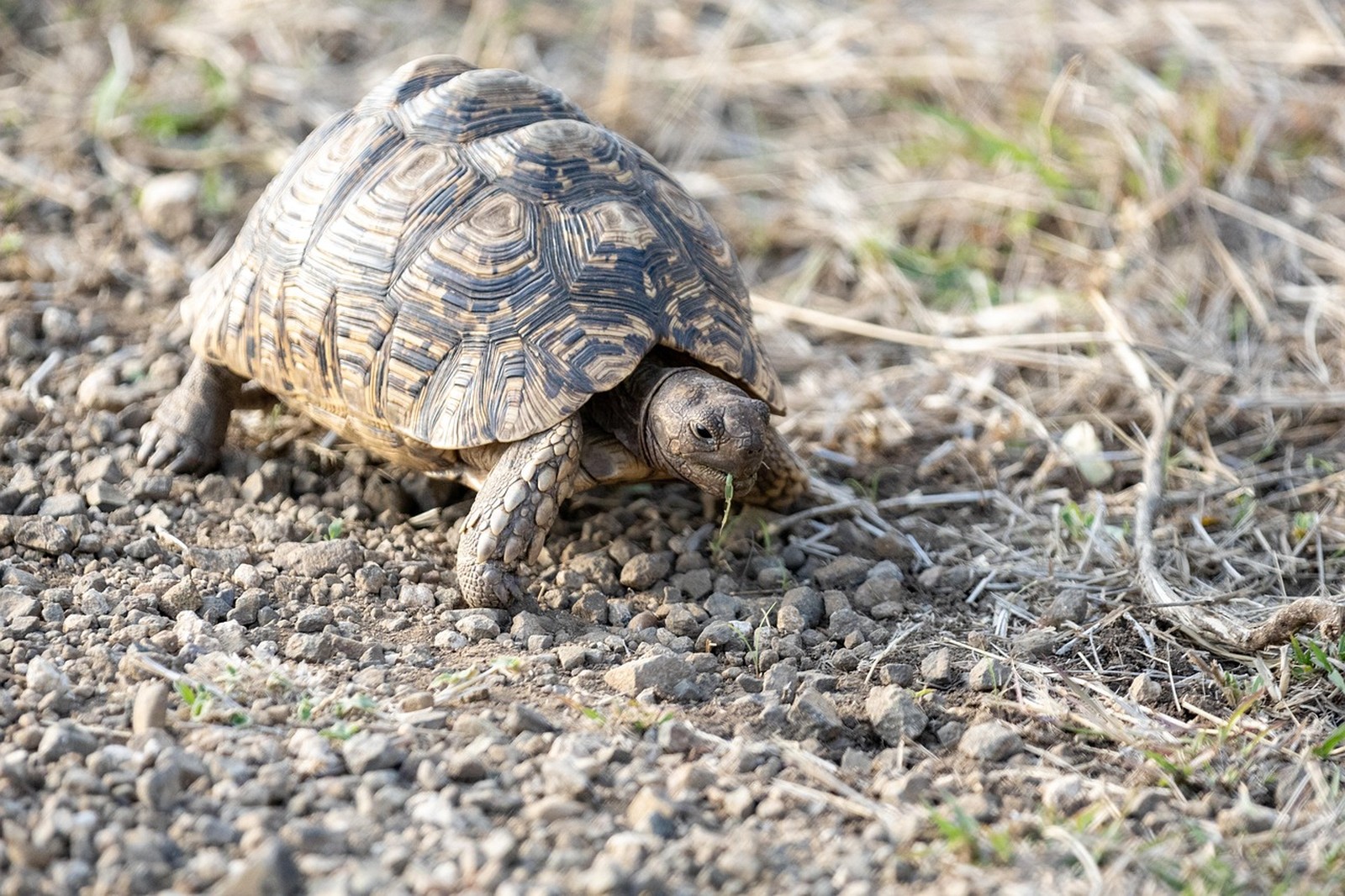
Slow is correct for a young tortoise. Owners often worry that a hatchling is barely growing, yet a small, steady gain is exactly what builds a sound shell and a body that stays in proportion. A Mediterranean hatchling such as a Hermann's, a Greek or a marginated tortoise typically gains only a few grams a month through its first year. Larger and faster-growing species gain more in absolute terms, but the pattern should still look gradual whenever you review it, never like a sudden spurt.
What healthy growth actually looks like
Healthy growth shows in the shell first. New growth appears as a thin, pale line along the seams between the scutes, the plates that make up the shell, and the shell stays smooth, firm and evenly domed as it expands. The tortoise should feel solid for its size when you lift it, neither hollow and light nor soft at the edges of the shell. Appetite, bright eyes and steady activity belong with that picture: a youngster that eats eagerly, basks, walks strongly on all four legs and gains a few grams a month is developing the way it should. Weight will not rise in a perfectly straight line. A quieter week, a cooler spell or a day of poor appetite can flatten one reading, so judge growth across several weekly weighings rather than reacting to a single flat result.
Weighing well enough to trust the trend
Weigh your tortoise once a week, at the same point in its routine, ideally before the morning feed and after it has had a chance to pass waste in a soak, so each reading is comparable with the last. A kitchen scale that reads in single grams is precise enough for a hatchling. Set the tortoise in a shallow container it cannot climb out of, wait for a steady reading, and write the weight down every time rather than trusting memory. Measure straight shell length, from the front edge of the shell to the back edge without following the curve, every few weeks as a second check. Weight rising slowly alongside length, with the shell staying smooth, is the combination you want. Weight rising while length barely moves suggests the tortoise is being fed too generously for the size it has actually reached.
When growth runs too fast
Growth that races ahead usually points to a feeding problem rather than a success. Too much food, offered too often, and a diet heavy in protein or fruit push a young tortoise to add shell faster than the shell can form properly. The warning sign is pyramiding: individual scutes rise into cone-like bumps instead of lying flat, giving the shell a lumpy outline. Pyramiding reflects growth conditions, including diet and humidity, and once the shape forms it does not flatten out again, though correcting the diet stops it worsening in the new growth that follows. Wild-type feeding is the model to copy: leafy weeds and greens as the staple, food offered in an amount the tortoise clears steadily rather than grazes on all day, and rich items kept as rare extras rather than daily fare.
When growth stalls, and when to involve a vet
No gain across several weeks, actual weight loss, a shell that feels soft or flexible, swollen eyes, or a youngster that stops eating and hides away all deserve a prompt appointment with a vet who treats reptiles. Before that visit, check the basics a vet will ask about: basking and background temperatures, access to ultraviolet light, how much and what the tortoise is actually eating, and whether it drinks and passes waste normally. Bring your weight records with you, because a written run of weekly figures shows the vet exactly when the trend changed. Keeping that log inside KinsLe Care Teams means the person who weighed the tortoise, whoever it was that week, marked the task complete with a timestamp, and the full run of weights stays ready to show at the appointment.