
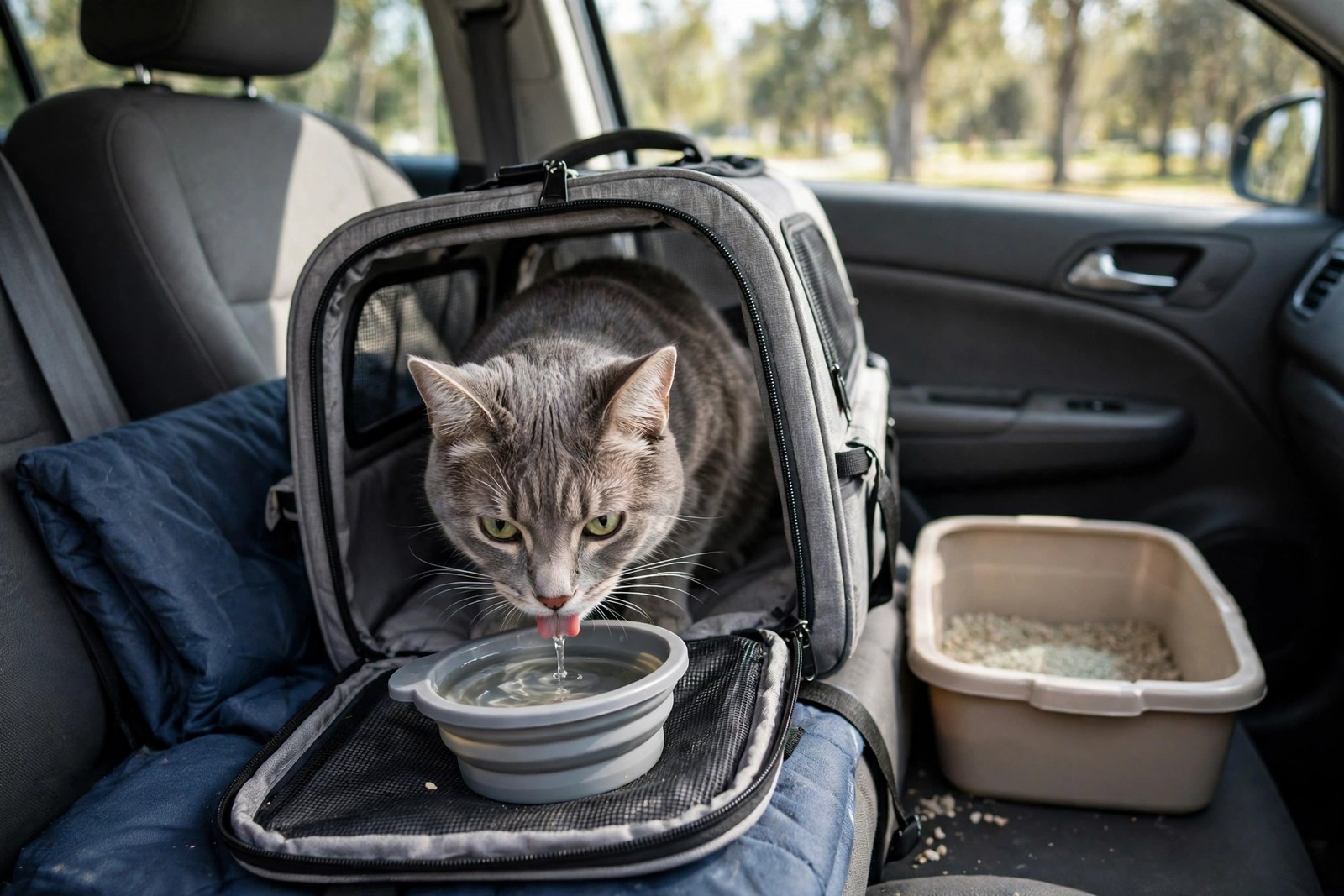
There is no single safe number of hours, but a good working rule is to plan a break every three to four hours on a long drive so your cat can drink, use a litter box, and stretch inside a safely enclosed car — and she should never be left unattended in a parked vehicle. Young kittens, seniors, and cats with health conditions usually need shorter stretches and more checks.
What actually limits carrier time
The carrier itself is not the problem; it is what your cat cannot do inside it. She cannot drink unless you offer water, cannot toilet unless there is space for a small litter tray, and cannot shift position much in a snug carrier. Heat is the other limit — a car warms quickly, even on a mild day, and a covered carrier in direct sun can become dangerous.
Most healthy adult cats tolerate a full travel day broken into sensible legs surprisingly well, often sleeping through much of it. What they do not tolerate is being forgotten: a ten-hour non-stop drive with no water, no litter access, and no check-ins is too long.
Planning breaks that stay safe
Stop somewhere quiet, away from heavy traffic. Keep every door and window closed before you open the carrier — a startled cat in an unfamiliar rest area is a lost cat in seconds. Offer water first, then set down a portable litter box on the car floor and give her privacy and a few unhurried minutes.
Practical tips for breaks:
- Do the break inside the car, never on a lead in an open parking area unless your cat is genuinely harness-trained
- Offer a small meal only if she is a relaxed traveller; nervous cats often refuse food, which is fine for a day
- Clean any accidents promptly — travelling in a soiled carrier adds misery fast
- Keep the routine identical at every stop so she learns the pattern
For multi-day drives, a pet-friendly hotel room each night beats trying to marathon through. Let her out in the room, set up her litter box and bedding, and let her properly eat, drink, and move around.
Very long days and special cases
If you are facing an exceptionally long day — a cross-country moving leg, for example — talk to your veterinarian ahead of time about what schedule suits your cat's age and health. Kittens need more frequent feeding and litter chances, senior cats may be stiff after hours in one position, and cats on medication may need doses timed to the drive.
Watch for warning signs at breaks: refusal to drink all day, open-mouth panting that does not settle, repeated vomiting, or a cat who has not urinated by evening. Those are reasons to find a local veterinarian rather than push on.
Safety beyond the schedule
Never leave your cat alone in a parked car, even "just for five minutes" — this is the single most dangerous part of road travel with pets. Take her carrier with you or have a travel partner stay with the air conditioning running.
Identification matters on the road too. On KinsLe, every pet profile carries a unique QR ID, and your cat's Verified QR ID Pet Profile links that code to her profile — if she ever slips out at a stop along the way, the person who finds her has a direct route back to you. One of the Verified QR ID Pet Profiles on KinsLe belongs to your cat, whose collar tag a finder can scan to reach that profile and confirm her name and owner before the drive continues.