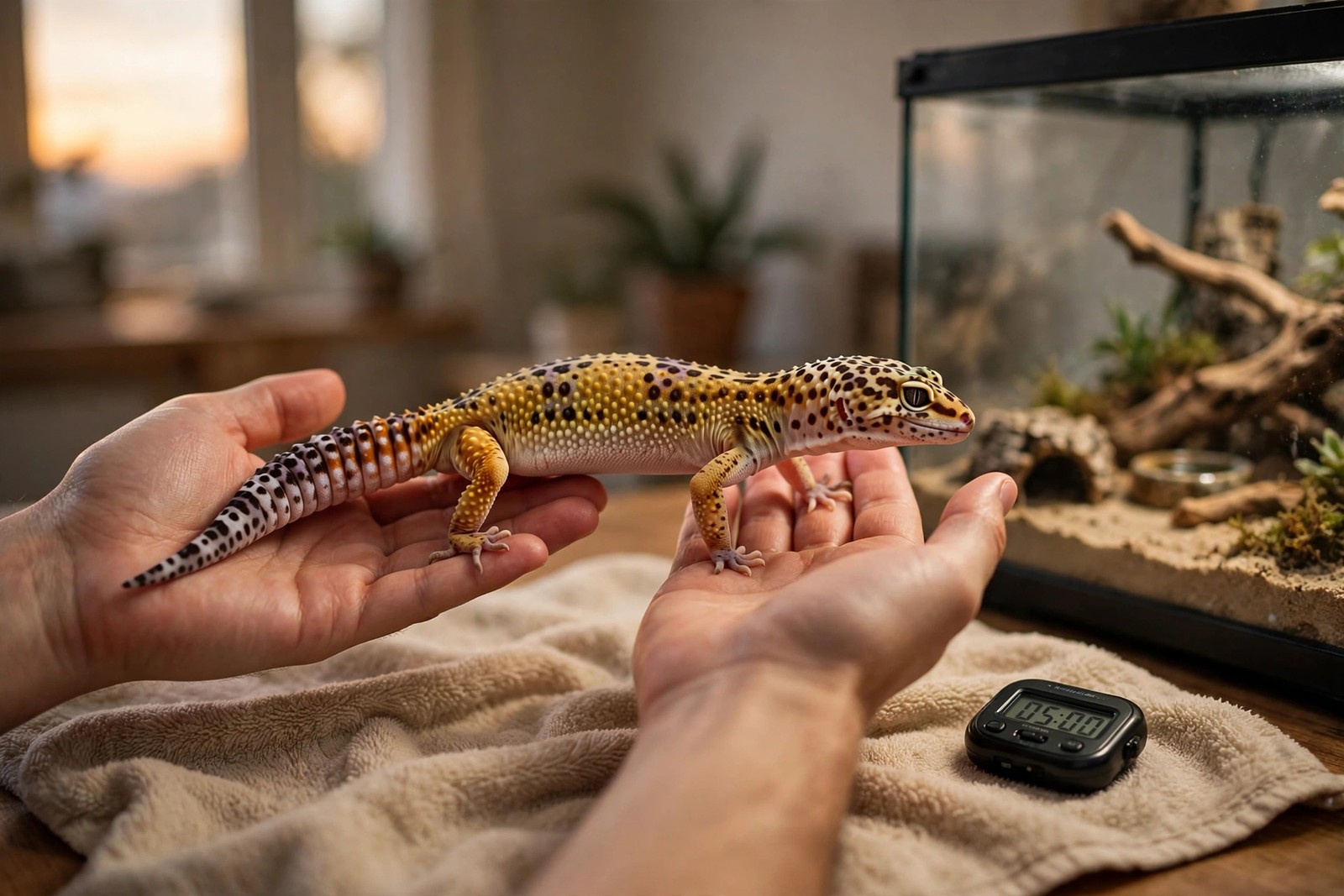
A new gecko does not need long handling sessions. It needs short ones that end well. Handling is a skill the gecko learns gradually: your hands, your smell and being lifted off the ground all start out alarming to a small prey animal, and confidence builds only when each session finishes before fear takes over. Give a new arrival several days with no handling at all beyond essential care, and wait until it is eating reliably and exploring its enclosure in the evening before you begin.
The first sessions: about five minutes
Begin with sessions of about five minutes, once a day. Let the gecko come onto your hand rather than grabbing it: rest your hand flat inside the enclosure, palm up, and let curiosity do the work, or scoop gently from underneath so the body is fully supported. Never lift a gecko by its tail. Several common pet geckos can shed the tail as an escape response, and a grabbed tail is one of the surest ways to trigger that loss. Sit down for these early sessions, close to the enclosure and low over a soft surface, so a sudden leap is a short drop rather than a fall. Hand-walking, letting the gecko step slowly from one hand to the other, gives it movement without restraint. If it will not come out willingly after a few calm attempts, end there and try again the next day rather than chasing it around the enclosure.
Building up, and knowing your ceiling
When five minutes passes with the gecko walking steadily, breathing calmly and showing no urge to flee, add a minute or two at a time over the following weeks. A leopard gecko or a crested gecko that is fully relaxed in the hands usually manages sessions of around fifteen to twenty minutes, and there is rarely any reason to push beyond that. Longer is not better: a gecko held out of its enclosure is cooling down, missing its hides, and spending energy on staying alert, so a calm twenty minutes achieves everything a forced hour would, without the stress. Some species should barely be handled at all. Day geckos, for example, have delicate skin that can tear under a gripping hand and are better enjoyed as display animals, while a leopard gecko or a crested gecko usually accepts regular gentle handling well once the routine above is established.
Reading the signs that say stop
Your gecko's behaviour sets the real limit on any given day, whatever the clock says. End a session early if it freezes rigidly, breathes fast, opens its mouth, squeaks or barks, thrashes, or makes repeated attempts to jump or bolt. A tail raised and waved slowly in some species is a warning to back off, not an invitation to persist. On the positive side, a gecko that walks unhurriedly, licks at the air and your fingers, settles on a warm hand and shows no interest in escape is telling you the session length suits it. Young geckos are usually flightier than adults, so keep a juvenile's sessions at the short end even when an adult of the same species would happily stay out longer.
Making the routine stick
Handle at a consistent time of day, in the evening for nocturnal species such as leopard and crested geckos, when they are naturally awake rather than dragged from a daytime hide. Wash your hands before and after, keep other pets out of the room, and let one confident person do the early sessions so the gecko learns one predictable pair of hands first. Recording each session's length and how your gecko responded in KinsLe Care Teams keeps the whole household honest about the build-up, so nobody jumps a nervous youngster straight to a long session because its progress was never written down.