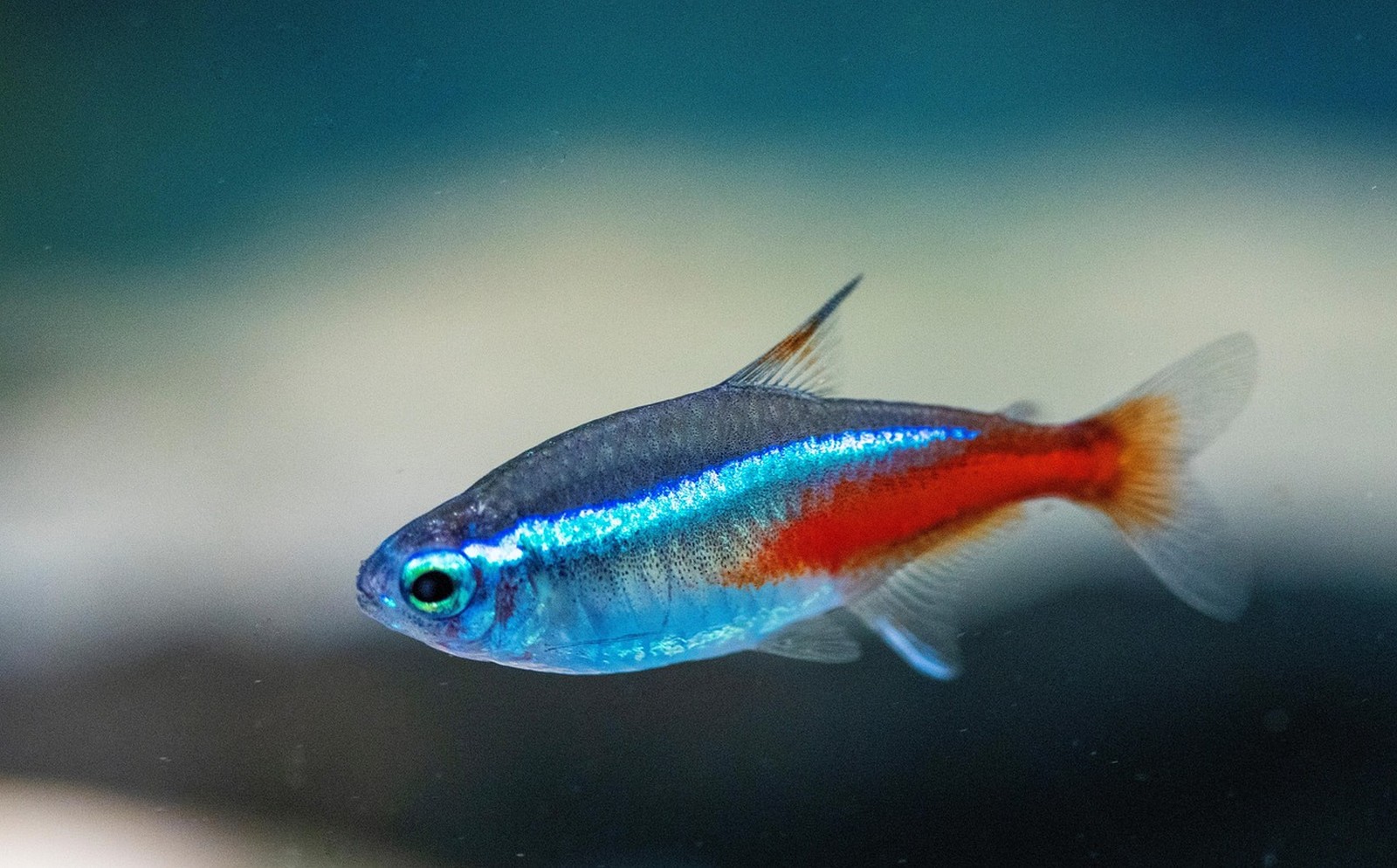
Neon tetras are built around the school. A neon on its own is a small, bright prey fish with nothing between it and every shadow that passes the glass, and it behaves that way: hiding, darting and refusing food. Put the same fish among enough of its own kind and it relaxes, because the school spreads the risk and tells each fish, through the calm behaviour of the others, that the water is safe. Numbers are not a decoration choice with this species; they are the condition the fish needs in order to behave and feed normally.
The number: six as a floor, ten or more as the aim
Keep at least six neon tetras, and aim for ten or more whenever the tank allows it. Six is a workable floor, but the change in behaviour between six and a school of ten or more is easy to see: the larger school moves around the middle of the tank as a loose, glittering group, comes forward at feeding time and holds strong colour, while a small group stays tight, nervous and close to cover. A tight, bunched school in a tank that holds plenty of fish is itself a useful signal, because neons bunch when something unsettles them and spread out when they feel secure. Cardinal tetras look similar and school in the same way, but they are a different species, slightly larger and with the red running the full length of the body; a mixed handful of neons and cardinals is two small groups, not one settled school, so choose one species and build its numbers properly.
Giving the school a tank that suits it
Neons swim in the middle layer and use the tank's length, so a longer tank suits a school better than a tall one. A tank at least 60 centimetres long (about 24 inches) gives a school of ten or more room to move as a group rather than circling in place. Plant the back and sides so the fish have cover, and leave the front and centre open for schooling. Keep the water stable: neons do poorly with sudden changes, so steady temperature, soft and slightly acidic water where your supply allows it, a mature filter and regular small water changes suit them far better than frequent adjustments chasing exact numbers. Lighting that is not harsh, with floating plants or tall planting softening it, also helps a new school settle and show its colour.
Adding the school and keeping it fed
Add neons only to a settled, fully cycled tank, and add the school together rather than in twos and threes, so no small group has to endure the nervous early weeks alone. Acclimate them slowly, keep the lights low for the first evening, and expect the colour to look pale on arrival day; healthy neons colour up over the following days as they settle. Feed small foods the tiny mouths can manage: crushed flake, micro pellets and small frozen foods, offered in amounts the school finishes promptly, with the flow eased if the current sweeps food away before the fish can reach it. After a loss, replace fish in a small group rather than singly where you can, and quarantine new arrivals first if you have a spare tank, because a school this size is easily unsettled by disease brought in with a single new fish. If colour fades across the whole school, appetite drops or the fish bunch and gasp, test the water first and seek advice from an aquatic vet or an experienced fish shop if correcting the water does not settle them.
Keeping count as a household
A school quietly shrinks when a fish is lost unnoticed, and a well-meant top-up of the wrong species quietly splits it. Keeping the species and the school size visible through KinsLe Family Sharing means anyone who helps with the tank works from the same count, and the school of ten or more you planned is the school that is actually swimming in the tank.