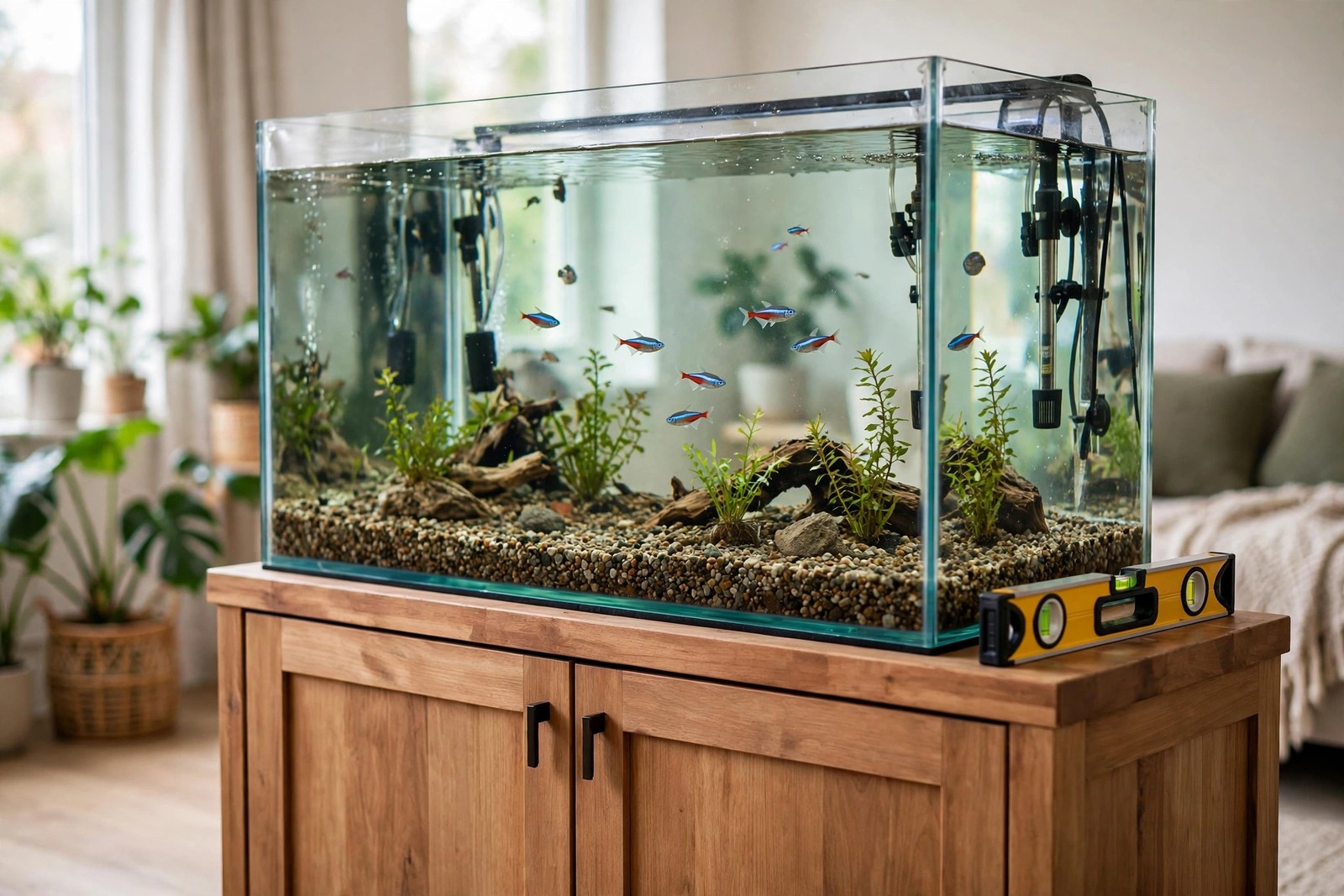
Start with one reliable number: water weighs about 1 kilogram per litre, or roughly 3.8 kilograms per US gallon. Everything else in the tank adds to that, which is why a filled aquarium is closer to furniture full of concrete than to the light glass box you carried in empty. Work the full figure out before you fill anything, because once the water is in, moving the tank is no longer a sensible option.
The Weight Maths, Worked Through
Add four things together: water, empty glass, substrate, and rock or heavy decor.
- 40 litres (about 10 gallons): 40kg of water, roughly 6kg of glass, and 5 to 8kg of gravel or sand gives a full weight near 50 to 55kg.
- 100 litres (about 25 gallons): 100kg of water, around 12kg of glass, and 10 to 15kg of substrate and rock gives roughly 125kg.
- 200 litres (about 50 gallons): 200kg of water, 25 to 30kg of glass, and around 20kg of substrate and decor gives roughly 245 to 250kg.
- 300 litres: expect the total to pass 350kg, which is serious floor territory.
A quick shortcut for a typical glass tank is about 1.2 to 1.3 kilograms per litre of stated capacity once everything is in — roughly 5 kilograms per US gallon. Deeper sand beds, slate, and large rocks push you above it, so treat the shortcut as a floor for your estimate, never a ceiling.
What the Stand Must Actually Do
Use a purpose-built aquarium stand or cabinet rated for more than your calculated full weight, not ordinary household furniture. A dresser or bookshelf may hold the load on day one, then sag, swell with a small spill, or rack sideways over months. The stand must support the entire footprint of the base evenly, with no overhang at any edge, and it must not wobble when you push it from the side.
Level matters as much as strength. A tank that is out of level front to back or side to side puts uneven pressure into the glass and seams, so check with a spirit level in both directions and shim the stand, never the tank itself, before filling. Rimless tanks usually need a flat, continuous surface and a foam levelling mat underneath. Keep enough clearance behind and inside the cabinet for filters, cables and buckets, because cramped plumbing is plumbing that gets skipped.
Floors, Placement and Filling Safely
Position counts. A ground floor on concrete is the easiest home for a large tank. On a suspended timber floor, place the tank against a load-bearing wall and running across the joists rather than parallel to them, so the weight spreads over several joists. For anything around 250 kilograms or more upstairs, get a builder or structural professional to confirm the floor before you commit, not after the first fill.
Fill in stages. Put the tank in its final position, add substrate and rock, then fill a quarter, check the level and every seam, fill halfway, check again, and only then top up and start equipment. Keep a note of your tank's calculated full weight, its dimensions, and where the stopcock and buckets live, because that information is gold during a leak or a house move. Finally, KinsLe's Family Sharing keeps those weight figures and setup details on your fish's shared profile, so every helper in the house works from the same numbers instead of lifting on a guess.