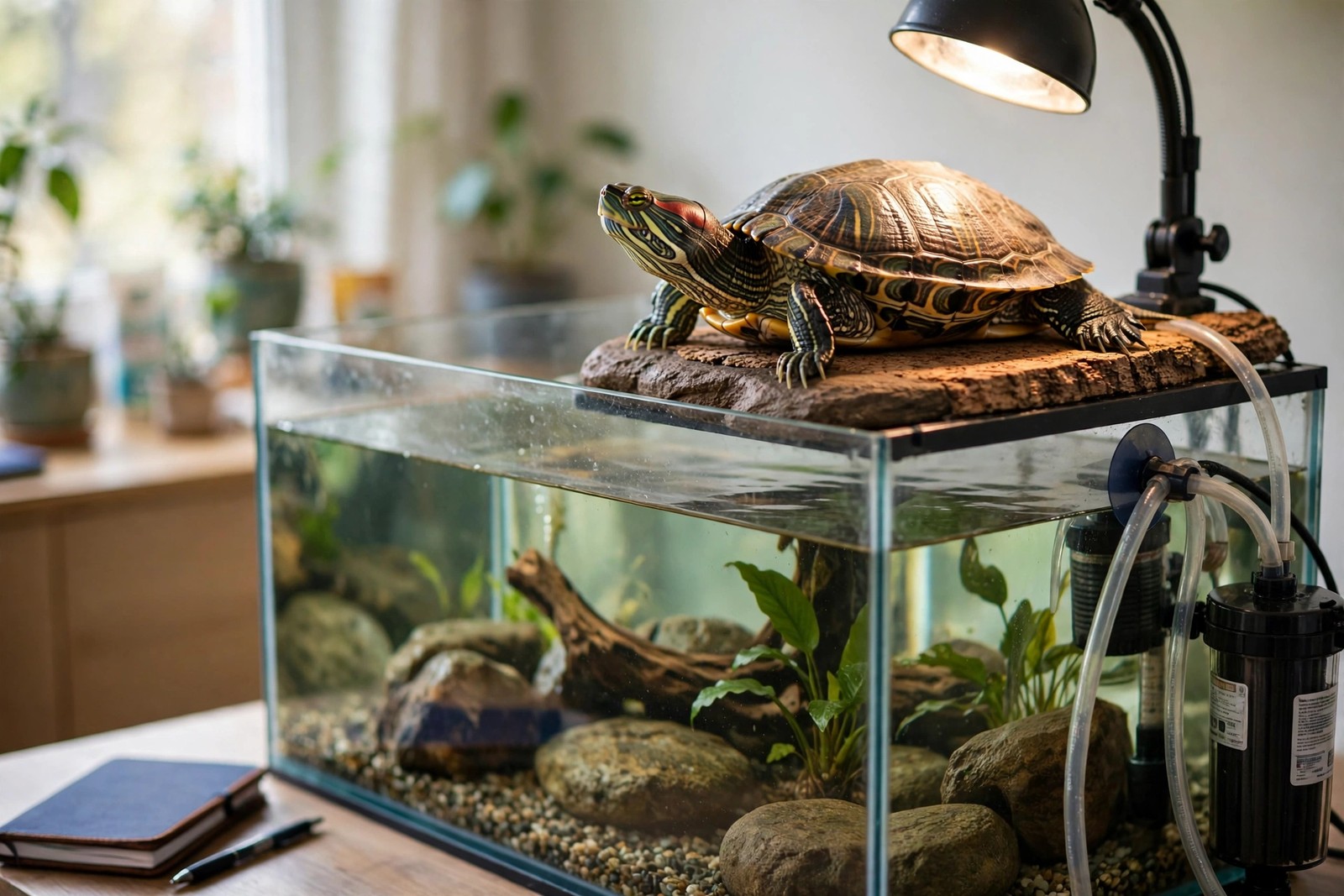
A red-eared slider's monthly cost surprises owners who remember the tiny hatchling in a small tank, because an adult slider is a large, messy, long-lived turtle that eats, filters and heats on a correspondingly large scale. Broken into its parts, the cost breaks down cleanly. For one slider, plan on $63 to $90 a month as a planning range: food $20 to $30, electricity for the filter, heater, basking light and ultraviolet light $15 to $20, ultraviolet and basking bulb replacement spread across the months between bulbs $5 to $8, filter media and water conditioner $8 to $12, and a vet fund set aside monthly $15 to $20. Those parts add to $63 at the low end and $90 at the high end.
Food through the slider's life stages
Food runs $20 to $30 a month, and what fills that line changes as the slider grows. A young slider eats a protein-heavy diet, so the spend leans toward a quality pellet plus live or frozen foods such as worms and shrimp, offered in measured amounts. An adult eats far more plant matter, so leafy greens and aquatic plants take a larger share of the basket while the pellet portion shrinks. An adult fed as though it were still a growing youngster gains weight, so the feeding plan and the budget line move together. Buy food in sizes you will use while it is fresh, and count treats such as feeder fish or extra shrimp inside this line rather than as uncounted extras.
Power, bulbs, filtration and water
Electricity runs $15 to $20 a month because a slider's equipment never really rests: the filter runs around the clock on a tank holding a large volume of water, the heater holds the water temperature, and the basking and ultraviolet lights run on a daily cycle above the basking platform. Bulb replacement adds $5 to $8 a month as a spread figure, because ultraviolet bulbs must be replaced on the maker's schedule while they still appear to work, as the ultraviolet output fades first; a $30 to $48 bulb replaced every six months works out at that $5 to $8 a month, and basking bulbs fail often enough to belong inside the same allowance. Filter media and water conditioner add $8 to $12 a month: a slider produces heavy waste, so mechanical media needs regular replacement, water changes need conditioner, and skimping here shows up as cloudy water and a turtle swimming in its own waste.
The vet fund, and the costs outside the month
Set aside $15 to $20 a month as a vet fund. Sliders are hardy, but shell problems, respiratory infections and egg-related trouble in females all need a vet who treats reptiles, often at short notice. A steady monthly set-aside means that visit is already paid for in planning terms. Keep two bigger costs outside the monthly figure. The first is the one-off setup: a genuinely large tank or indoor pond, a filter rated well above the tank's volume, heating, lighting and a dry basking area, all bought before the first month begins. The second is growth itself: a slider that outgrows its tank needs a larger home, and that upgrade is a planned project cost, not a monthly surprise. Ask any seller for the slider's feeding history, age and how it has been housed, because a turtle raised in poor water or under no ultraviolet light may bring health costs with it.
Keeping the figures with the turtle
A slider kept for decades will outlive several tanks and filters, so its records matter as much as this month's receipts. Note the monthly lines against what you actually spent for the first few months, and adjust your planning range to your turtle's appetite, tank size and equipment. Storing that breakdown in your slider's KinsLe Pet Passport keeps its running costs in the same packet as its feeding history and vet records, ready for a sitter, a new vet or a future owner to pick up and understand.