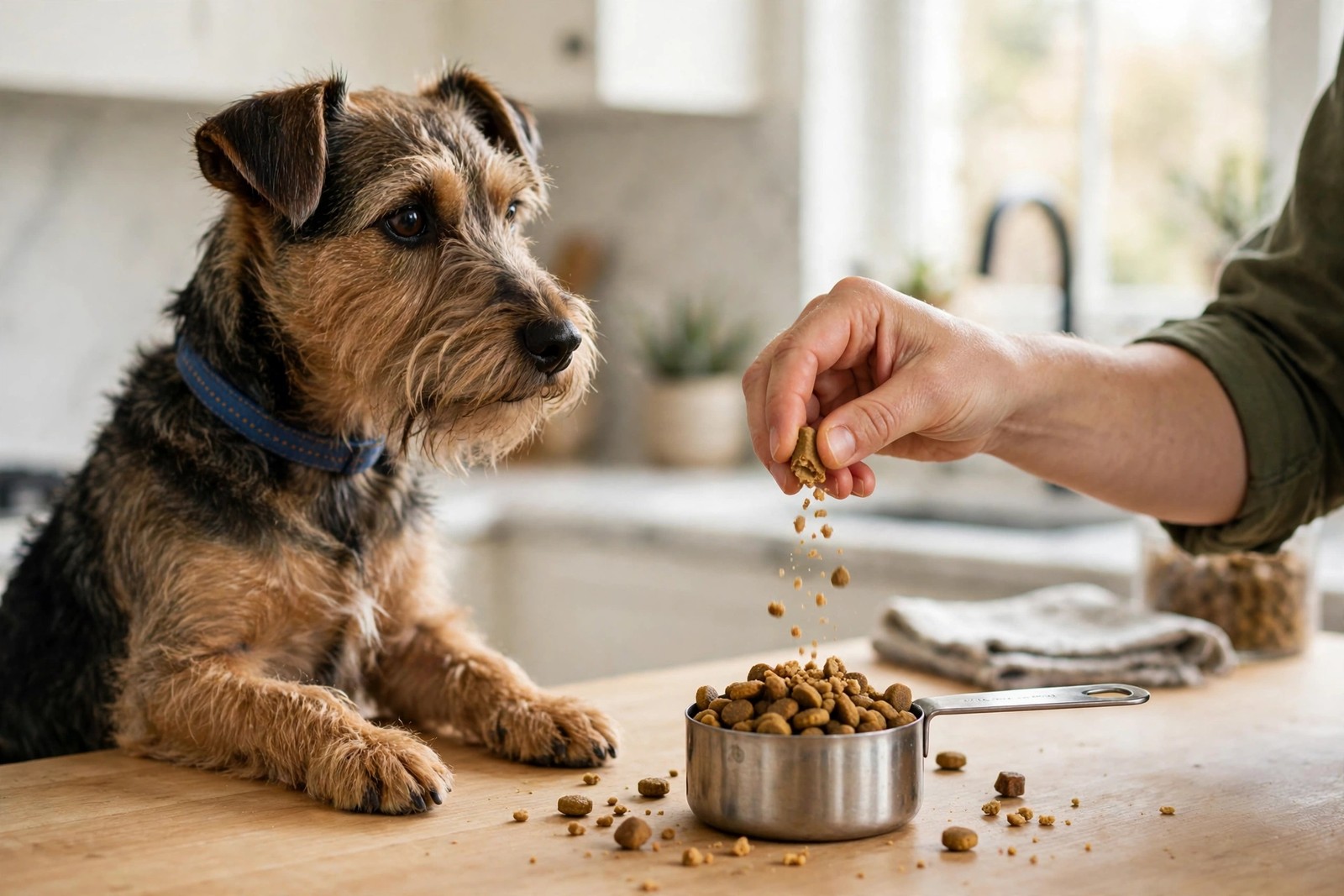
Treats should make up no more than about 10 percent of your dog's daily calories. The remaining 90 percent needs to come from a complete, balanced diet, because the main food is what carries the protein, vitamins, and minerals in the right proportions. Treats are nutritionally lopsided by design — tasty, but not balanced — so once they push past roughly a tenth of the day's intake, they start diluting the diet and adding calories your dog does not need.
Turning 10 percent into real numbers
The rule only helps once you convert it into calories for your own dog. Check the calorie content on your dog's food, work out how many calories a day your dog actually eats at a healthy weight, then take a tenth. A toy dog maintaining on about 300 calories a day has roughly 30 treat calories — often just two or three small commercial treats, or a modest handful of tiny training pieces. A medium dog on 600 calories gets about 60 treat calories. A large, active dog on 1,200 calories gets about 120, which sounds generous until a single large biscuit or a piece of cheese from the table eats most of it.
Everything outside the bowl counts: training rewards, the crust shared at lunch, food used to hide a tablet, and scraps dropped by children. Owners are often surprised how quickly uncounted extras double the intended budget.
Training without blowing the budget
Training days are where the rule usually breaks, because a good session can involve dozens of rewards. The fix is size, not stinginess. Break soft treats into pea-sized pieces — your dog works for the event of being rewarded, not the volume — and keep a portion of the day's normal kibble in your treat pouch for easy repetitions, reserving the high-value pieces for recalls and genuinely hard distractions. Count those kibble pieces as part of the main meals, and reduce the bowl slightly on heavy training days so the total day still balances.
For dogs on a weight-loss plan, ask your veterinarian to set the treat budget as part of the plan itself. Many owners do better using measured pieces of the dog's own ration, or low-calorie vegetables their vet has approved for that dog, and keeping rich treats for rare occasions.
Puppies, seniors, and sensitive stomachs
Puppies need the 90 percent more than adults do: they are building bone and muscle on small stomachs, so rich or frequent treats can crowd out growth nutrition and loosen stools. Keep puppy treats tiny, infrequent, and plain. Senior dogs often run the opposite risk — slowing metabolism means yesterday's treat habit quietly becomes today's weight gain — so recheck the budget whenever activity drops. Dogs with pancreatitis, food allergies, kidney disease, or diabetes may need treats restricted far below 10 percent or limited to specific types, and that decision belongs with your veterinarian, not a general rule.
Judge the system monthly by body condition: ribs should be easy to feel under a thin fat covering, and a waist should be visible from above. If the waist is disappearing, treats are the first place to audit.
A shared treat tally kept through KinsLe's Care Teams, where training and feeding tasks are assigned to specific people and marked complete with a time, turns the 10 percent rule into a number everyone in the house can see and follow.