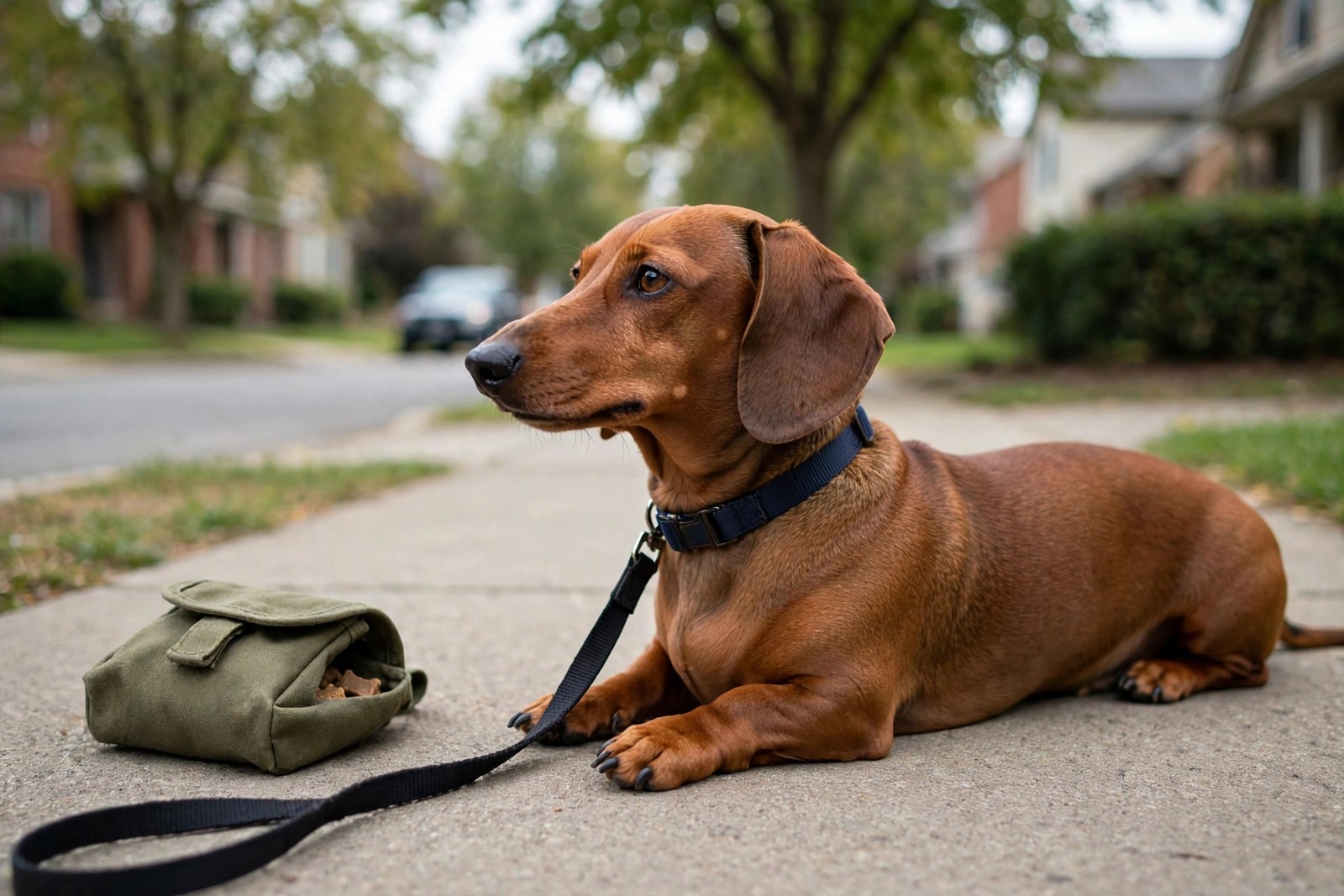
An adult Dachshund's typical weight depends first on the size variety. A standard Dachshund commonly weighs 16 to 32 lb, which converts to about 7 to 15 kg. A miniature Dachshund weighs 11 lb (about 5 kg) or under at maturity. Between those groups sit intermediate dogs that fit neither label neatly, and their healthy weight depends on frame rather than on a category name. Establish which variety and frame your dog has, ideally with your vet's help, before you hold the scale reading against any range.
Hands Along a Very Long Ribcage
Dachshunds carry an unusually long ribcage and back on short legs, and condition assessment should travel the full length of that body. Run flat palms from shoulders to hips and feel for ribs that present readily under a thin fat layer along the entire span. Fat often settles unevenly in this breed, gathering behind the shoulders and over the hips while the mid-ribs still feel lean, so a quick touch at one point misleads. Viewed from above, look for a gentle waist behind the ribs. Viewed from the side, the chest should sit clear of the ground with the belly line rising slightly rather than sagging parallel to the floor.
Coat variety changes the visual picture. Wire-haired and long-haired Dachshunds wear outlines that flatter or exaggerate condition, and smooth-coated dogs reveal every change. Owners of coated varieties should trust the hands and the scale over the silhouette in the hallway mirror.
The Back Raises the Stakes
The Dachshund's long spine is the breed's defining feature and its known vulnerability. Extra body weight increases the load carried by that spine and by the short legs beneath it, meal after meal and stair after stair. No owner can shorten the back or lengthen the legs, and weight remains the one structural factor the household controls completely. Vets commonly discuss weight early and firmly with Dachshund owners for exactly this reason, and any episode of back pain, wobbliness, or reluctance to move warrants prompt veterinary care in which current weight forms part of the assessment.
Daily habits support the same goal. Ramps beside sofas and beds reduce jumping loads, steady low-impact exercise maintains the muscle that supports the back, and weighed meals prevent the gradual surplus that daily eyeballing misses.
Outwit the Scavenger, Reduce Slowly, and Weigh a Long Dog Safely
Dachshunds were bred to work independently underground, and the breed applies that determination to food acquisition with impressive creativity. Counter-height determination, bin investigations, and persuasive performances for second breakfasts all belong to the repertoire. Households should count every treat, keep food storage genuinely dog-proof, and agree one daily allowance that every family member respects. In multi-dog homes, feed the Dachshund separately, because a low-slung dog can clear a housemate's leftovers within moments of the other dog walking away.
Safe reduction for an overweight Dachshund proceeds slowly under vet guidance, with monthly weigh-ins and portion changes in small steps. Rapid restriction risks muscle loss in a breed that needs muscular support along the spine. Weight that climbs despite verified portions, or falls without explanation, gives a vet reason to investigate possibilities such as thyroid conditions, and a dated weight record sharpens that investigation.
Choose a weighing method that a long dog tolerates calmly. Many Dachshunds stand happily on a low platform scale for a food reward taken from the daily allowance. A dog who resists can be weighed in a carrier, with the carrier weighed separately and subtracted, which yields the dog's figure without a struggle that risks a twisted back. Record the method alongside the result so every reading in the log stays comparable.
Back health gives this breed's weight checks a purpose beyond appearance, and KinsLe Care Teams keeps your Dachshund's monthly weigh-in assigned and the portion history visible to everyone who feeds the dog.