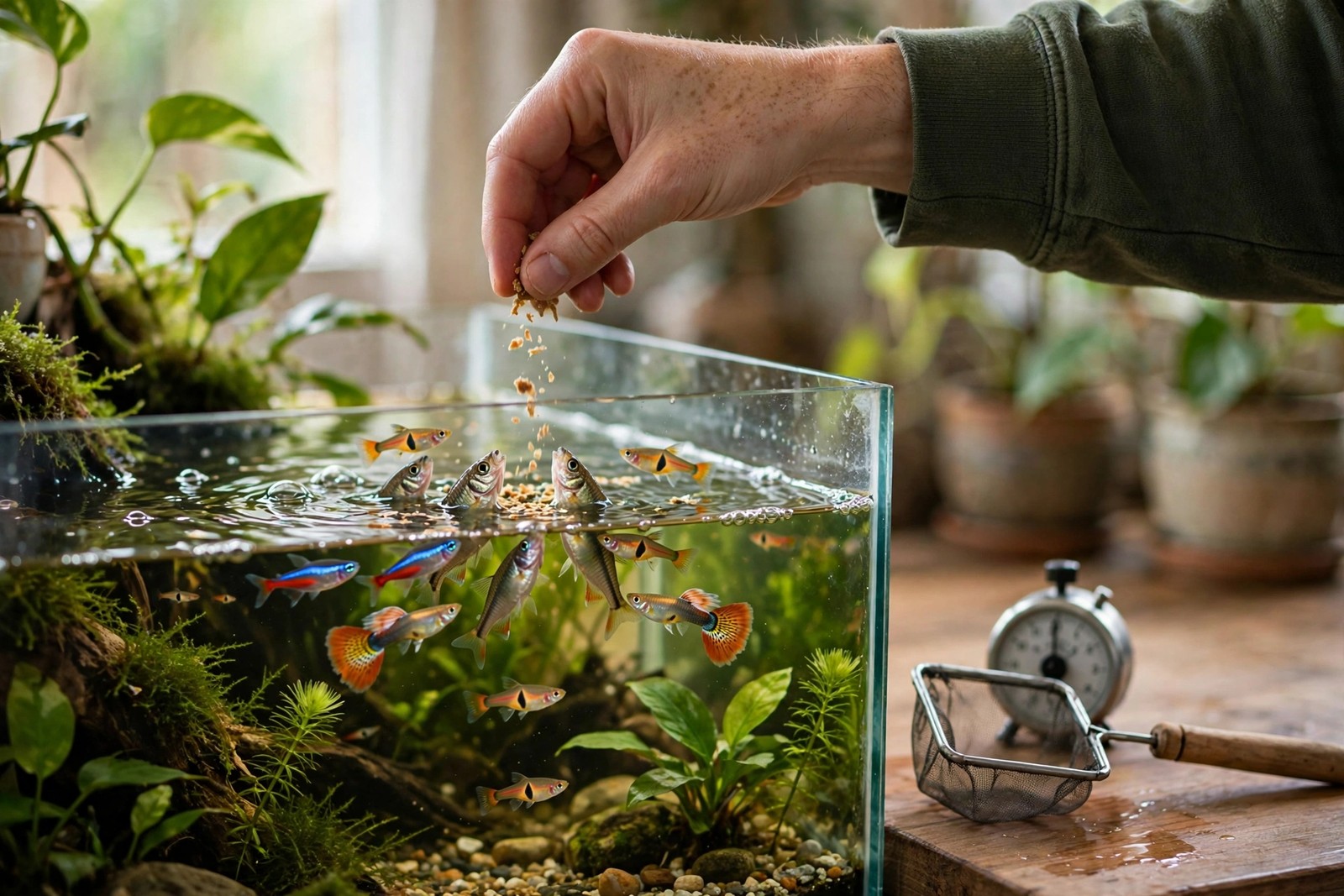
Overfeeding is the easiest way to spoil a tropical tank, and it happens because the fish always look hungry. Healthy fish beg at the glass whether they need food or not, so appetite is a poor measure. Time is a far better one. For adult community tropical fish, the working rule is simple: feed only as much as the whole tank can eat within two minutes, feed that amount once or twice a day, and remove anything that is still uneaten when the two minutes are up.
Working the two-minute rule in practice
Start smaller than you think the tank needs. Offer a small pinch of flake, a few micro pellets or a modest portion of frozen food, then watch the whole two minutes rather than walking away. If every scrap is gone well before the time is up and the fish are still actively hunting for more, offer a second, smaller portion inside the same feeding. If food is still drifting, sinking untouched or being spat out at the two-minute mark, the portion was too big, and the next feed should shrink. Net out or siphon up leftovers at the end of the feed rather than leaving them: uneaten food rots in the gravel and between plants, and the ammonia it releases stresses every fish in the tank, including the ones that never overate. Within a week of watching properly, you will know your tank's portion by eye, and the rule becomes a quick daily habit.
Once or twice a day, and who the rule bends for
Once or twice a day suits adult community fish: a single measured feed keeps a lightly stocked tank lean and clean, while two smaller feeds suit a busy community tank and spread the food more fairly among fast and slow feeders. The rule bends for youngsters and for specialists. Fry and young growing fish need smaller meals more often than once or twice a day, because their stomachs are tiny and they are building body mass. Bottom feeders such as corydoras and loaches need their share delivered deliberately, in sinking pellets or wafers, ideally as part of the same measured feeding, because surface fish can finish a whole feed before anything reaches the floor. Nocturnal species may take their portion best as the lights go down. What does not bend is the two-minute test itself: whatever the species or the hour, food left uneaten when the time expires is food the tank did not need.
Reading the tank for overfeeding and underfeeding
The tank tells you when the amount is wrong. Persistent leftovers, cloudy water, algae that keeps surging, snails multiplying rapidly and a filter that clogs quickly all point to too much food going in. Test the water if you see those signs, because rising ammonia and nitrite are the real harm behind them, and cut the portion before you cut the frequency. Underfeeding looks different: fish that are thin behind the head, concave bellies, smaller fish losing condition while tankmates thrive, and food vanishing in seconds with frantic competition at the surface. In a mixed community the fix is usually distribution rather than more food: feed at two spots at once, mix floating and sinking foods in one feed, and make sure shy species get a share.
Stopping the double feed
The other classic route to overfeeding is the double feed, where two people each feed the tank in good faith because neither knew the other already had, sometimes twice in one day. A tank fed that way quietly receives double rations while every person involved believes the feeding is careful. Agree one simple system: one named person feeds, the food lives in one place, and a feed is recorded as soon as it is done. Putting that duty in KinsLe Care Teams means the day's feeding is marked complete with a timestamp by the person who did it, so the next person who walks past the begging fish can see the tank has already been fed and leave the tub closed.