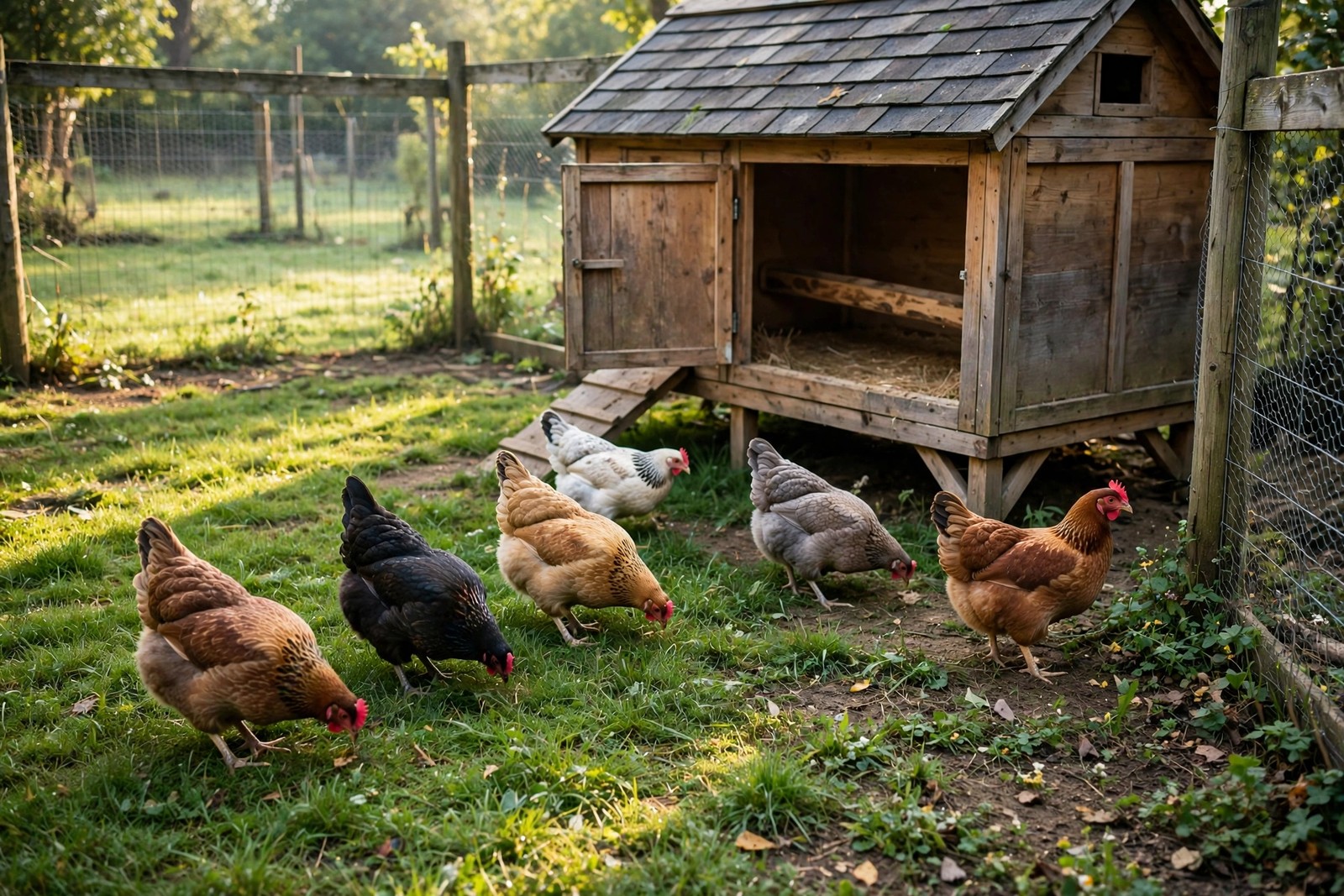
Inside the coop, work on roughly three to four square feet of floor space for each standard hen, plus eight to ten square feet outdoors in the run for each bird. Those two parts add up to 11 to 14 square feet per bird in total. A starter flock of six hens therefore needs about 18 to 24 square feet of coop, reached from 3 to 4 multiplied by six, and about 48 to 60 square feet of run, reached from 8 to 10 multiplied by six, giving 66 to 84 square feet altogether. Bantams can manage with a little less, and large, heavy breeds need the top of the range or a little beyond it.
Why the two spaces are measured separately
The coop is where hens sleep, lay, and shelter in bad weather, and on a wet winter day the whole flock may spend most of its hours indoors. Crowding there concentrates droppings and damp bedding, raises ammonia at floor level where the birds breathe, and gives a hen at the bottom of the order nowhere to move away from a bully. The run is daytime living space for scratching, dust bathing, and foraging, and a run that is too small turns to bare mud quickly, which is hard on feet and makes droppings build up where the hens feed.
Roost space counts separately from floor space. Allow roughly 8 to 10 inches (20 to 25 cm) of perch per hen, at one even height where possible, so birds do not compete for a single highest spot over the droppings area. For laying, one nest box of roughly 12 inches (30 cm) square for every 3 to 4 hens is usually enough, because hens share favourite boxes and rarely all lay at once.
What to do with the numbers
Measure the inside of the coop, not the outside walls, and subtract space taken by fixed feeders, drinkers, and nest boxes that sit on the floor. Count only run the hens can actually use: a strip under a low cover that an upright hen cannot stand in, or a corner that floods, is not living space. If your ground is heavy clay or the run cannot be rotated, give more than the minimum run area, because rest is what keeps grass and dry soil in the system.
More space than the minimum is never wasted. Extra run room is the simplest cure for feather pecking, bullying at the feeder, and a run that smells. If behaviour problems appear, check stocking before anything else: a flock that was peaceful at five hens can become fractious at nine in the same pen, and no enrichment fully compensates for birds living on top of each other.
Space through the seasons and the flock's life
Chicks in a brooder, growing birds, and a hen raising chicks all need their own allowances, and growers should move up before they are visibly cramped, because growth stunts quietly under crowding. In hot weather, shade within the run matters as much as area, and hens need to be able to spread out away from each other. In cold weather they huddle by choice, but the coop still needs ventilation above roost height that lets moisture out without a draught at the birds' level, because damp air in a tight coop damages airways.
Before buying more birds, redo the arithmetic with your real measurements, and include any cockerel, who needs room of his own and makes hens use space differently. Selected grandparents and parents may view a profile covering the hens after access reaches them through KinsLe Family Sharing.