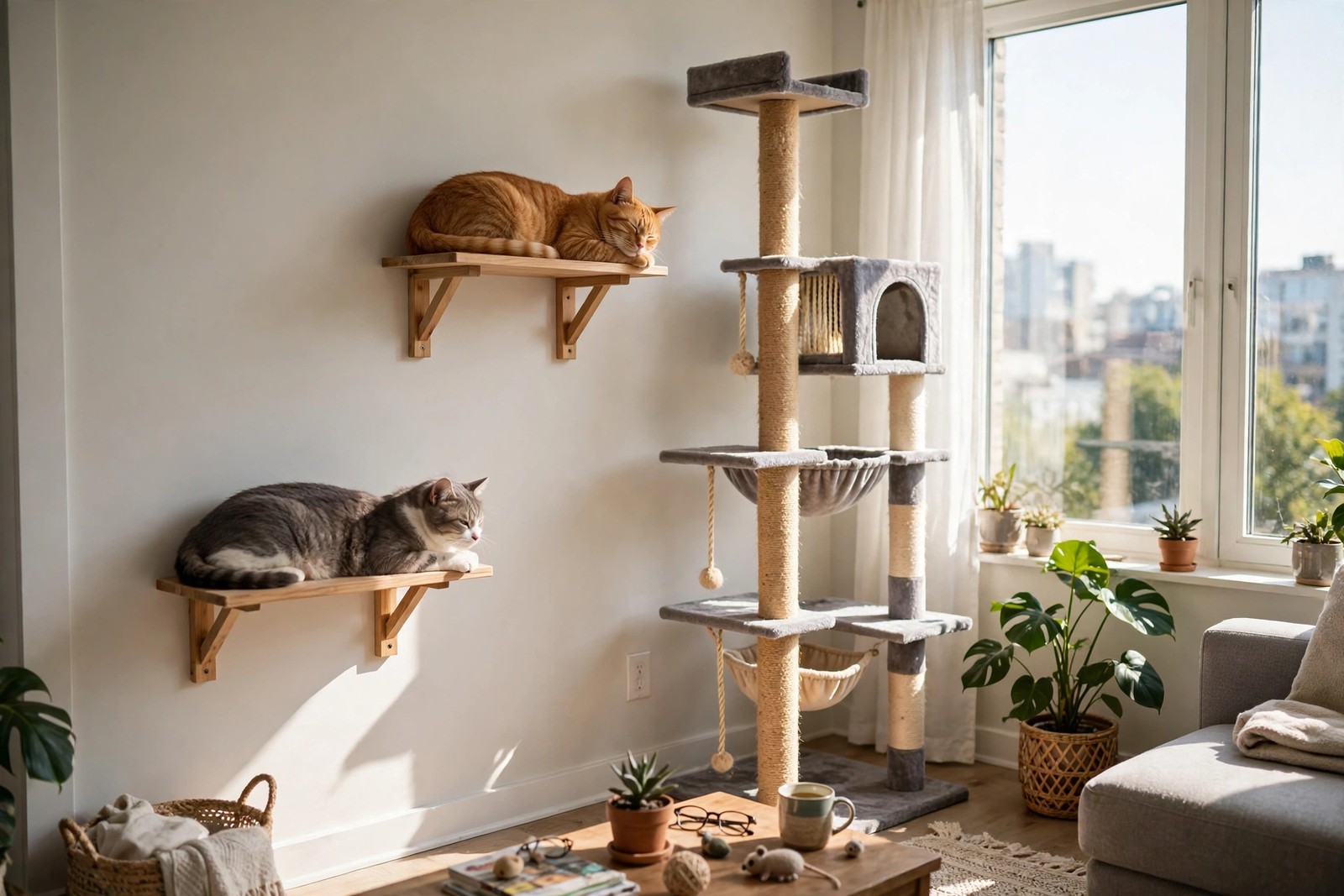
Cats need height more than they need floor area. A practical starting point for one indoor cat is a climbing route that tops out around five to six feet — roughly the height of a tall cat tree or the top of a bookcase — with at least one comfortable resting platform up there, plus intermediate steps to reach it. In multi-cat homes, plan on at least one elevated territory per cat, and one spare, because a single prized perch is a resource cats will contest.
Why Height Does So Much Work
Height is safety, surveillance, and status in one package. A cat up high can watch a room, including its dogs, children, and rival cats, without being reachable — which is why nervous cats calm down once they own a route up, and why so many indoor behaviour problems soften when vertical territory appears. It also multiplies your home's usable area: shelves stepping up a wall add 'rooms' a cat counts as its own without taking a single square foot of your floor, the difference between a studio flat that frustrates a cat and one that genuinely works.
Building the Route
Cats climb in hops, not ladders, so space your levels roughly 12 to 18 inches apart vertically — a chair to a sideboard to a shelf reads as a staircase to a cat. Anchor anything load-bearing properly: wall shelves must be fixed into studs or suitable wall anchors and rated well above the cat's weight, because a shelf that fails once teaches a cat to distrust every shelf. Put the best resting spot somewhere that pays rent — overlooking the room's activity, ideally with a window view — and add a second way down wherever you can. A dead-end perch above another cat's favourite chair is a trap waiting for its first argument; two routes turn a standoff into a shrug.
A ready-made tree in the 5-to-6-foot range with a mix of open platforms and one enclosed cubby covers most single cats. Seniors and arthritic cats still want height, but delivered kindly: lower, wider steps, the top platform nearer three or four feet, and a ramp or sturdy furniture chain instead of athletic leaps.
Counting Territory in a Multi-Cat Home
The formula that prevents most friction is simple: high spots should outnumber cats. Two cats want at least three worthwhile elevated resting places, spread so that no single location controls the whole map — one in the living room, one near a window in another room, one quiet retreat. Spread matters as much as count, because territory a shy cat cannot reach without passing the bold cat is not really hers. Watch the traffic for a week after installing anything new: a perch nobody uses usually wants moving a few feet or re-aiming at a window, not more company up there.
Once the cats have settled their map, the household's job is to leave it settled — furniture reshuffles and 'tidied' perches undo negotiations you never saw happen. KinsLe's Family Sharing keeps each cat's claimed perches, preferred routes, and any limits a vet has set for a senior jumper on the profile the household shares, so everyone moves around the cats' vertical world instead of accidentally redesigning it.