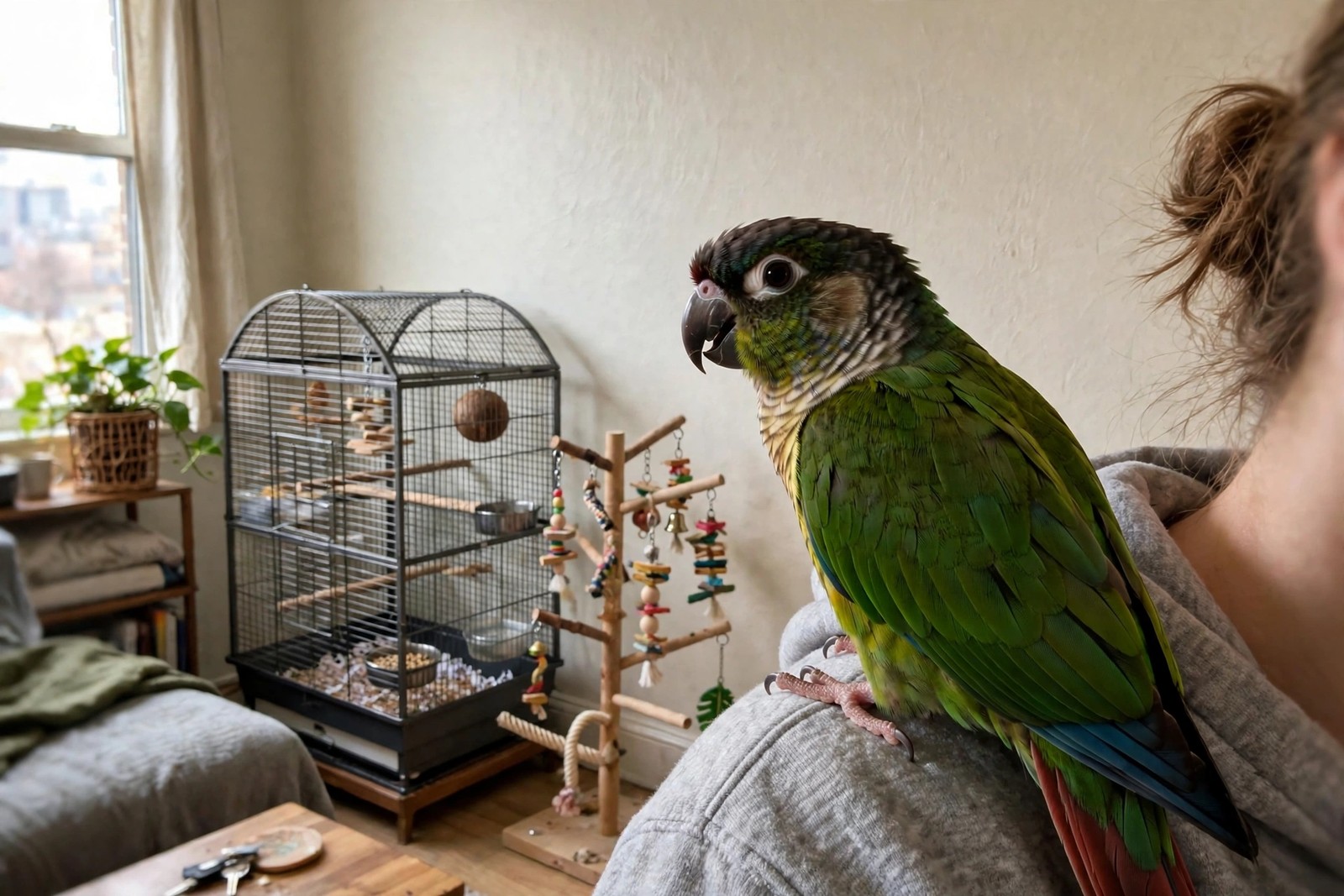
For an apartment, the green-cheeked conure has the best noise reputation in its family. Expect a baseline of moderate chatter — muttering, grinding its beak contentedly, whistling fragments, and practicing scraps of speech — punctuated by short, sharper contact calls and the occasional full screech when startled or demanding attention. What you do not usually get is the sustained, high-pitched screaming that makes some parrots a genuine neighbor problem.
The comparison that matters
Conures split into two noise camps. The larger aratinga species — sun, jandaya, and gold-capped conures among them — produce piercing calls built to carry across forest canopy, and in an apartment block those calls carry across several flats too. Green-cheeked conures belong to the smaller pyrrhura group, whose calls are lower in pitch, shorter, and far less powerful. Owners routinely describe the difference as a bird you hear clearly in the next room versus a bird the whole building hears. Within parrots generally, a green-cheeked conure sits at the quiet end, closer to a cockatiel than to a macaw, though it is more vocal and more frequent in its calling than a budgie.
Quietest conure is still a relative term. A green-cheeked conure is never silent, dawn and dusk bring a natural chorus, and an excited bird greeting you at the door will be audible through a thin stud wall. If your lease has strict noise clauses or your neighbor works nights, that honest caveat matters.
When a quiet species gets loud
Extended screaming from a green-cheeked conure is usually a management signal, not a species trait. The common drivers are too little sleep — these birds need 10 to 12 dark, quiet hours — boredom in an empty cage while the household works, and accidental training, where running to the cage to hush the bird teaches it that screaming summons company. A bird with foraging toys to dismantle, a predictable out-of-cage session, and attention given for quiet behavior rather than noise will usually settle back to the species baseline within a few weeks.
Practical apartment steps help too: place the cage against an interior wall rather than a shared one, use a play stand in the room where you spend evenings so the bird is included without shouting for you, and keep a friendly word with neighbors before any complaint reaches the landlord.
Making the decision
Visit a green-cheeked conure in person if you possibly can, ideally at a lively time of day, and judge the real volume against your walls and your tolerance rather than against a video recorded on a phone. Most apartment owners who do that homework find the species entirely workable — and many keep one for years without a single noise complaint.
Keeping the sleep, play, and foraging routine consistent is what holds the volume down day after day, and logging those duties in KinsLe's Care Teams, with each task assigned and timestamped, stops the routine slipping when one person's week gets busy.