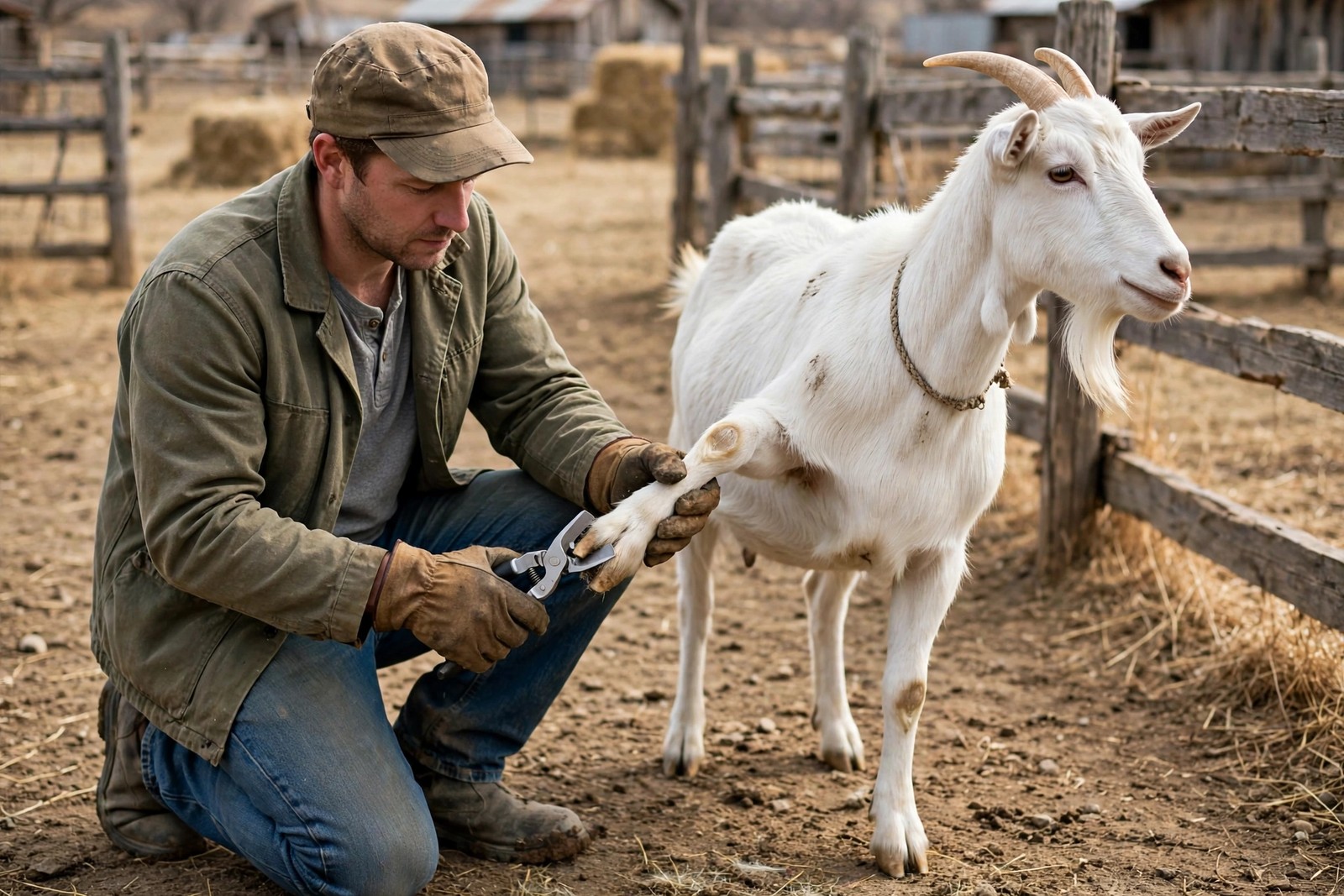
Plan to look at every goat's hooves about once a month, and to trim them roughly every 4 to 6 weeks. Where a goat lives decides where it sits in that range. Goats kept on soft pasture, bedding, or damp ground grow wall that nothing wears away, so they usually need the 4-week end. Goats that climb and walk daily over rocky, stony, or dry hard ground file their own feet down as they move and can often go nearer 6 weeks, although they still need the monthly check, because wear is rarely even across all four feet.
What an overgrown goat hoof looks like
A goat's hoof has two toes, and each toe has a hard outer wall that should finish level with the sole. Left alone, the wall keeps growing, curls outward or folds right over the sole, and traps mud and droppings against the soft tissue underneath. Look for toes that look long and pointed from the front, walls turned under when you lift the foot, a goat walking back on its heels, or one that kneels to graze, grazes less keenly, or lies down more than its herdmates. A pocket of black, crumbly material or a strong sour smell when you clean a foot suggests rot developing in the trapped space, and a goat that is lame, has a hot or swollen area above the hoof, or is not bearing weight needs a vet rather than just a trim.
How a routine trim goes
Restrain the goat calmly with a helper, or against a fence or stand if it is used to one, and work one foot at a time. Clean mud away first so you can see the true shape, then take off small amounts at a time with hoof trimmers: trim the wall down until it is level with the sole, tidy the point of the toe, and pare away folded wall so the pocket where dirt collected is opened out. Stop well before you see pink, and stop at once if you nick the foot and it bleeds; small cuts usually settle with pressure and a clean, dry standing area, but a deep cut or one that stays sore belongs to the vet.
Little and often is the whole technique. Taking a small amount every 4 to 6 weeks is quick and calm for goat and keeper, while rescuing a badly overgrown foot takes several sessions, because trimming it back to the correct shape in one sitting would cut into living tissue.
Ground, housing, and prevention
Dry standing helps as much as trimming does. Keep gateways, water points, and shelter entrances from becoming deep mud, because constant wet softens the wall, speeds rot, and makes even a well-trimmed foot tender. A hard standing area, a pile of large rocks or a solid climbing structure that goats genuinely use, and dry bedding in the shelter all create natural wear between trims. Check kids from a young age too, handling their feet briefly and often so trimming as adults is a familiar event rather than a wrestling match.
Keep a date for each goat rather than one date for the herd, because a fast-growing individual hiding among slower herdmates is how a goat ends up kneeling with folded walls that everyone assumed were done last time. KinsLe's Care Teams lets you set that monthly check as a named duty for each goat in the herd, with the completed trim timestamped so the record shows exactly which animals were actually done.