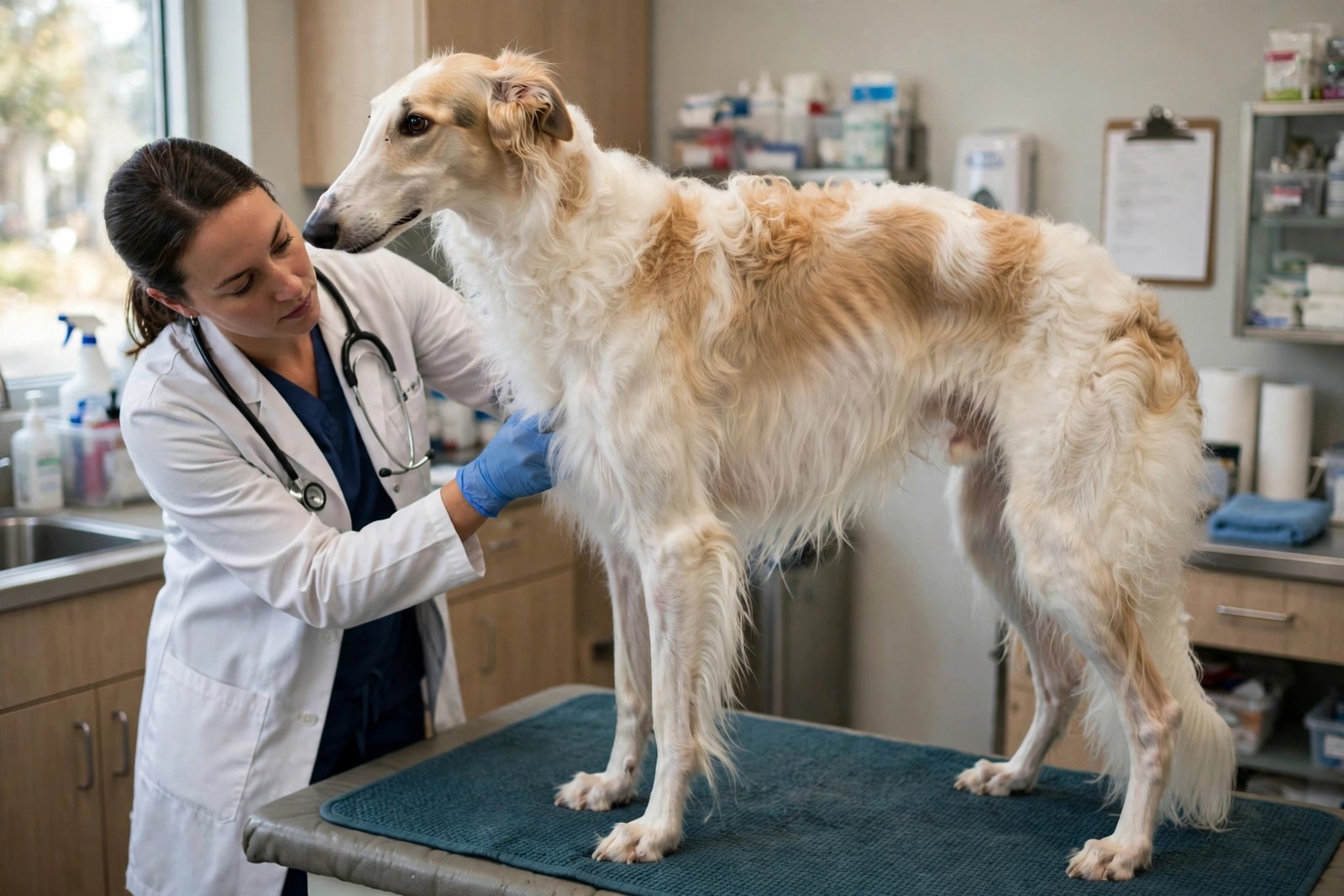
One Checkup a Year, Read Through Sighthound Eyes
A healthy adult Borzoi should see a vet once a year for a full routine checkup. Borzoi puppies need visits every few weeks in their early months for vaccinations, growth, and feeding reviews, and senior Borzoi should be seen twice a year. The yearly adult exam covers heart and lungs, mouth and teeth, eyes, skin and coat, abdomen, joints, and body condition, but interpreting almost every one of those findings in a Borzoi requires someone who understands how a sighthound is built, because normal for this breed looks unusual next to most dogs.
Lean Is Correct, but Thin Still Needs Checking
A fit Borzoi shows the last ribs, a dramatic tuck-up, and defined hip points under a silky coat, and that is healthy condition rather than underfeeding. The annual visit is where that judgement gets made properly: your vet weighs him, scores muscle over the spine and hindquarters, and reviews exactly what and how much he eats, including the extras that arrive during training and coursing season. The value of the yearly weigh-in is the comparison. A Borzoi who drifts steadily downward across three annual weights has a problem to investigate even if he still looks like a Borzoi, while a stable weight with good muscle is reassurance you can trust.
Tell the vet about appetite honestly: a missed meal in an otherwise bright Borzoi is a note, while several days of disinterest with lethargy or vomiting is an earlier appointment.
The Deep-Chest Emergency Every Borzoi Owner Should Know
Borzoi are tall and deep-chested, a shape associated with a stomach emergency in which the stomach fills with gas and can twist. Use a routine visit to learn the signs properly: sudden restlessness, pacing, drooling, retching that produces nothing, and a belly that looks or feels swollen and tight. There is no home treatment and no watching period; those signs mean emergency care immediately.
Heart, Eyes, Gait, and a Runner's Frame
The annual exam should include careful listening to the heart and a conversation about exercise tolerance: a Borzoi who begins lagging on the run home, coughs after exertion, or takes longer to recover his breathing deserves investigation rather than an assumption that he is ageing. Eyes should be checked as well, and any bumping into objects in dim light, reluctance to run in unfamiliar fields, or cloudiness mentioned promptly, since vision changes in a breed built to chase at speed carry obvious safety implications.
Watch the gait of a dog who covers ground at a gallop. A shortened stride, a toe that drags, repeated licking at a wrist or hock, or stiffness that appears after hard running and lingers into the next day should be booked in early. Sighthounds are not dramatic about pain, and a subtle change in how a Borzoi moves is often the only announcement a joint, foot, or muscle problem will make.
Senior Borzoi: Earlier and Twice a Year
Giant, deep-chested breeds reach their senior years sooner than small dogs do, so when your Borzoi greys around the muzzle, rises more carefully, and chooses the rug over a full gallop, move to twice-yearly checkups and ask about screening to track heart and internal health. Bring notes on appetite, weight trend, breathing recovery after walks, and sleep, because those details decide what each senior visit investigates.
A lifetime of weights and results only tells its story if it stays together, and KinsLe's Pet Passport gathers your Borzoi's annual weights, heart notes, and vaccinations into one record that any clinic can read at a glance.