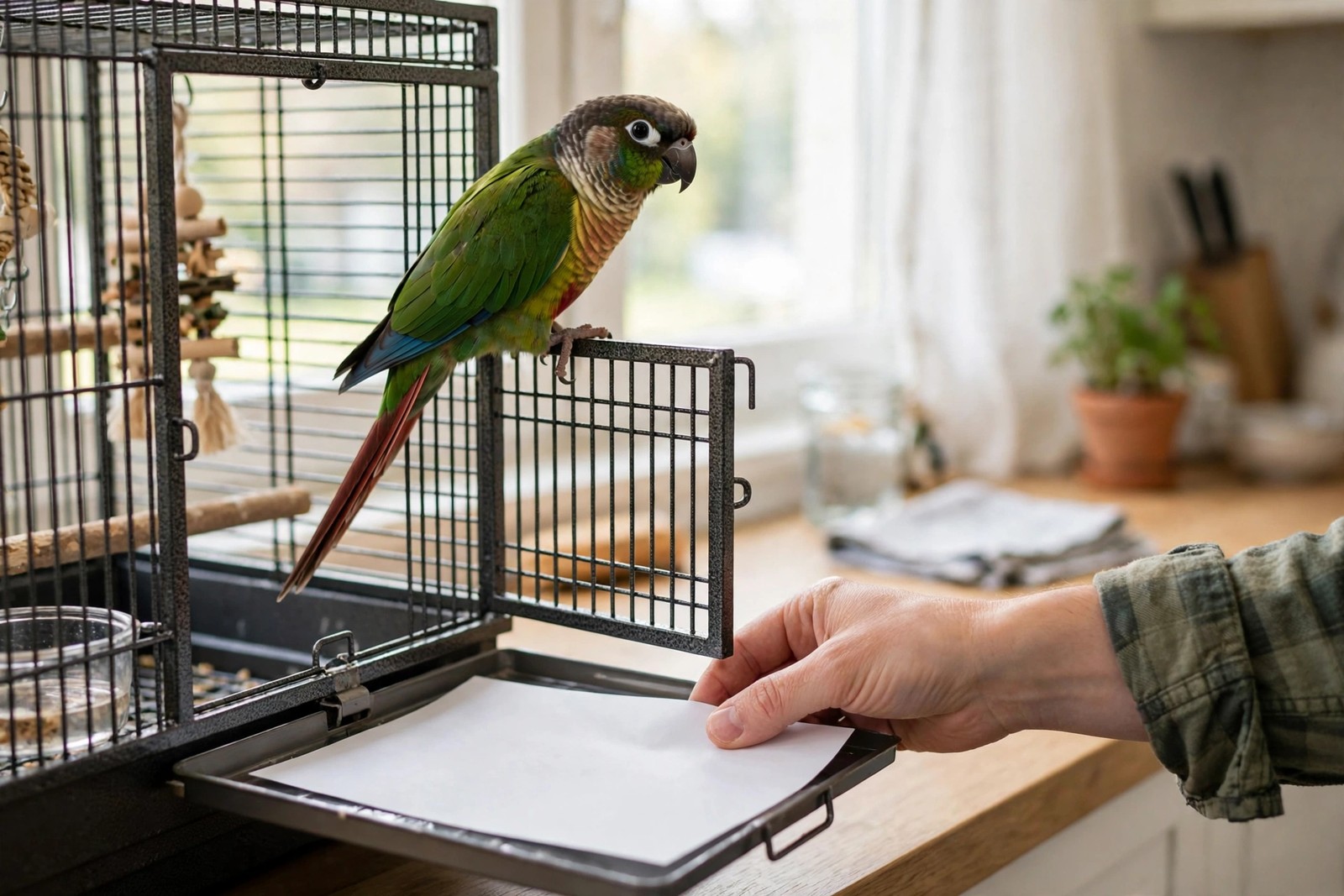
Change cage papers every day. That single daily habit is the baseline for budgies, cockatiels, lovebirds, conures, and large parrots alike, because droppings, scattered seed, hulls, and splashed water build up on the cage floor within hours, and soiled paper left in place grows mold, draws fruit flies, and smells fast. A fresh sheet every morning also gives you something no tray liner ad can sell you: a clean page on which to read your bird's droppings, one of the earliest health signals birds give.
When Daily Is Not Often Enough
Move to twice-daily changes whenever the load increases. Warm weather speeds up odor and bacterial growth on damp paper, so summer cages often need a second sheet by evening. Several birds sharing one cage, a bird perched for hours over one spot, and a bird being treated for illness all call for more frequent changes, and a sick bird's paper should be swapped whenever it is soiled so you can track output closely. Spilled bath water or a dunked food bowl means an immediate change too: wet paper left overnight is a mold risk, and birds forage on the cage floor more than most owners realize, picking through whatever the paper holds.
Reading the Droppings on Fresh Paper
A clean sheet turns each morning into a quick health check. Normal droppings have three parts: a formed dark green or brown center, white or cream urates, and a little clear liquid. Note what is normal for your bird on a seed diet versus a pellet diet, since color shifts with food. Watery droppings for a day after a bath or a juicy meal are usually unremarkable; persistently watery droppings, black or bloody droppings, undigested seed, or a sudden drop in the number of droppings are reasons to call an avian vet promptly, because birds hide illness well and droppings often change before behavior does.
Choosing and Laying the Paper
Use plain, flat sheets: unprinted paper, plain newsprint, or paper towels, laid smooth so your bird cannot get underneath and become trapped or chew inks and coatings. Skip glossy inserts, scented liners, and grit or sandpaper sheets, which can harm feet and encourage birds to eat things they should not. A practical trick is to stack five to seven fresh sheets in the tray at the start of the week, cut or folded to size, then peel off the top soiled layer each morning; the tray itself still needs a weekly wash with hot water and a thorough dry, because residue builds under the stack. Empty the tray fully if your bird shreds paper, so wet layers are not hiding underneath.
Building the Daily Rhythm
Pair the paper change with the morning feed and water refresh, and the whole floor-to-fresh routine takes two minutes. If several people share bird care, decide whose morning it is rather than assuming someone else did it, since a missed day is exactly when droppings pile up unread. In KinsLe, putting the paper change on your bird's Care Teams duty list, with each completion timestamped, keeps that daily sheet genuinely daily even when the household's mornings get hectic.