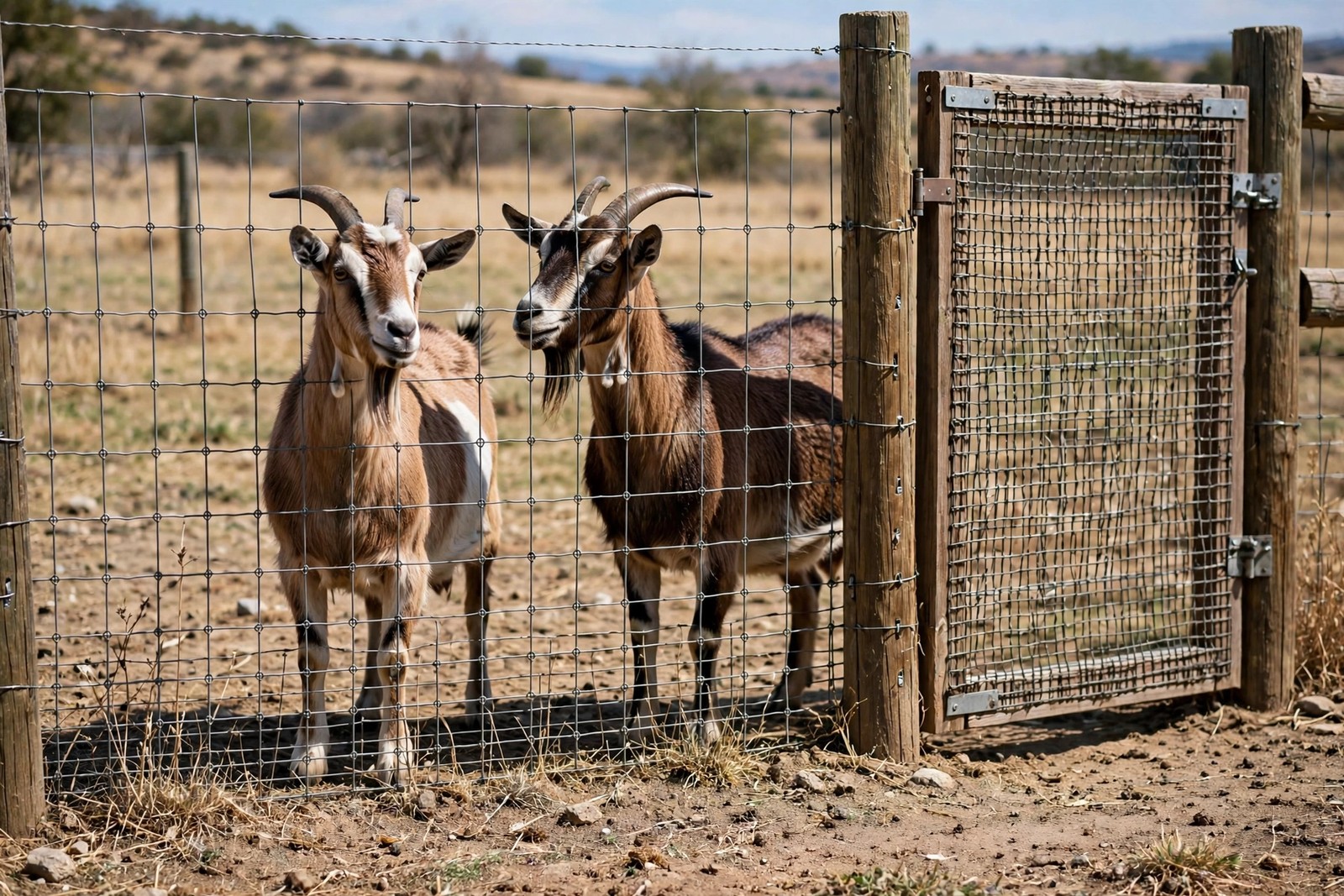
Posts come first in a goat fence: sturdy, well-braced posts carry mesh wire pulled tight, standing four to five feet (one point two to one point five metres) high. Goats test fencing in ways sheep and cattle do not: they stand on it, rub along it, climb into corners, push under loose bottom edges, and put their heads through any opening that looks as if food might be on the other side. A fence that would hold most livestock can fail with goats in a week if it sags, because a standing goat's full weight on woven wire quickly bows a slack run out of shape.
Choosing the wire and the mesh size
Woven wire, sometimes sold as stock fencing, and woven no-climb mesh both work, provided the openings are small enough. Keep openings to no more than about 4 inches square on the main fence, so a goat cannot push its head through and then trap itself by its horns when it tries to back out, which is a common and sometimes fatal accident. Where kids are kept, that mesh is still too wide at ground level: a small kid can wriggle through a gap an adult cannot, so add a tighter-mesh panel or an extra low strand along the kidding and nursery area until the kids have grown.
Take the bottom of the wire close to the ground and tension it so it cannot be lifted with a nose and crawled under. Barbed wire is a poor choice for goats: it tears skin and udders, goats ignore it once they decide to push, and it provides none of the mesh barrier that actually contains them.
Posts, corners, and gates
The wire is only as strong as what holds it. Corner and gate posts take the strain of a tensioned fence and need to be set deep and braced diagonally, while line posts can be lighter but must be close enough together that the wire stays upright when several goats lean on it at once. Gates should be mesh-filled so goats cannot climb the bars, hung to swing without dragging a gap open at the bottom, and fitted with a latch a goat cannot work: goats learn simple bolts and chains quickly, so use a latch that needs a lift and a pull, and clip it shut. Keep anything climbable, such as hay racks, shelters, stumps, and stacked bales, well away from the fence line, because a goat that can climb up will treat the fence top as a step down to the other side.
The electric offset for determined goats
For goats that climb, rub posts loose, or keep challenging one stretch, a single electric offset wire fixed inside the fence at roughly nose height teaches them to respect the boundary without the fence itself taking the punishment. It protects the woven wire as much as it contains the goats. An offset can also be added temporarily along a section being repaired. It needs its own checks, because vegetation touching the line drains it and a dead electric wire teaches goats that the whole fence is optional.
Walking and maintaining the fence
Walk the full boundary at least weekly and after storms, looking for sagging spans, lifted bottom edges, dug gaps, fallen branches resting on the wire, and the polished, hair-caught patches that show where a goat has been working at one spot. Repair a weakness the day you find it: goats watch each other succeed, and one escape route demonstrated by a single animal becomes herd knowledge quickly.
Write down the fence height, mesh, gate latch routine, and which stretches carry the electric offset, so a helper does not leave a gate chained in a way the goats already know how to open. Under KinsLe Family Sharing, the profile for these goats becomes available to relatives you select.