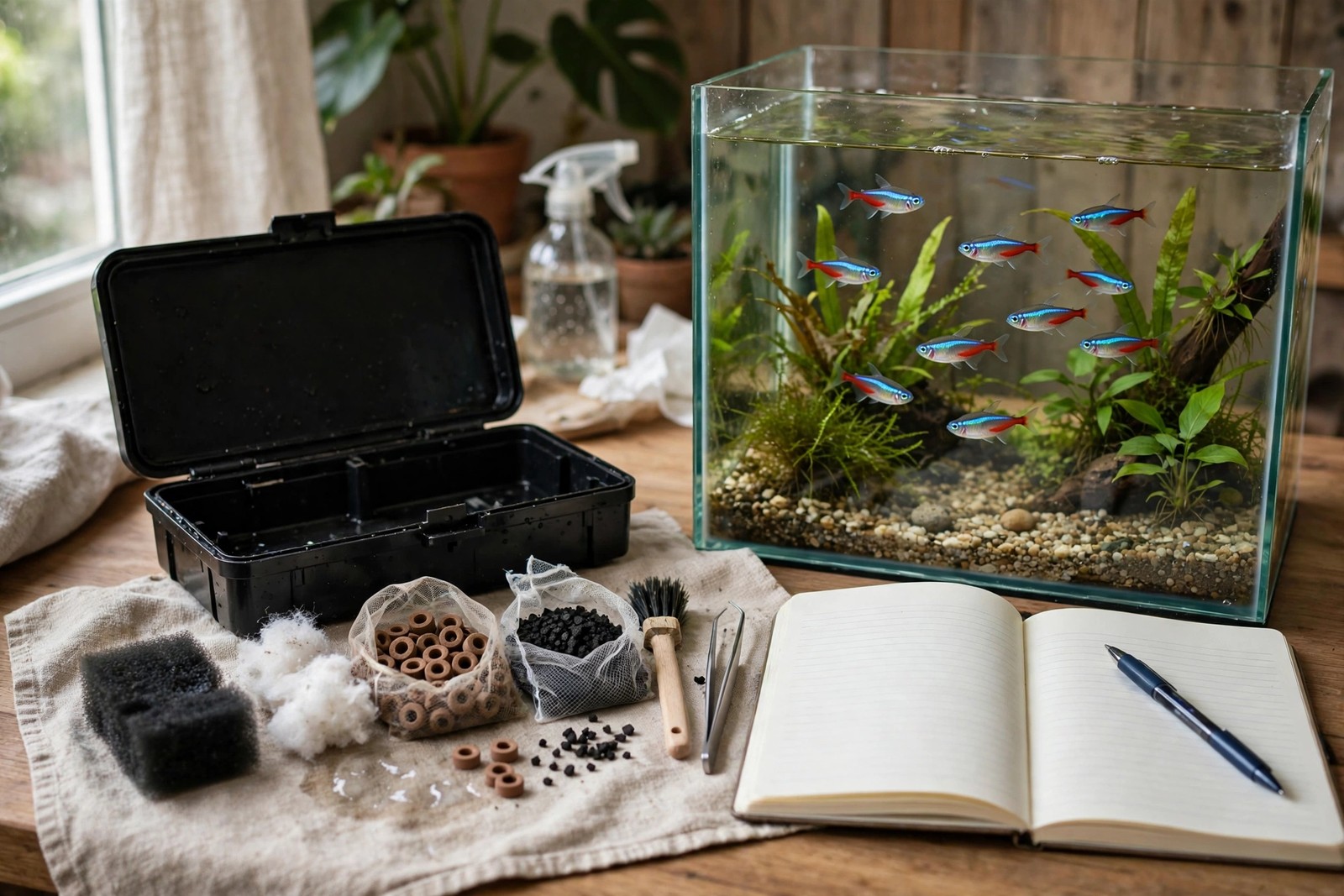
The accident this question guards against is easy to picture: a helpful session cleans the sponge, swaps the carbon, and rinses the bio-media all in one afternoon, and the tank's beneficial bacteria, which live across all that media, are knocked back in a single day. Tetras are small, sensitive schooling fish that feel water-quality swings quickly, so the safeguard is structural, not a matter of remembering harder. Log each media type separately, touch only one media type per session, and keep sessions at least a week apart, and the accident becomes impossible rather than merely unlikely.
Three media, three separate histories
Treat the filter as three items sharing a box. The sponge traps debris and holds some bacteria. The bio-media exists mainly as a home for beneficial bacteria and should be disturbed least. The carbon removes dissolved compounds and is the one media that is genuinely replaced on a cycle. Each needs its own log history, because their rhythms differ: the sponge is rinsed most often, the carbon is replaced rather than rinsed, and the bio-media is rinsed only when flow drops and sludge builds up, and even then only part of it at a time. When the log shows three histories side by side, you can see at a glance which media is due and which was touched recently.
The six fields on every line
Record each session as one line with the same six fields. First, the date. Second, the media type: sponge, bio-media, or carbon. Third, the action taken: rinsed, partially rinsed, or replaced. Fourth, the water used, which for rinsing should be tank water removed during a water change, never untreated tap water. Fifth, the flow afterwards, noted as normal or improved, since flow is your everyday signal of how clogged the media was. Sixth, the next due note for that media, written while you are looking at it. Six fields, in the same order, every time, means any line can be compared with the last line for the same media in seconds.
The stagger rule the log enforces
The rule is simple: one media type per session, and sessions at least a week apart. Before touching anything, read the log. If any media was rinsed or replaced within the past week, wait; the log's dates make that check instant instead of a memory test. When a session does go ahead, rinse media gently in removed tank water to protect the bacteria on it, and never replace all the bio-media at once: if it must be renewed, change part of it and let the new portion seed from the old before changing the rest. Because two other media are always left untouched, the bacteria they carry keep processing waste while the serviced media recovers, which is exactly the stability a tetra tank needs.
Sharing the tank without double-handling it
Filters get double-cleaned when two people in a household both help and neither knows the other has just done a session. The log ends that: whoever services the filter writes the six-field line the same day, and whoever comes next reads it first. Note the filter's flow in passing between sessions, too, because a falling flow rate is usually the sponge asking for its rinse, not a signal to service everything at once. KinsLe's Care Teams turns each media session into an assigned duty that is marked complete with a timestamp, so everyone sharing the tetra tank can see which media was serviced, on which date, and which media is due next.