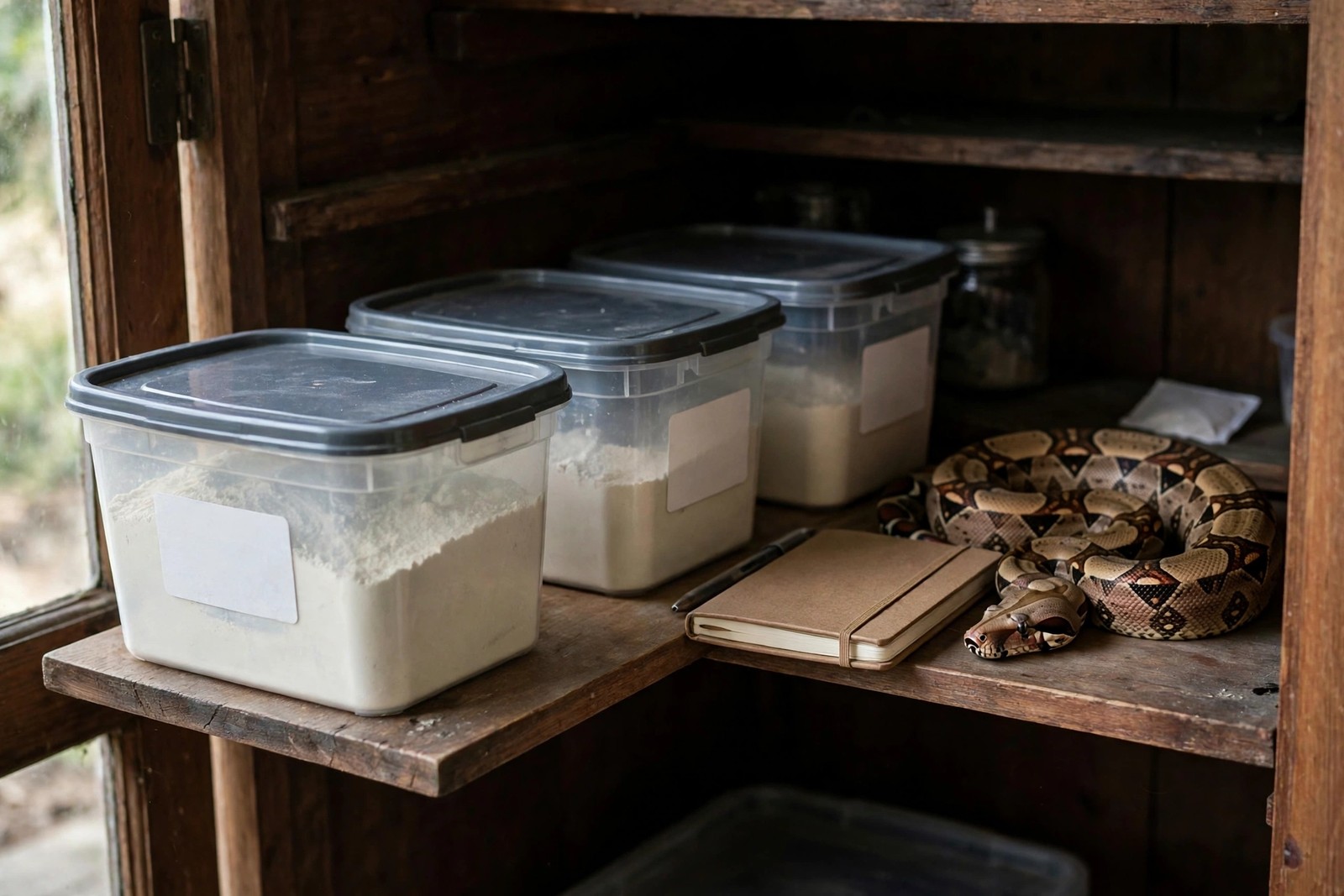
A powdered diet can look identical the day it is opened and a year later while being a poorer food in every way that counts. Powders do not spoil loudly like fresh food; their vitamins and nutrients fade with heat, light, moisture, and air, and the animal eating them cannot file a report. Storage and rotation are therefore feeding decisions, not housekeeping, and a keeper's system matters more than any single tub.
Cool, Dry, Dark, and Sealed
Store powders in a cool, dry, dark place: a closed cupboard away from enclosure heat lamps, radiators, and sunny windowsills is the standard to aim for. Heat speeds the breakdown of the nutrients the powder was bought for, and light does the same work more slowly. Bathrooms and steamy kitchens are poor choices despite the convenient shelves, because humidity is the other enemy — a powder that has absorbed damp air clumps, cakes against the scoop, and ages faster in every spoonful.
Keep each powder in its original labeled container, sealed after every single use. The original tub carries the product name, the batch, and the expiry entry the rotation system depends on, and decanting into a prettier unlabeled jar throws that information away. Press the lid down until it seats fully; a lid resting loosely on a tub in a warm room is a slow leak of everything the powder was meant to deliver. Keep a dedicated spoon for the tubs only, always dry, and never use a wet spoon or one shared with food: moisture carried in on a spoon ages the whole tub.
Oldest First, Every Time
Rotate strictly by the date written on the tub at opening: the tub with the oldest open date is the one being fed from, and a new tub is opened only when the current one is finished or retired. If two tubs of the same powder end up open, the date written on each tub at opening decides the order, and the oldest open date is used up first. This sounds obvious and fails constantly in real cupboards, because the new tub looks cleaner and lives at the front. Put the working tub at the front and the reserve behind it, and let position do the remembering.
Never top an old tub up with new powder. The gesture feels thrifty and ruins both lots: the fresh powder mixes over an aging layer at the bottom that then sits for months more, and every scoop becomes an unknown blend of new and tired. Finish a tub, replace a tub, or retire a tub — those are the only three honest endings.
Sweeps, Expiry Entries, and Fading Potency
Check expiry entries on a regular sweep rather than when a tub happens to run out. Powders are replaced on the maker's guidance because potency fades over time even in a sealed tub, so a supplement well past its printed entry is retired, not used up bravely. Shelf life differs by product, so the maker's printed guidance is the authority rather than any fixed figure. At the same sweep, discard anything that smells stale or musty, has clumped hard from damp, or has changed color — the nose catches failures a date cannot.
A Rotation Someone Owns
Rotation systems collapse when they belong to everyone in general. Care Teams on KinsLe lets the household name the job: one keeper, Sam, runs the monthly sweep of expiry entries and storage conditions, another, Lee, is the only person who opens new tubs, and the log of what was retired and replaced is written where both can see it. Each completed sweep is marked with a timestamp, which turns an easy-to-postpone chore into a dated record — and in a home where a partner, a housemate, or a sitter may also feed the animals, that shared record is what stops two tubs standing open and aging side by side.
Care Teams puts that sweep on a shared list inside KinsLe, so the person restocking sees at once which powder is oldest and due to be used first.