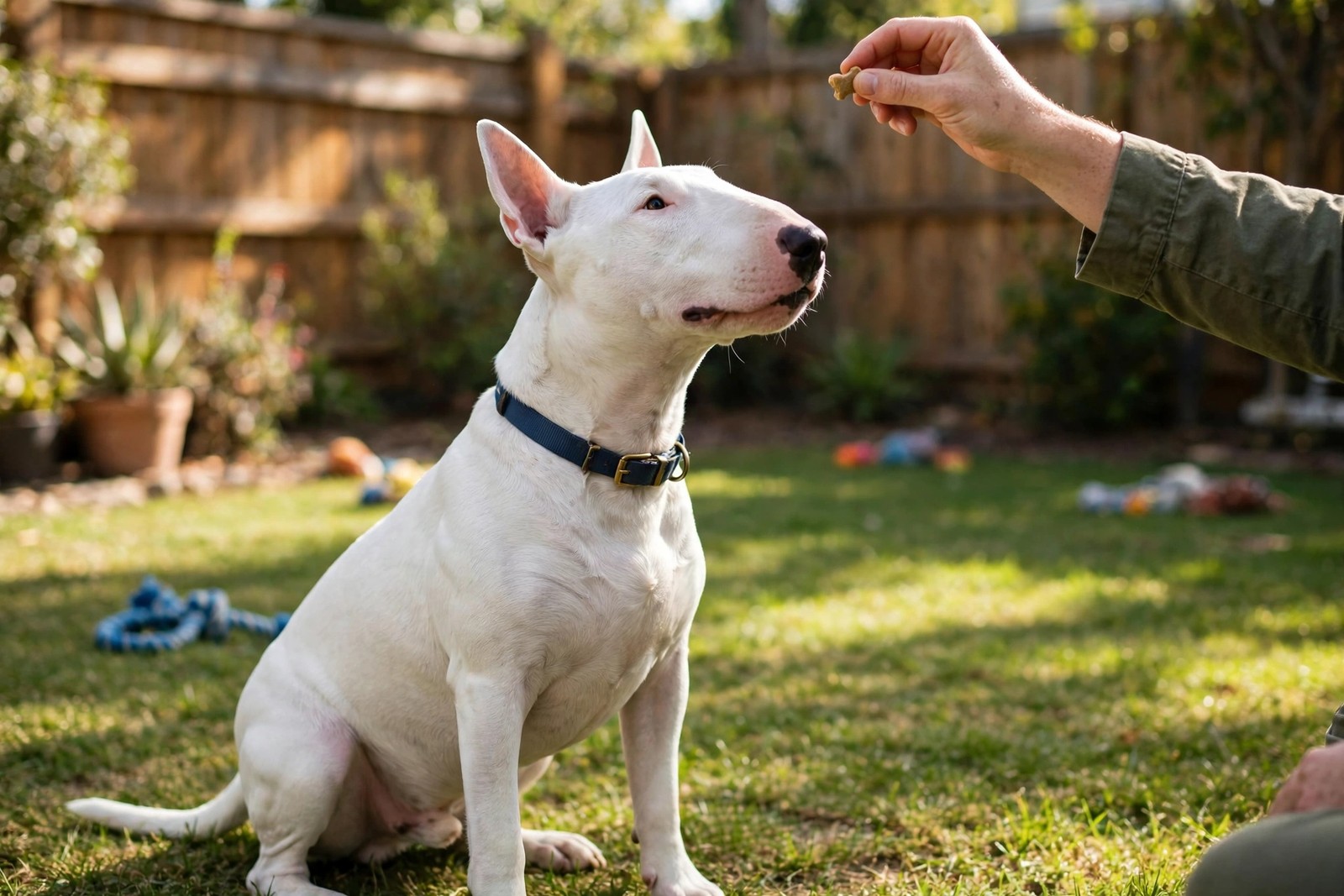
Yes, really. A Bull Terrier is not being difficult for the sake of it, but this breed was never built to drill the same cue fifty times and thank you for it. Bull Terriers are independent-minded and famously clownish, with a strong streak of self-direction: once a dog has shown you it understands sit, the next fifteen repetitions offer it nothing new, and its attention goes looking for something more interesting. Owners who expect that pattern from the start train successfully. Owners who expect eager, endless compliance usually end up in a contest of wills the dog enjoys far more than they do.
What the Stubbornness Actually Looks Like
In practice it rarely looks like defiance. It looks like a dog who learned a cue on Tuesday, performs it beautifully on Wednesday morning, and then stares at you on Wednesday afternoon as if the word were brand new — because the setting changed, the reward got dull, or something across the yard is simply better entertainment. Bull Terriers also tend to check whether a rule still pays. If come was rewarded yesterday and ignored today, the dog files that away. That testing is not spite; it is a smart, bored dog running experiments, and it is exactly why experienced owners build training around interest rather than pressure.
Very Short, Varied Sessions
The method experienced owners return to most is brevity. Sessions of a couple of minutes, several times a day, beat one long session every time, because the dog stays fresh and the last memory of training is success and food, not fatigue. Variety matters just as much: practice the same cue in the kitchen, then the yard, then on a walk, and mix known cues in among new ones so the dog cannot predict a dull sequence.
Teach one cue at a time. A Bull Terrier juggling three new words at once learns none of them cleanly, and the resulting confusion looks exactly like stubbornness. Get one cue reliable — offered promptly, in a few settings — before adding the next, and keep refreshing the old ones inside play so they stay valuable.
Rewards That Are Worth the Effort
High-value food rewards are the other non-negotiable. A dog who is deciding between coming back to you and chasing a squirrel is doing math, and dry everyday kibble loses that math. Small pieces of real, strongly scented food — the kind the dog only gets for training — change the calculation, especially for recall and for cues asked at a distance.
Ending on a win protects the whole system. When a session starts to wobble, ask for one easy cue the dog knows cold, pay well for it, and stop. The dog walks away remembering training as short, profitable, and fun, which is precisely the memory you need tomorrow.
Training Folded Into Play
Bull Terriers light up for play, so experienced owners hide training inside it. A round of tug pauses for a sit before it resumes. A ball is thrown only after the dog offers eye contact. A walk includes brief recalls rewarded with a chase game or a favorite food piece, then freedom again. Because the reward is often the activity itself, the dog stops seeing cues as interruptions and starts seeing them as the way the good stuff happens.
Keeping a Record of What Works
Because every Bull Terrier has its own price list, write yours down: the exact cue words used, which rewards actually move the dog, how long a session stays productive, and which games teach fastest. That written record matters when a partner, a family member, or a future caregiver trains the dog, because mixed cues and cheaper rewards undo progress quietly. When ownership or daily care shifts, KinsLe gives that hard-won training history a lasting home because Transferrable Profiles moves the dog's cues, favorite rewards, and play-based routines along with its profile.