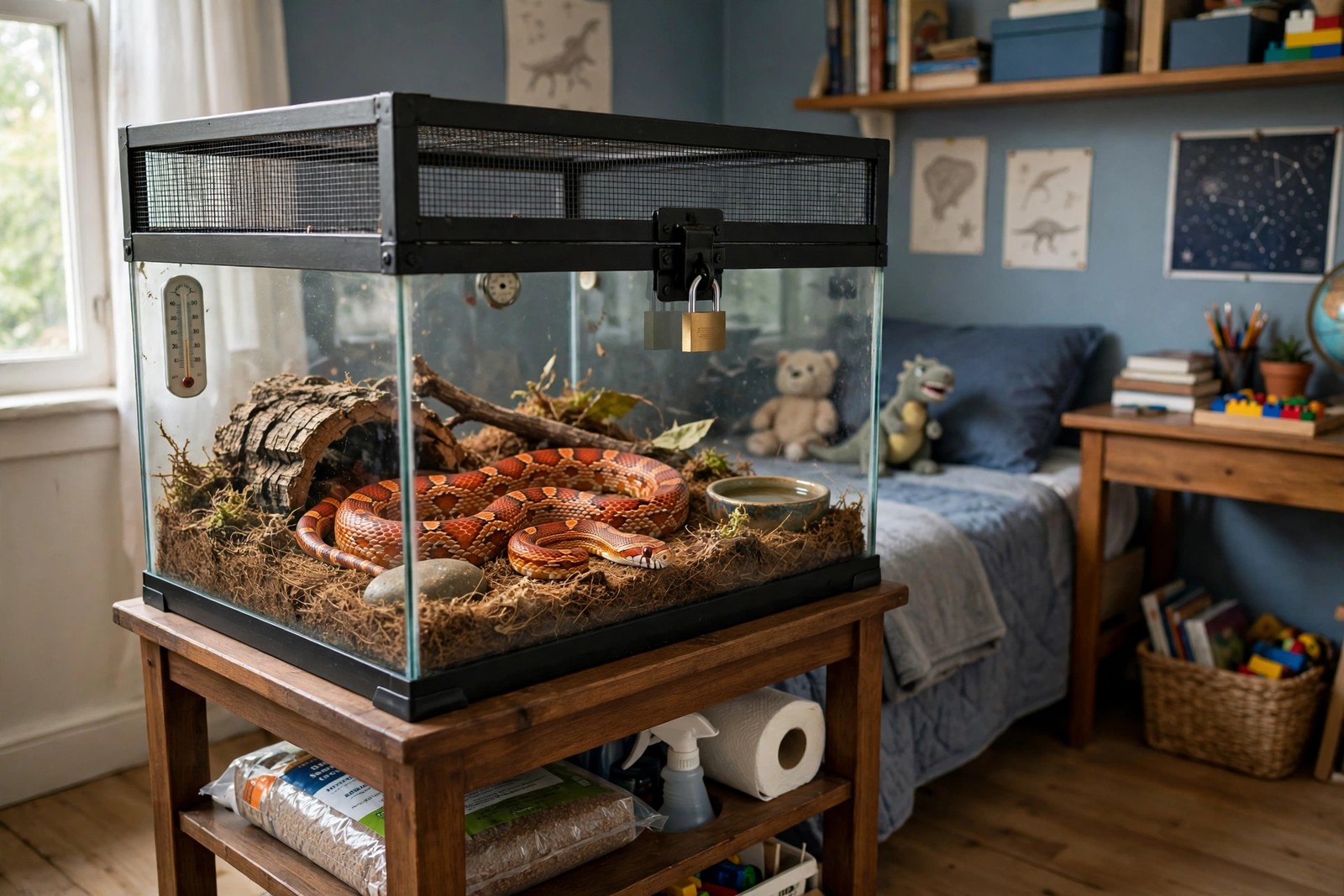
The honest answer is that the snake is rarely the risk; the setup around it decides whether this arrangement is safe. A small, docile snake in a secured enclosure is an educational presence in an older child's room. The same snake in a clip-lid tank a child can open alone, handled in bed, and fed by a seven-year-old is a different proposition.
The enclosure must be escape-proof and locked
Snakes are persistent explorers, and they leave through gaps adults would swear were too small. The enclosure needs a latching lid or sliding doors with a lock, not clips or a book, and the key or latch routine must be one the child cannot operate alone. Site the enclosure away from the bed, on a stable stand that cannot be climbed. Heat sources belong outside the child's reach: heat mats on a thermostat, lamp fittings guarded, and cables routed where small hands cannot pull them down. Escaped snakes are often found safe, but the search and the risk of injury by a door or a family cat are preventable by the lock alone.
Supervision and handling rules are non-negotiable
Handling is an adult-present activity, and the adult sets its length. Handle it over a table or seated on the floor, never carried on shoulders, never taken into bed, and never handled by visiting friends whose parents have not agreed. Sessions stay short, the snake goes back if it becomes restless or the child becomes excited, and it is never handled during shedding or for a day or two after feeding, when it is most likely to be defensive or to regurgitate. Feeding is an adult-only job, carried out with tongs, because feeding responses are a common context for pet snake bites and because the freezer-and-defrost routine for prey items is not a child's task. The child can own responsibilities — recording sheds and feeds and misting under supervision — and those jobs teach more than unsupervised handling does.
Hand-washing and Salmonella hygiene
Reptiles commonly carry Salmonella in their gut without being ill. The rule that makes a bedroom arrangement workable is hand-washing with soap after touching the snake, its water bowl, its decor, or anything from the enclosure, and before touching food, faces, or bedding. Enclosure items are washed in a utility sink or a bowl, never in the kitchen sink and never alongside family dishes, and substrate and waste are bagged and removed by an adult. The snake never roams the bedroom floor, the bed, or soft furnishings, both for hygiene and because a loose snake seeks tight warm gaps that are hard to search. For children under about five, health guidance generally advises against reptile handling and contact altogether, because toddlers mouth their hands so readily and their immune systems are still developing; for that age group, keep the snake in a family room instead, watched rather than handled.
Choose the animal and the age pairing conservatively
Small, steady species such as a corn snake or a ball python suit a supervised older child; large constrictors, fast and flighty species, and anything capable of a serious bite do not belong in a child's room. Consider the child's temperament as honestly as the snake's: a child who respects the lock, washes without being chased, and accepts that the snake stays hidden for days is ready; a child who taps the glass, sneaks the lid, or wants a pet to cuddle is not, yet. Corn snakes and ball pythons are mostly active after dark, so expect a watching pet whose busy hours are the evening.
Write the rules where everyone can see them
Bedroom arrangements fail when one adult enforces the lock and another leaves the lid ajar, or a babysitter agrees to one quick hold. Put the enclosure rules, the hygiene routine, and the feeding and shed log in one place that every caregiver reads before they are left in charge. KinsLe's Family Sharing holds those rules in the snake's shared profile, so parents, grandparents, and sitters all work from the same written boundaries rather than from memory and good intentions.