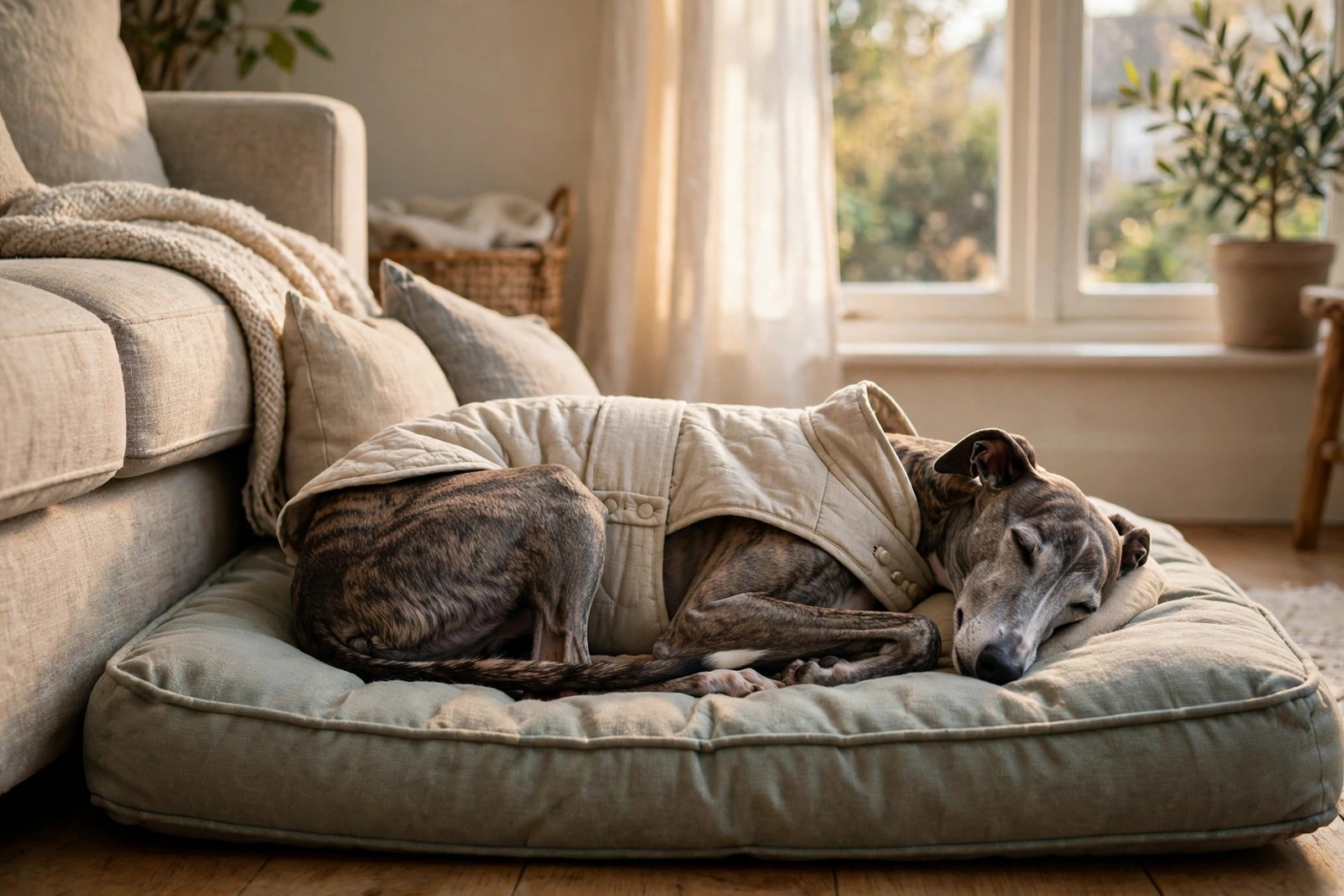
The reputation is earned. A retired racing Greyhound in a home is usually a quiet, gentle, low-demand companion that sleeps deeply for long stretches, leans against familiar people for contact, and asks for little beyond a soft bed, a predictable routine, and short daily exercise. What the reputation does not cover is the translation work between kennel life and house life, and that work belongs to the first weeks.
The parts that hold completely true
The calm is real. Racers are raised in quiet kennel blocks with set routines, and that upbringing produces adults that settle readily indoors and rarely bark without a clear trigger. The gentleness is real too: handling by kennel staff, vets, and racing officials is part of a racer's working life, so retired dogs are typically tolerant of being groomed, examined, and led by unfamiliar people. Exercise needs are modest compared with other large breeds. A total of 40 to 60 minutes a day, split into two walks of 20 to 30 minutes, plus a chance to stretch out at speed occasionally in a secure area, suits a healthy retired adult. The rest of the day is largely devoted to sleep, and that pattern is normal for the breed rather than a sign of low mood.
What kennel life has not taught them
A racer may never have seen stairs, a glass door, a television, or a vacuum cleaner, and may never have been alone. Expect to teach stairs one step at a time with food placed in the dog's mouth at each step, to mark glass with tape at eye level until the dog learns it is solid, and to build up alone time in minutes before you leave for an hour. Toilet training usually transfers quickly because kennel dogs are turned out on a schedule, but you must supply that schedule: out on waking, after meals, after walks, and last thing at night. Some racers guard their sleeping space at first, because a kennel bed was the one place that was entirely theirs, so give the dog a bed in a quiet corner and let sleeping dogs lie undisturbed.
The chase instinct is the honest exception
Indoors, the same dog may ignore a household cat it has been properly introduced to, yet outdoors a moving squirrel, cat, or small dog can trigger an immediate, committed chase. That response is individual: rehoming organisations test and grade it, and their assessment should shape your choices. Walk on a lead, use a secure field for off-lead running, and consider a muzzle for early walks if your rehoming organisation advises one, because racers are used to wearing one and it adds safety while you learn your dog. Never assume a placid house manner predicts outdoor restraint around small, fast-moving animals.
Thin skin, thin coat, and teeth
Greyhound skin tears more easily than that of thicker-coated breeds, so small knocks against furniture or brambles can open wounds that look dramatic; keep a basic first-aid kit and ask your vet to show you what needs stitching and what needs cleaning and watching. The thin coat means a fitted coat for cold or wet walks and bedding with real padding, because bony elbows and hips press into hard floors. Teeth deserve a budget line of their own: dental disease is a recognised issue in retired racers, so daily tooth care where the dog tolerates it and regular veterinary dental checks protect both comfort and the household budget.
The verdict
Gentle, quiet, and couch-centred: true. Effortless: only after the first weeks of patient house training, and only with respect for chase instinct outdoors and for a body built for speed rather than for hard floors and cold weather. Choose your dog through an organisation that assesses temperament in foster homes where possible, and ask specifically about stairs, alone time, and behaviour around cats and small dogs. Handing a sitter the feeding routine, coat and bedding needs, and outdoor cautions through KinsLe's Care Pass keeps a retired Greyhound's quiet home life intact while you are away.