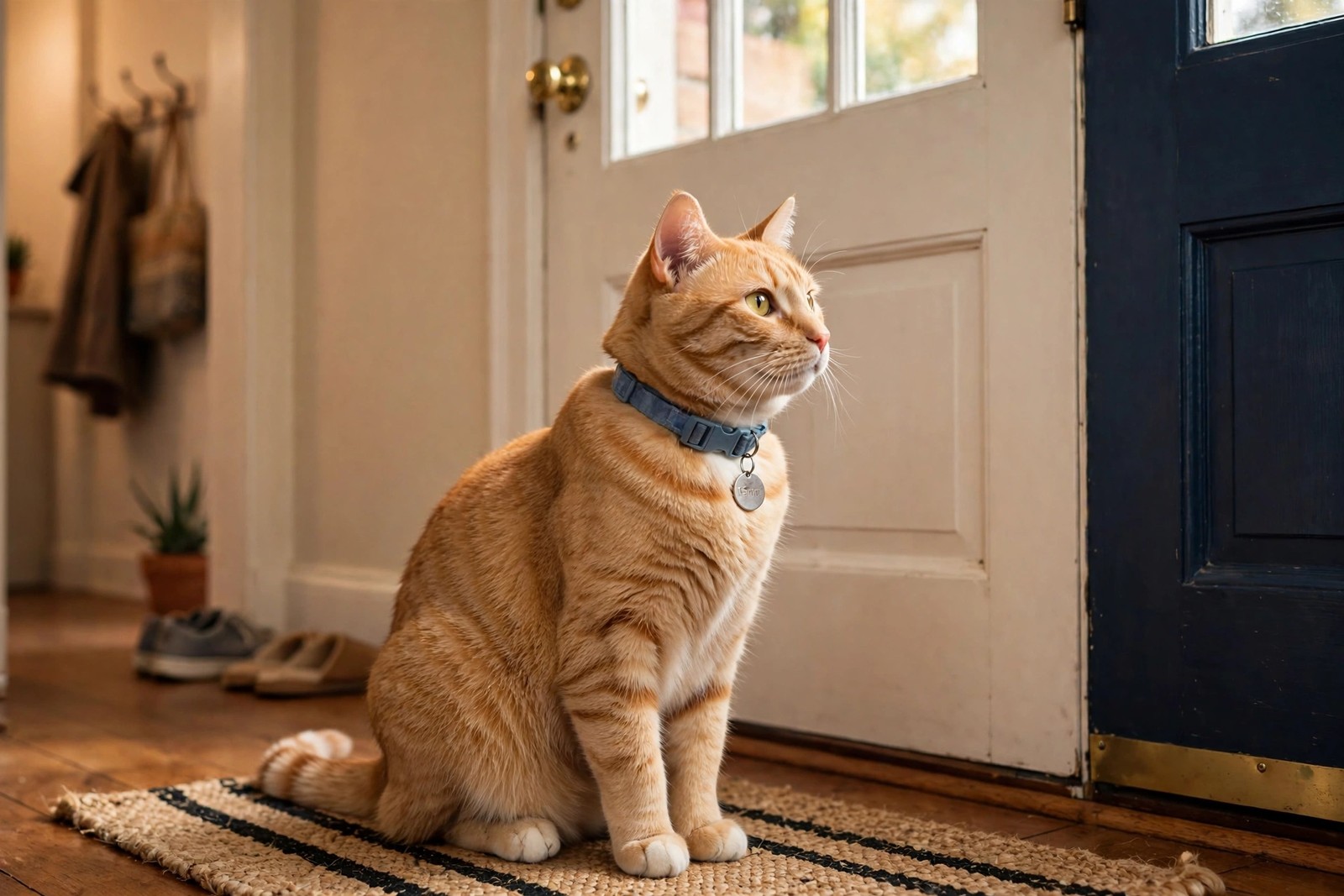
Yes, for most indoor cats the answer is a collar and tag — because "indoor" describes your intention, not a guarantee. Indoor cats slip out through doors held open for shopping, torn window screens, visitors who do not know the house rules, and the chaos of moving day, and they are the cats least equipped for outdoors: no territory knowledge, no street sense, and often a hiding temperament that keeps them silent in a neighbour's shed for days. A visible collar also signals instantly to anyone who spots the cat that this is an owned pet who is lost, not a stray to be ignored or adopted on the spot.
The One Non-Negotiable: Breakaway Design
The safety case against collars is real, and it is answered by design, not by skipping the collar. A cat's collar can catch on branches, fences, furniture, or its own jaw if it works a paw or its lower teeth under a loose strap. So an indoor cat's collar must be a breakaway collar, whose clasp is designed to release under a firm pull, freeing a snagged cat. Test the clasp before it goes on — it should pop open with a sharp tug, not a heroic effort — and replace collars whose clasps stiffen with age. Avoid elasticated collars that stretch enough to trap a leg but not enough to release, and skip dangling charms and bells on breakaway clasps if they add snag points; the tag itself should lie flat and light.
Fit matters as much as the clasp. The collar should sit snugly enough that it cannot slip forward over the chin — a too-loose collar is the one that ends up hooked over the jaw — while still letting you slide two fingers underneath. Check the fit weekly on kittens, whose necks grow fast, and after any weight change in adults.
Tag, Chip, and Getting Home
Put your phone number on the tag itself, in text big enough to read on a wriggling cat; a finder should not need any equipment to reach you. A collar is still only the visible layer: have your cat microchipped as the permanent backup, since a breakaway collar that did its job may be left hanging on a fence, and keep the chip contact details current whenever you move or change numbers. Take a clear, recent photo of your cat showing face, markings, and collar, so a lost-cat message is ready in minutes rather than assembled in a panic.
Some cats genuinely cannot settle in a collar — persistent distress, skin irritation, or repeated jaw-catching despite a correct fit are reasons to talk to your vet about relying on the chip alone. Introduce the collar gradually to a cat new to one: short supervised sessions, then longer, checking the neck for rubbing over the first fortnight.
With KinsLe's Verified QR ID Pet Profiles, the collar gains a second route home alongside the printed number: anyone who finds your cat can scan the code, see the profile you control, and contact you directly, even if the tag's text has worn smooth.