
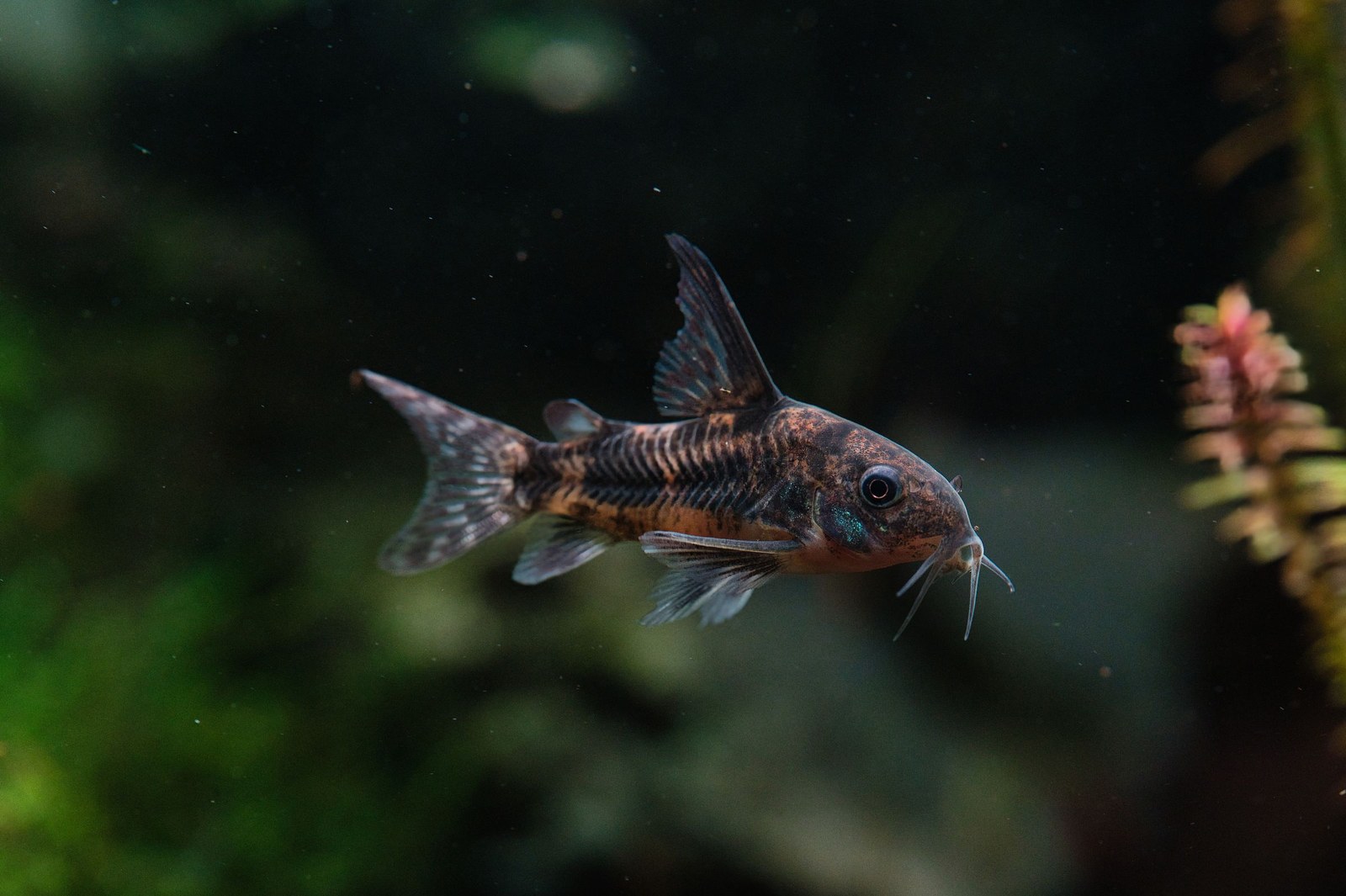
Yes — bottom-feeding fish absolutely need their own food. Do not assume corydoras, loaches, or plecos will thrive on scraps that drift down, because mid-level fish almost always eat everything first. The fix is simple: drop in a sinking wafer or pellet specifically for them, and for shy species, do it after lights-out when the rest of the tank has settled.
The scraps myth
The idea that bottom feeders "clean the tank" by eating leftovers is one of the hobby's most persistent myths. In a mixed community tank fed only floating flakes, virtually nothing nutritious reaches the substrate — tetras, barbs, and livebearers intercept nearly every particle on the way down. What does sink is usually picked-over crumbs and dissolved nutrients, not a meal. A corydoras kept this way slowly starves over weeks, often while the owner assumes it is fine because "the tank is clean." Chronic underfeeding shows up as a sunken belly, faded color, and lethargy — easy to miss until it is serious.
Sinking foods that actually work
Choose food designed to sink fast: sinking pellets, bottom-feeder tablets, or wafers formulated for catfish and loaches. Algae wafers suit true herbivorous plecos, but most corydoras and loaches are omnivores or carnivores that need protein — check the label for fish meal or shrimp as primary ingredients rather than grain fillers. Drop the wafer in after the main feeding is finished so the mid-water fish are already full and less interested. For nocturnal species like kuhli loaches, a lights-out feeding is ideal: their feeding behavior peaks in the dark, when competition from daytime fish is asleep.
How much, how often
One wafer or a small pinch of sinking pellets per two or three bottom dwellers, once daily, is a solid baseline. Watch the wafer: it should be substantially consumed within a few hours, with the bottom feeders actively working it. If chunks remain the next morning, reduce the portion. If it vanishes in minutes and the fish are still foraging, add a second piece. Bottom feeders benefit from the same one-day-a-week fast as the rest of the tank — their digestive systems are not exempt from the overfeeding risks that plague the upper layers.
Placement and water quality
Drop sinking food away from the filter outflow so it settles in one spot instead of being blasted across the tank. Uneaten sinking food fouls water just as fast as floating food, so siphon the spot during your regular water change. A bare-bottom feeding patch or a flat stone in one corner makes a good target zone — the fish learn where dinner lands, and you learn where to check for leftovers.
Keep the whole household feeding one way
The bottom-feeder routine falls apart when one person feeds flakes and assumes that is the whole job. KinsLe Messenger is the per-pet communications hub, so the tank's feeding routine — flakes for the top, sinking pellets after lights-out for the corydoras — can live as one shared note that everyone in the household sees. No more "I fed them" that really meant "I fed half the tank."
Feed the bottom like it is its own tank, because nutritionally, it is. The KinsLe Messenger thread on KinsLe keeps that lights-out wafer routine visible to every feeder, so shy corydoras get their own meal even when someone else handles tank duty.