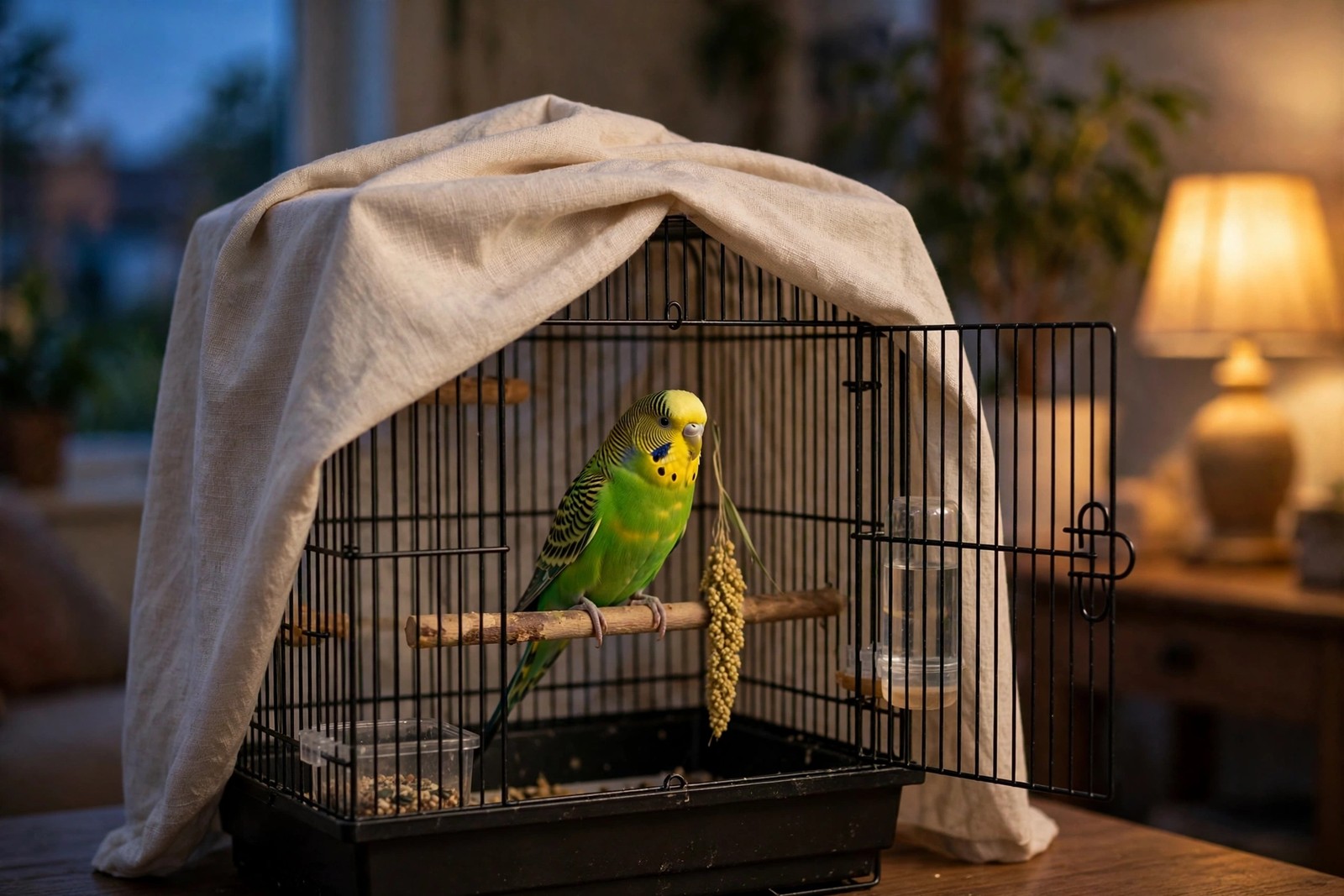
Covering your budgie's cage at night is a good habit for most birds. Budgies need around ten to twelve hours of proper sleep, and a cover delivers the darkness that a lived-in home rarely does: it shuts out lamps, television flicker, and people moving about, and it gives your budgie a clear signal that the day is over. Many budgies settle faster and call less at dawn under a consistent cover routine. The cover is not compulsory — a budgie sleeping in a genuinely dark, quiet room may not need one — but where evenings are bright and busy, it is the simplest way to protect sleep.
Choosing and Using the Cover Properly
Airflow is the rule owners most often get wrong. Use a breathable fabric such as light cotton, drape it so air still circulates freely, and never seal the cage in anything plastic, heavy, or airtight — a budgie needs fresh air all night, and stale, warm air inside a sealed cover is a real risk. The cover should block light and visual disturbance, not wrap the cage like packaging. Wash the cover regularly, because it collects feather dust and seed husks, and check it for loose threads or frayed edges that a budgie could catch a toe or beak in overnight.
Consistency matters as much as the cover itself. Put it on at roughly the same time each evening and remove it at the same time each morning, so your budgie's body clock locks onto a stable light cycle. A budgie whose cover goes on at ten one night and seven the next gets neither enough sleep nor a reliable routine, and broken sleep shows up as a grumpy, nippy, or unusually quiet bird the next day.
Night Frights: The Exception to Full Darkness
Some budgies — and cockatiels are even more prone — suffer night frights: a sudden panic in the dark where the bird thrashes around the cage and can injure wings or break blood feathers. A noise, a shadow, headlights sweeping the room, or nothing obvious at all can trigger one. If your budgie has ever had a night fright, total darkness is the wrong prescription. Leave one side or the front of the cage partly uncovered, or keep a very dim night light nearby, so the bird can orient itself instantly if startled. A small gap of light lets a frightened budgie see the bars and perches instead of colliding with them blind.
If a fright happens, turn the lights on, talk calmly, and let your budgie settle before checking for injuries. A broken blood feather that keeps bleeding needs prompt attention, so know where your avian vet's emergency number is before you need it at midnight.
Alternatives and Fine-Tuning
A sleep cage in a quiet spare room achieves the same darkness without a cover and suits birds who chew covers or panic under them. If you use one, keep the move to the sleep cage part of a calm, identical nightly ritual so the transfer itself becomes the bedtime cue. Whatever you choose, judge by the bird in front of you: a budgie who wakes bright, vocal, and hungry is sleeping well; one who naps heavily through the day may need an earlier cover time or a darker arrangement.
Sleep routines fail when different people run different bedtimes, so anchor the cover to a fixed household moment such as the last feed of the day, and KinsLe's Care Teams lets you list cover-on and cover-off as timed daily duties, keeping your budgie's ten-to-twelve-hour night intact even when someone else closes up.